
Newsom, lawmakers lean on reserve funds and Medi-Cal premiums in final budget plan
A final budget agreement struck between top legislative Democrats and Gov. Gavin Newsom relies heavily on reserve accounts to fill a deficit as the state grapples with high health care costs and immense uncertainty over federal funding.
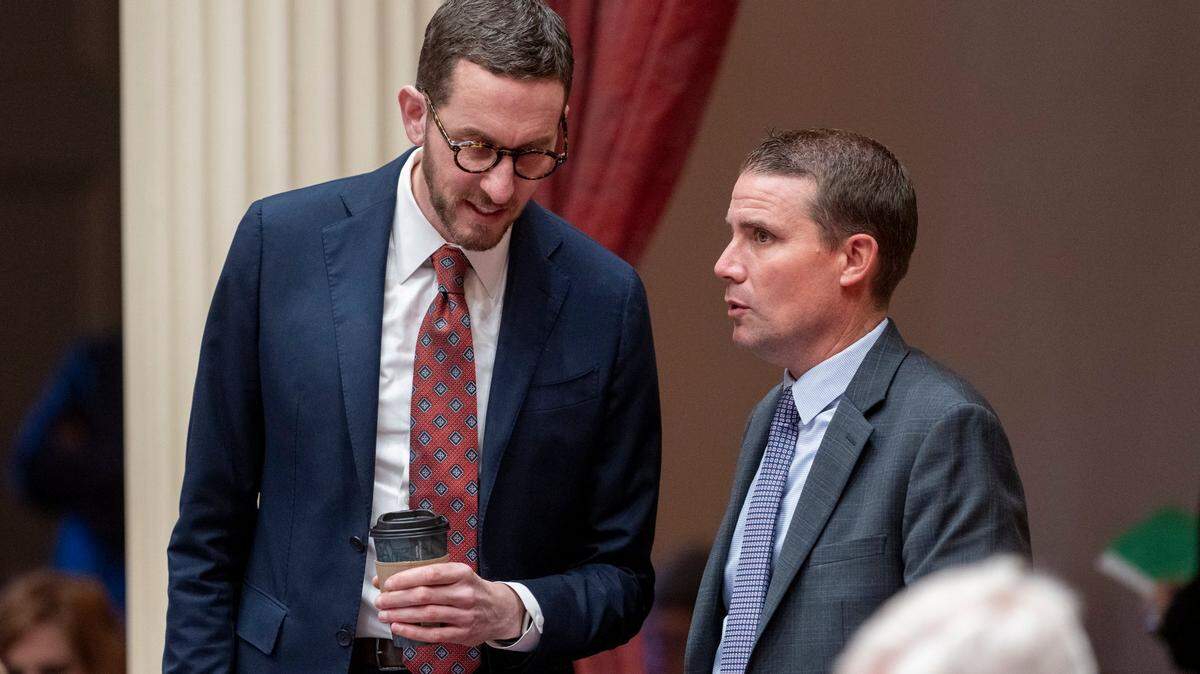
The agreement, which was acknowledged Tuesday by the Senate’s budget chair Scott Wiener, D-San Francisco, caps months of negotiating between lawmakers and Newsom over how to fill a deficit of around $12 billion – a budget hole Democrats have blamed on losses from President Donald Trump’s tariffs.
“We had a huge budget deficit to close this year that’s been made worse by Trump’s chaos,” Wiener said. “And under the circumstances, I think we did really strong work to protect health care access.”
Details over some proposals were sparse Tuesday evening as the governor, Speaker and Senate pro Tem wrapped up negotiations.
The agreement also comes as the Republican-led Congress weighs Trump’s “Big, Beautiful Bill,” which could include hundreds of billions in cuts to Medicaid. Federal cuts could cost the state between $10 billion and $20 billion, according to a UC Berkeley analysis.
All told, the spending plan amounts to $321 billion, including $228.4 billion in General Fund revenues, according to a Senate analysis.
Newsom had proposed cuts to higher education, health and social services to help fill the deficit, but lawmakers rejected many of those cuts or pushed them back to future years.
The final budget plan would draw more than $13 billion from reserve accounts – $7.1 billion from the rainy day fund and $6.5 billion from other reserves. According to a legislative staff analysis, $11.2 billion would remain in the rainy day fund after withdrawals and the Special Fund for Economic Uncertainties would hold $4.5 billion.
The spending agreement also backfills $1 billion in General Fund spending from the Greenhouse Gas Reduction Fund, which is funded by cap-and-trade auctions to pay for climate projects.
A compromise on Medi-Cal
Facing lower revenues and steep cost increases to Medi-Cal, Newsom had proposed pausing enrollment to the state’s low-income health insurance program for undocumented immigrants next year as well as $100 premiums for existing patients with “unsatisfactory immigration status,” which includes people in the state legally who don’t yet qualify for federal Medicaid.
But the final agreement was less drastic and largely follows what the Legislature proposed earlier this month.
“No one is being disenrolled from Medi-Cal — no one — and people still have another six months to sign up,” Wiener told The Bee. “We reduced the proposed premium by 70% and delayed it two years, and that held. Given the circumstances, I’m proud of the work we were able to do to support our immigrant Californians.”
The enrollment freeze remains in the final budget plan and begins in January 2026, and includes a three-month “grace period” for re-enrollment if someone falls off the rolls.
Undocumented adults aged 19 to 59 who remain enrolled will pay $30 premiums beginning in July 2027. The budget also avoids cuts Newsom had proposed for in-home services for elderly and disabled people, including capping overtime for workers.
Some Democratic lawmakers, particularly members of the Latino caucus, opposed adding premiums and capping enrollment for undocumented residents.
Less and less for Prop. 36
A persistent question throughout the negotiations has been whether the governor would approve funding for Proposition 36, the state’s new theft and drug treatment law, which was overwhelmingly approved by voters.
Newsom, an opponent of the measure, had declined to send any money to the counties to implement the law, despite pleas from local officials.
In an earlier agreement between the Senate and Assembly, legislators set aside $110 million in one-time funding, a fraction of the $400 million Republican lawmakers had asked for.
“Whatever one’s view on Prop. 36, the people spoke very clearly,” Wiener told The Bee. “For us, it was important to provide funding, particularly around behavioral health, because that was such a focus of the Prop. 36 campaign. And so that’s what we’ve done.”
However, the new three-party agreement scales back the nominal amount further, and adds new restrictions and reporting requirements. The Senate budget analysis has $100 million earmarked for Prop. 36.
Within that number is $50 million in behavioral health grants, with at least half going to increasing local capacity to treat people for drug addiction, and $20 million to courts to deal with an expanded workload.
The remaining portion will be split between probation and public defense. However, the public defense funding doesn’t need to be spent on Prop. 36 cases, and probation departments in the state say the $15 million they’re allotted for pretrial services is negated by a simultaneous $20 million cut in existing funding for pretrial services.
Homelessness assistance preserved at locals’ insistence
The spending bill includes $500 million in flexible homelessness grants for the Homeless Housing, Assistance and Prevention program, known as HHAP. Newsom had declined to include new funding in his spending plans and chided local leaders for ever-present homeless encampments on city streets.
“I’m not interested in funding failure anymore,” he said during his May budget presentation.
But after forceful lobbying from mayors and county government officials, state lawmakers included half a billion dollars for another round of grant funding, which will likely be distributed in the 2026 budget year.
The final budget agreement also includes $100 million for encampment cleanup and $300 million for a first-time, first-generation homebuyer assistance program.
CEQA housing reform fast-tracked but not Delta Tunnel
In his May Revision, Newsom endorsed a proposal to fast track housing production and urged lawmakers to do the same for the controversial Delta Conveyance Project.
Specifics weren’t available Tuesday, but main components of two bills to streamline the California Environmental Quality Act to speed housing projects would be included in future trailer bills, according to the Senate analysis.
Lawmakers declined to take action to cut red tape on the Delta Conveyance Project, a long-discussed plan to divert water from the Sacramento-San Joaquin Delta down to Southern California. The governor had said the project was necessary for climate adaptation, and should bypass unneeded delays.
There were no details about why lawmakers rejected the governor’s suggestion, although several legislators recently voted to audit the project, a proposal that was ultimately shot down.
State worker payroll changes in limbo
Absent from the latest budget plan was an earlier proposal by the governor to freeze all state employees’ salaries, which Newsom hoped would save California $767 million.
Earlier this month, the Legislature rejected that cost-saving measure and it appears the two branches have decided not to impose broad freezes to public employee payrolls, though specific details were not available.
It’s not yet clear how California hopes to save on employee compensation costs, but officials are in active negotiations with several of the state’s bargaining units discussing the issue.
This story was originally published June 24, 2025 at 11:24 AM.