
California lawmakers want to unmask officers doing immigration enforcement
Good morning and welcome to the A.M. Alert!
NO HIDING
Two bills aimed at unmasking and identifying individuals involved with immigration enforcement were considered by the Assembly Public Safety Committee Tuesday.
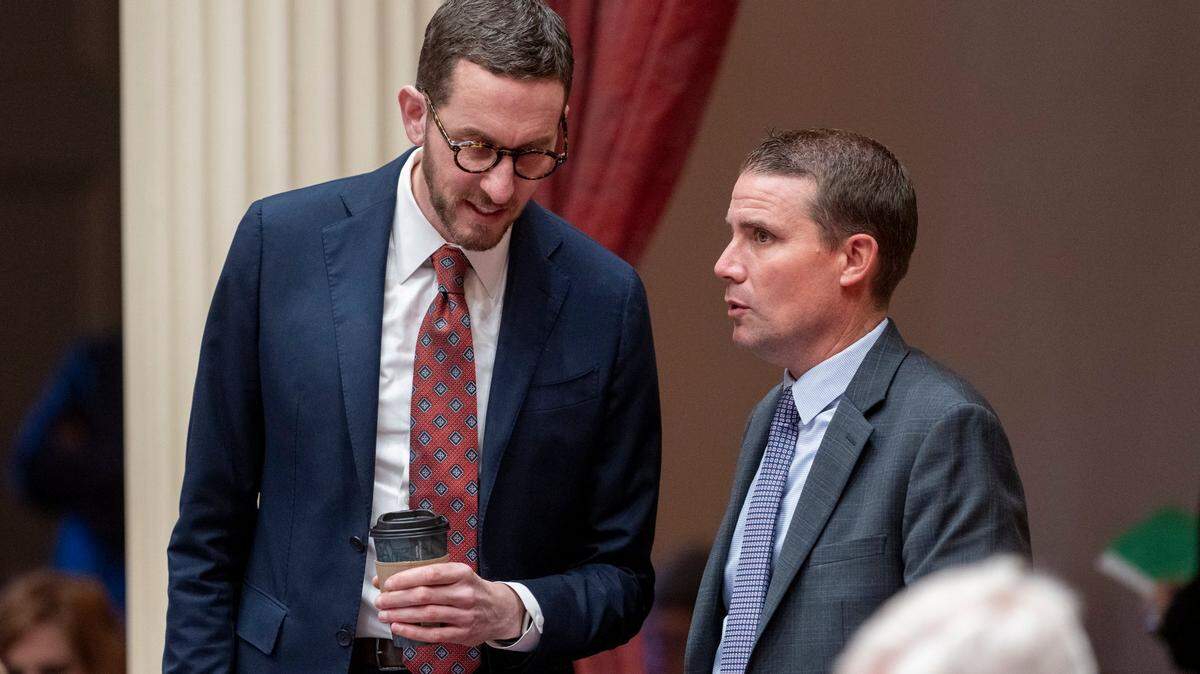
State Sen. Scott Wiener, D-San Francisco, presented his bill to make it illegal for local, state and federal law enforcement officers to wear masks or other face coverings, except in specific scenarios. Failure to comply would result in an infraction. A second offense would be a misdemeanor.
SB 627 faced considerable pushback from law enforcement representatives. The inclusion of local and state law enforcement officers was the real sticking point for those in opposition to the bill.
A representative with the Peace Officers Research Association of California said local and state officials are not participating in immigration enforcement, per sanctuary laws.
“California law enforcement are not wearing ski masks and grabbing people out of churches, synagogues and their homes,” the representative said.
They urged the bill be changed to mandate a minimum set of standards for state and local law enforcement to follow.
As written now, the bill would make it a criminal offense to violate the masking provisions. Another recommendation was to remove state and local law enforcement from the bill altogether and only go after federal law enforcement.
“Our officers are part of this bill,” the representative said. “We are being swept into this issue when we do not want to enforce immigration and we have been publicly clear about that.”
The federal government could seemingly conscript state and local law enforcement, Wiener said, making it important to ensure all agencies operating in the state have the same standards.
Wiener acknowledged bills have been introduced at the national level by Sen. Alex Padilla, D-California, and Sen. Cory Booker, D-New Jersey, to require immigration enforcement officers to display identification when interacting with the public.
“I am rooting for them to pass those bills,” Wiener said. “I’m also not holding my breath, in this Congress, that those bills are going to advance.”
By including federal officers, Wiener opened the bill up to legal challenges, according to an analysis of the bill. State laws that apply to the federal government face scrutiny due to the Supremacy Clause of the Constitution, which makes federal law the supreme law of the land.
State Sen. Sasha Renée Pérez, D-Alhambra, presented a bill, co-authored with Wiener, that has similar challenges, but received less criticism from committee members and witnesses. The committee’s vice chair, Assemblymember Juan Alanis, R-Modesto, even said he hopes to be able to vote for the bill on the floor, but refrained from voting Tuesday.
SB 805, also known as the No Vigilantes Act, would also require law enforcement at all levels to display identification to the public when carrying out their duties and failure to do so would be a misdemeanor.
“When immigration enforcement officers fail to identify themselves,” Pérez said, “they create opportunities for vigilantes to target our communities.”
The bill also expands the misdemeanor crime of impersonating an officer, allows local agencies with probable cause to ask any alleged law enforcement agents to produce their identification and prohibits bounty hunters from taking part in immigration enforcement.
DOGE COMES TO CALIFORNIA
Via Lia Russell...
Months after crowing that California was “DOGE before DOGE,” Gov. Gavin Newsom is enlisting investors and executives from the state’s most powerful tech companies for advice on making state agencies run faster and cut through red tape.
Newsom said Tuesday he had named executives from companies like defense AI firm Anduril, venture fund AME Cloud Ventures, Instacart, mobile gaming company Scopely and Snap Inc. to the California Breakthrough Project, which is tasked with offering ideas and advising state leaders on ways to make agencies more efficient.
He also named investors Ron Conway and Asheesh Birla, former Tesla exec Jason Wheeler, and Code For America founder Jennifer Pahlka to the group, which began meeting June 6 at crypto exchange firm Ripple’s San Francisco headquarters.
Newsom has often leaned on his ties to the tech industry dating back to his time as mayor of San Francisco for advice on cutting government largesse. As lieutenant governor, he published a guide to using technology and social media to improve civic participation, and has tried to shore up his relationships with executives as the tech industry has cozied up to the White House.
Most recently, Newsom touted artificial intelligence as both a solution to bureaucratic bloat and a revenue generator for the state, despite questions about the industry’s shaky business models and large language models’ tendency to hallucinate, or present false information. On Monday, he praised former DOGE chief Elon Musk, calling himself the Tesla executive’s “biggest advocate and fan” during a four-hour interview with podcaster Shawn Ryan.
“The Golden State continues to lead in efficiency, strategically implementing technologies and practices that make Californians’ lives better,” Newsom said Tuesday in a statement. “As the birthplace of modern tech, our state is uniquely positioned to bring the best and the brightest together to advance our work. We will not shy away from progress, but embrace it for the benefit of all Californians, including our state workforce.”
In addition, he signed an executive order requiring every state agency to offer up at least one idea within the next three months to improve services. He ordered CalHR to work with the State Personnel Board to overhaul the civil service hiring process; the Department of Technology to identify areas to cut down on IT procurement and project approval; and the Department of General Services to identify ways to cut through red tape and streamline approval processes for approval between agencies.
CALIFORNIA’S CHANGING VOTER TRENDS
Via Rebecca-Ann Jattan...
A recent Public Policy Institute of California blog post by Eric McGhee, PPIC policy director and senior fellow, analyzed overall voter turnout levels in California from the 2024 congressional and presidential election races.
McGhee discussed the significant gains President Donald Trump made statewide, noting that “he did better than any Republican in 20 years.” Compared to the 2020 presidential election, Trump gained 4.5 percentage points among voters statewide while the Republican party only gained 0.3 percentage points compared to the 2022 congressional elections.
In the post, McGhee noted the timing difference between the presidential and congressional races, which might explain the continued Democratic wins despite some growing support for Trump.
Using the 2020 congressional elections as a baseline, he noted more comparable performances for Democrats in the run for the House and the presidential race, with Democrats losing 2.7 percentage points and 3.7 percentage points respectively.
In 2024, the Democrats were able to maintain their California stronghold by making “the most of the close races,” having won all but one seat with a margin of victory under 5 percent and flipping all three of the seats with the tightest races for Congress.
The shifts to Trump were bigger where overall voter turnout dropped and Latino populations were larger, according to McGhee’s blog. Changes in votes for the congressional elections also correlated with overall voter turnout and the local Latino population.
There was a one point increase shifting in favor of Republicans for the congressional race and a 3.8 point increase for Trump in districts with large Latino populations. In those districts with the biggest voter turnout decreases, there was a congressional shift of a 1.8 point increase in favor of Republicans, with a 2.8 point shift increase in the presidential election.
“Most people vote a straight party ticket, but in 2024 a meaningful number focused instead on candidates — enough to shift the congressional delegation one way as presidential support went the other,” McGhee wrote, noting that shifts among voters supporting Republicans for Congress were smaller and less consistent than for the presidential race outcome. These outcomes emphasize a “modest separation” in how Californians vote for congressional and presidential candidates.
QUOTE OF THE DAY
“For more than a month, @realDonaldTrump has been exploiting @TheCalGuard as his political pawns. Thousands of members are still federalized in Los Angeles for no reason and unable to carry out their critical duties across the state. End this theater and send everyone home.”
— Gov. Gavin Newsom on X
Best of The Bee:
CalPERS health premium rates to increase in 2026. Here’s how much they’ll cost, via William Melhado
House Speaker Mike Johnson sees no progress on CA disaster aid, blasts Gavin Newsom, via David Lightman and Nicole Nixon
Former Sacramento city manager made nearly $800K in total wages last year, via Matthew Miranda