
Here’s who’s up and who’s down in the battle for California campaign cash
AI-generated summary reviewed by our newsroom.
- Rep. Adam Gray holds financial edge over GOP rivals in key House battleground.
- Rep. David Valadao maintains strong cash advantage over declared Democrats.
- Sen. Adam Schiff raised $1.9M despite no race until 2030, boosting national profile.
California Rep. Adam Gray, one of the nation’s most vulnerable House incumbents, has a huge financial lead over his Republican challengers.
Republican Rep. David Valadao had a lot more cash on hand than his Democratic opponents.
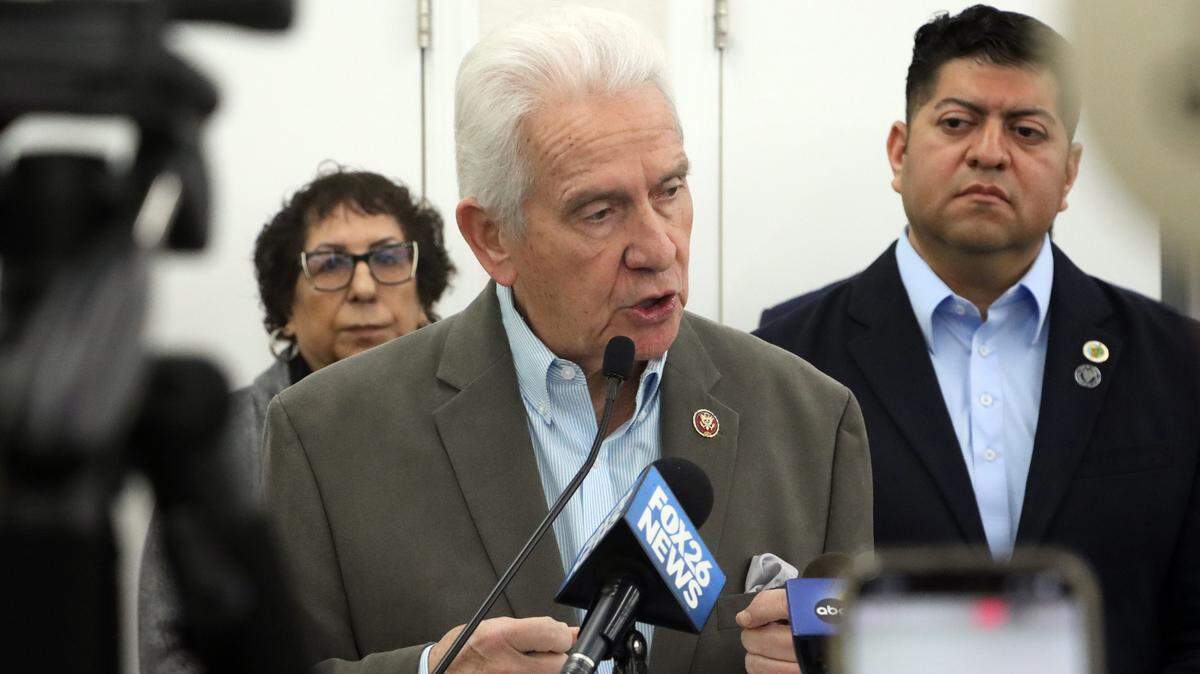
Republicans criticized Democratic Rep. Jim Costa’s financial showing, saying it was unusually weak for an incumbent. Costa returned fire with a feisty response.
Sen. Adam Schiff raised $1.9 million for his Senate campaign in the first half of this year, even though he doesn’t have to run until 2030.
Those are among the highlights and controversies of the latest round of campaign finance reports filed with the Federal Election Commission this week. The reports cover January 1 to June 30, and are the first hints of how 2026 candidates are faring.
The reports can be “kind of a signal for a party to see some vulnerability, or to say we’ve caught somebody sleeping,” said Charles Turner, professor of political science at California State University, Chico.
Adam Gray vs. Republicans
The most bitterly fought battleground is the House, where Democrats need a net gain of three seats to win control.
The seat now held by Gray, D-Merced, is regarded as one of the nation’s most hotly contested races by Inside Elections, a nonpartisan group that analyzes campaigns.
Gray, who won his seat last year by 187 votes, had $781,283 on hand at the end of June after raising $714,232 in the spring quarter.
Entrepreneur Vin Kruttiventi, a Republican challenging Gray, reported $111,584 on hand, though he also listed campaign debts of $806,000. He reported $307,237 in contributions in the spring.
The campaign said the debt is from not just this election cycle but the last one, when Kruttiventi unsuccessfully ran for Congress. It said it very pleased with this cycle’s fundraising so far, noting it has far more on hand than what it calls “the establishment candidate.”
Ceres Mayor Javier Lopez, another Republican challenger, reported $40,267 available and $48,360 in contributions. He formally announced his candidacy in mid-April. He did not respond to a request for comment.
Democrats are firing away at the reports. “It’s embarrassing that House Republicans’ star recruit can’t even get his campaign off the ground, demonstrating just how unprepared and unserious Javier Lopez is,” said Anna Elsasser, spokeswoman for the Democratic Congressional Campaign Committee.
Independent analyst Kyle Kondik, managing editor of Sabato’s Crystal Ball, sized up the race this way: “On paper that is one of the top offensive targets for Republicans in the country, but (they) will need to pick up the pace to really push Adam Gray.”
David Valadao and Jim Costa
In another closely-watched race, Valadao, R-Hanford, reported $1.39 million on hand at the end of June. He had a hotly-contested fight in 2024, one that got the attention of former Trump adviser Elon Musk, whose political action committee spent nearly $1 million trying to get Valadao elected. The Valadao campaign was not allowed to coordinate with the committee.
Among Democrats, Assemblymember Jasmeet Bains, D-Delano, announced her candidacy this week, so no mid-year report has been filed.
Of other Democrats eager to win the Valadao seat and showing campaign finance activity, former Assemblymember Rudy Salas, who lost to Valadao in 2024, reported $175,952 on hand, and college professor Randy Villegas had $126,432 available.
Costa, D-Fresno, first elected to Congress in 2004, won last year with 52.6%. Inside Elections rates the district as leaning Democrat. Republicans are pointing to his campaign finance report as evidence of vulnerability.
Lorenzo Rios, a Republican and CEO of the Clovis Veterans Memorial District, announced his candidacy to run against Costa this month. No FEC report was available.
“Out of touch Democrat Jim Costa is a political relic running on fumes,” said Christian Martinez, spokesman for the National Republican Congressional Committee. “His humiliating fundraising haul is a flashing red warning sign — no message, no energy, no grassroots support.”
Costa and the DCCC fired back.
“It is my honor and privilege to serve the constituents of the 21st Congressional District. I am running for re-election in 2026 and look forward to seeing Lorenzo as he learns about the region that I serve,” he said.
“Costa has never been a particularly impressive fundraiser or electoral performer,” Kondik said. “That said, he should probably still be okay in the context of the 2026 midterm, but it’s a sleeper district to watch after it got much less Democratic in 2024.”
Adam Schiff’s haul
Schiff’s $1.9 million in fundraising is hardly unusual for a high-profile U.S. senator.
Sen. Alex Padilla, D-Calif., whose term expires in 2029, had $6.84 million on hand. He reported raising $376,712 in the spring.
“Schiff has become such a national figure that he may just have a more potent fundraising network than your average Democrat in a safe seat,” Kondik said.
“It is standard practice for incumbent senators like Senator Schiff to maintain and grow a strong cash on hand even when they are not actively campaigning for office themselves,” Schiff campaign spokeswoman Marisol Samayoa explained. “This allows the senator to be active in supporting his colleagues and candidates in California and around the country.”
In all, the Schiff 2030 campaign brought in $2.7 million in the first half of the year. The $1.9 million he raised came almost exclusively from smaller individual contributions. Schiff does not accept corporate political action committee donations.
The other $860,000 came from interest on leftover money from the 2024 campaign.
He wound up the first six months of the year with $7.25 million, which he can use toward his 2030 campaign if he runs again.
Schiff won his seat last year with 59% of the vote in the general election, though he survived a bruising primary.
Schiff has been sending out campaign requests frequently. Tuesday, after President Donald Trump suggested he should be investigated for mortgage fraud, Schiff sent out a fundraising appeal.
“He wants to silence his critics. But I refuse to back down — and with you in my corner, I never will,” Schiff insisted.
The next day, he sent out another missive to supporters, asking them to fill out a “Summer Priorities Survey.”
“Too many in Washington are focused on polls and pundits, but I’d rather listen to real people,” he said. At the bottom of the email was a box saying “Donate.”
This story was originally published July 17, 2025 at 12:47 PM.
.jpg)