

US Border Patrol made arrests in Sacramento. Is it in their jurisdiction?
AI-generated summary reviewed by our newsroom.
- Border Patrol arrested 12 people in Sacramento, raising jurisdiction questions.
- Federal law permits CBP activity within 100 miles of any external U.S. boundary.
- Legal expert warns actions by CBP may conflict with constitutional protections.
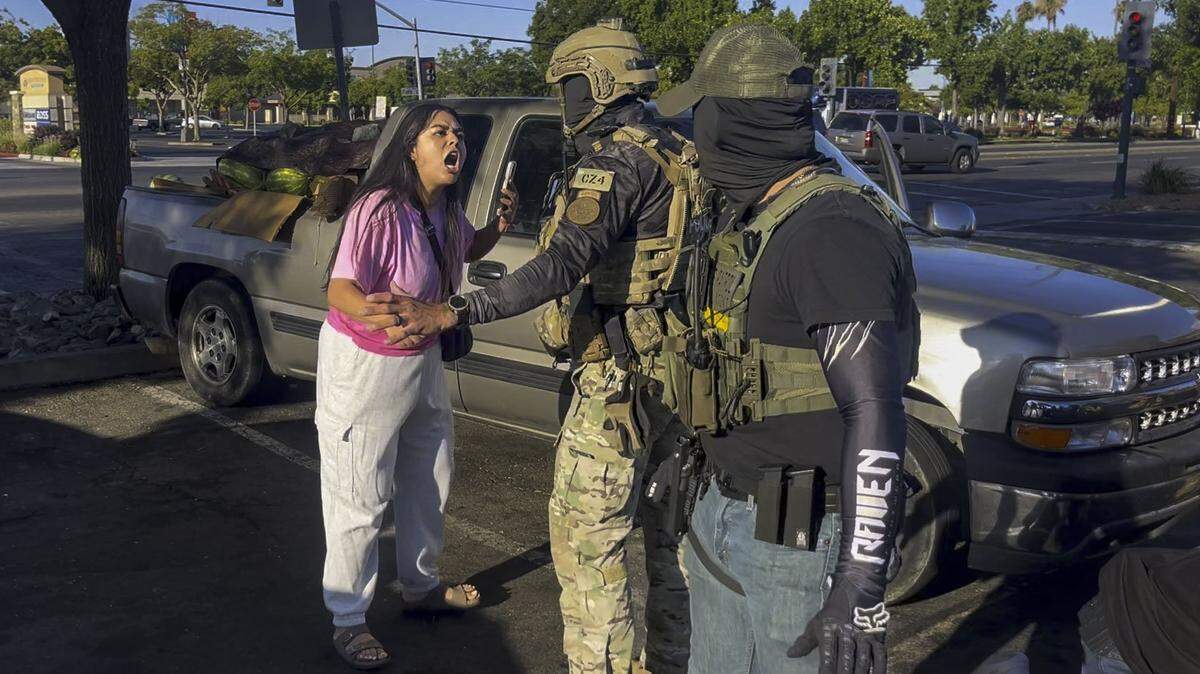
The arrest of 12 people in a Home Depot parking lot in Sacramento by U.S. Border Patrol agents Thursday morning prompted questions from residents on social media and state and local elected officials about why the agency was in the capital city, far from borders on both sides.
Assemblymember Rhodesia Ransom, D-Tracy, wrote a letter to Attorney General Rob Bonta shortly after the arrests, asking him to investigate whether the Customs and Border Protection agency was legally authorized to conduct enforcement operations in the area. She noted a U.S. citizen who was arrested “was later tracked to an (Immigration and Customs Enforcement) facility in Stockton, CA,” in her district, at least 300 miles from the nearest border crossing.
“I just want (the AG) to check and make sure that they are following the letter of the law, because they are only adding more chaos to the situation,” she said in an interview. In an emailed statement, the AG’s office said it could not confirm or deny potential investigations.
Despite more commonly operating near the country’s borders, federal border patrol agents can operate within 100 miles of an external boundary of the U.S., including the coast line.
That ability comes from a statute Congress passed in 1946 that gave U.S. Customs and Border Patrol the authority to stop and search vehicles within a “reasonable distance” from any external boundary of the country. Since 1953, federal regulations have defined “reasonable distance” as 100 miles from the border or coast line.
According to the American Civil Liberties Union, about two-thirds of the U.S. population lives within that 100-mile zone, subjecting those residents to potential warrantless search and detention by Border Patrol agents.
Sacramento is just under 100 miles inland from the Pacific Ocean.
Possible legal challenge
The expansive enforcement zone of CBP hasn’t been meaningfully challenged, said Raquel Aldana, a law professor at the University of California, Davis who specializes in immigration law and policy.
If it was, she thinks there would be a strong legal argument against CBP acting in this capacity, in part because existing law is vague.
She predicts the argument from the Department of Homeland Security, which has overseen CBP since 2002, would be that both CBP and ICE agents are theirs to allocate as they see fit. That argument, she said, could be flawed.
ICE and CBP are trained to perform different duties, Aldana said. “Their understanding of what is permissible is different.”
CBP officers are used to functioning in a particular way, she said, guided by the understanding that Fourth Amendment rights are more flexible near the border due to the government’s interest in securing that space. Officers that typically operate at the border are not necessarily going to understand how their enforcement should differ further inland the way that ICE agents do, Aldana said.
“If you care about constitutional rights, all of that can be dangerous because it muddles the law in even greater ways than what we’re seeing.”
The Customs and Border Protection office did not respond to questions about why they were the ones to carry out the operation, instead of ICE, which typically operates in the interior of the United States to enforce federal immigration law.
“It’s clear that they are employing everything that they possibly can,” said Assemblymember Ransom, referencing the stated quota of the Trump Administration to arrest 3,000 people a day.
On Thursday afternoon, Sacramento Assemblymember Maggy Krell published a statement questioning CPB’s operation in Sacramento, since CBP agents were barred from conducting “indiscriminate raids” in the area by an Eastern District federal court in April.
“This blatant abuse of power is meant to spread fear across our immigrant community and does nothing to advance public safety,” she wrote.
Bill Melugin, a Fox News correspondent who joined agents on Thursday, tweeted that Border Patrol said it checked license plates at the parking lot in the days preceding the operation, and some had come back matching plates of “previously deported illegal immigrants.”
This story was originally published July 18, 2025 at 1:48 PM.