New redistricting maps leaked before release by CA Legislature. See them here
If Democrats succeed with their lightning-speed push to redraw congressional districts, California’s Republican strongholds will look very different. New district maps leaked online ahead of their official release by the Legislature confirmed that Democrats are targeting five Republican districts in the North State, Central Valley and southern California, while hoping to shore up other competitive districts to make them easier for party candidates to win.
Gov. Gavin Newsom has led the charge for Democrats to respond in kind after President Donald Trump asked Texas Republicans in June to fortify their House majority by redrawing districts to eke out another five seats in the 2026 midterms. At a Thursday campaign launch, Newsom framed redistricting as Democrats’ chance to “liberate democracy” as Border Patrol agents stormed the rally and President Donald Trump seized control of law enforcement in Washington, D.C.
Newsom is calling for a special Nov. 4 election, and the Legislature will return from summer break Monday to swiftly pass a constitutional amendment and related ballot language by next Friday. Organized labor, reproductive rights groups and House Majority PAC, the leading fund for Congressional Democrats, are all backing his campaign.
The California Republicans whose districts Democrats are targeting are Reps. Kevin Kiley, David Valadao, Ken Calvert, Doug LaMalfa, and Darrell Issa. If successful, the effort would net Democrats 48 of the state’s 52 congressional seats; the party currently controls 43. Other districts that Democrats have narrowly won would also be consolidated into friendlier terrain. Political data scientist Paul Mitchell, a redistricting veteran, drafted the maps.
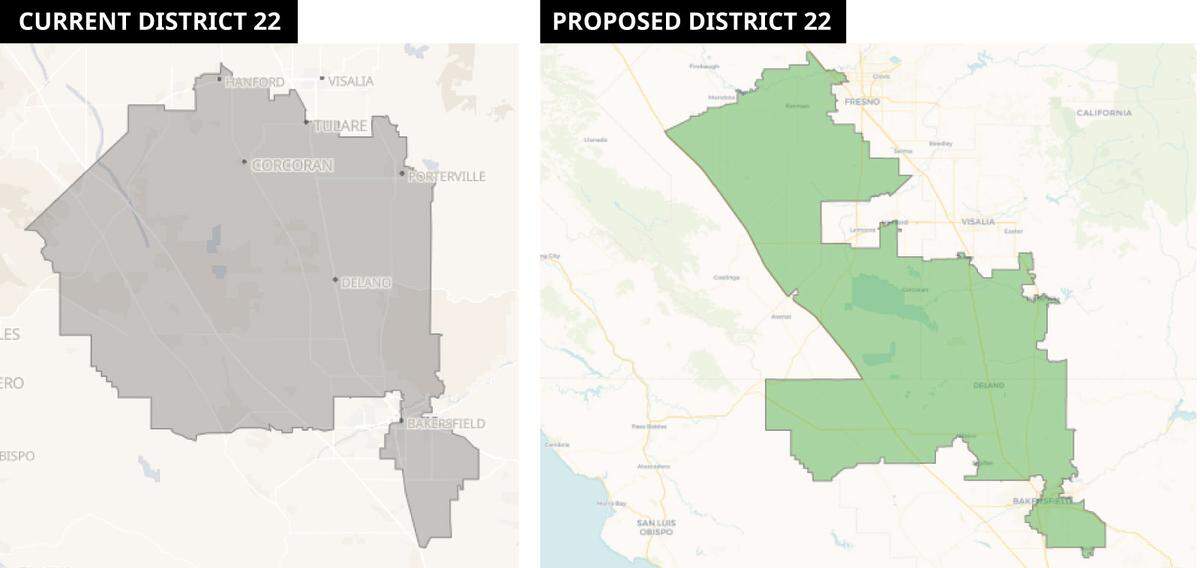
“Our proposed map was created using traditional redistricting criteria, consistent with guidelines laid out by the California’s Citizen Redistricting Commission,” according to a cover letter from Julie Merz of the Democratic Congressional Campaign Committee included with the map.
“It allows for more compact districts than in the current Commission-drawn map, keeps more communities and neighborhoods together, splits fewer cities, and makes minimal disruptions to the Commission-drawn map so as to impact as few residents as possible,” Merz wrote.
“This is a striking contrast from Texas’ proposed gerrymander which redrew all but one of their 38 congressional districts to minimize the state’s growing minority voting strength.”
What would change?
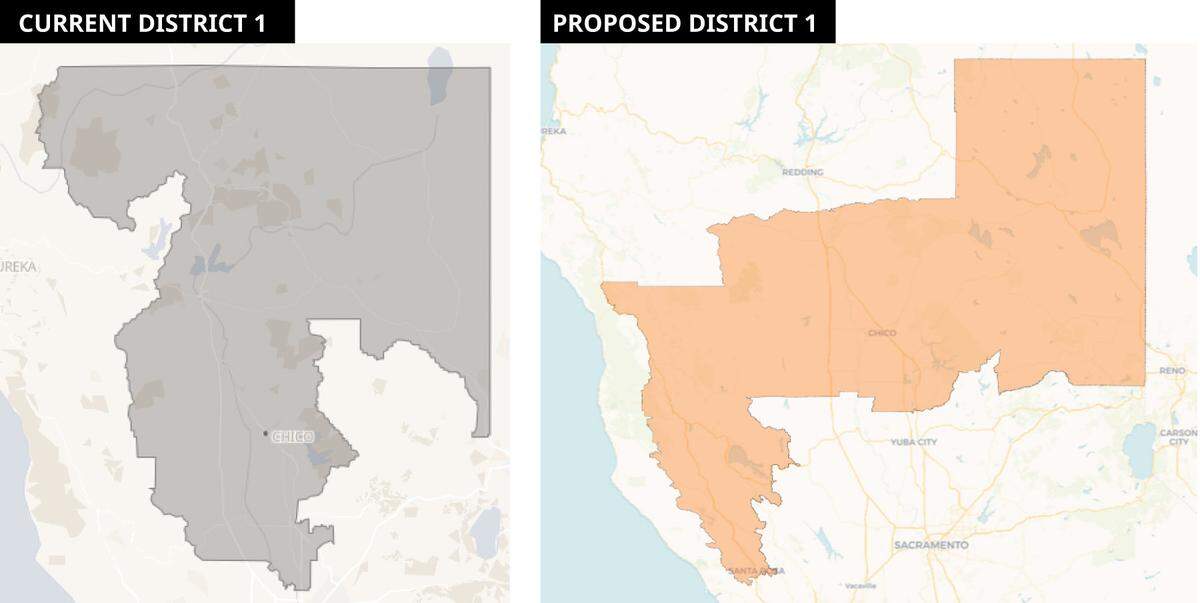
The draft maps, which leaked online ahead of their official release Friday, would shrink most Republican districts. It would shift much of the North State into the coastal 2nd Congressional District seat currently held by Democratic Rep. Jared Huffman while including parts of northern Marin and Sonoma counties.
Kiley’s district would also shrink and encompass part of the greater Sacramento area, shift the bulk of voters to Republican Rep. Tom McClintock’s district and remove a broad section of the eastern Sierra Nevada.
Valadao’s district would also shrink, as would that of Issa, who trumped his Democratic opponent in 2024 by almost 19 points to be reelected to his San Diego-area seat.
Per a chart that leaked Thursday, all of those districts would shift from being “safely” Republican to either lean Democrat, or be considered safe for any Democratic candidate if voters approve them in November.
Calvert and Issa currently represent parts of Riverside and San Diego counties and Valadao represents a Central Valley district. LaMalfa currently represents much of the North State from Yuba City to the Oregon border. Kiley, arguably Newsom’s arch rival within the state, currently represents much of the northern Sacramento suburbs, northern Sierra Nevada, and the Nevada border down to Death Valley.
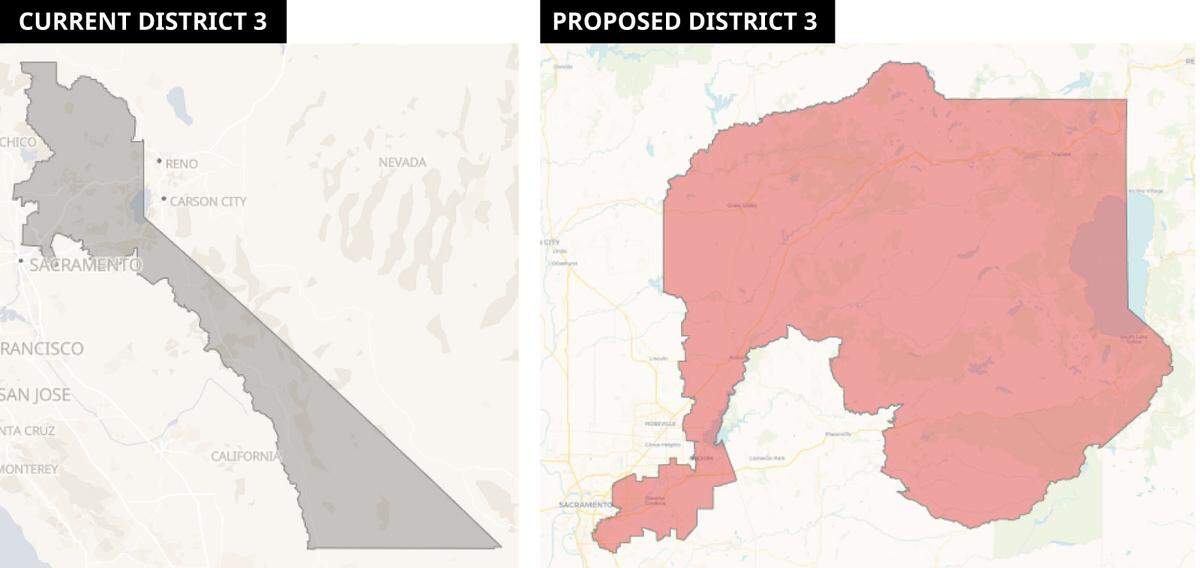
“Make no mistake, I will win reelection regardless of Newsom’s attempt to gerrymander my district,” Kiley said on X, linking to a photo of his newly redrawn district. “But I fully expect that the beautiful 3rd District will remain exactly as it is. We will defeat Newsom’s sham initiative and vindicate the will of California voters.”
LaMalfa’s district has voted for every Republican presidential candidate since 2012, the year LaMalfa first won election. At a town hall held Monday in Chico, a veteran criticized him for not pushing back on Trump’s staffing cuts at the Department of Veteran Affairs, forcing the man to seek mental health care in San Rafael, three hours away.
Hours before the maps were published, a handful of Democratic candidates who had previously lost to Republican incumbents said they were considering running in newly drawn districts.
That included Chico ag consultant Audrey Denney, who previously ran against LaMalfa in 2018 and 2020, and confirmed she would run again for his seat if voters approved temporary redistricting in November.
“With this map, my home in Chico is now in a district that Democrats can win. And if Californians vote for the map, I plan to run to replace Rep. Doug LaMalfa and take on this administration in 2026,” she said in a statement.
“We will step up and fight back when Trump and MAGA Republicans break the rules. We will not allow them to rig the system against working people any longer. Our message is clear: If you take away our freedoms, we will take away your seats.”
Lawmakers debate
Outgoing Assembly Minority Leader James Gallagher, R-Yuba City, said he had heard speculation leading up to the maps’ release that Democrats were considering redrawing LaMalfa’s district to draw more liberal voters in from the coast, as far down as parts of Sonoma and Marin counties.
“There’s no justification for it,” he said earlier this week. “It will drown out more rural voters.”
“We’re going to focus on how corrupt this process is. It won’t result in more fair representation,” he said of Republicans’ opposition efforts. “We decided that the voters would decide, that we’d do things differently, and not let politicians draw the lines. Either you believe in the principle or not.”
A handful of congressional Democrats said normally, they were opposed to letting politicians rewrite districts, but that Trump’s request that the GOP maintain its hold on Congress so it could continue enacting his agenda without opposition demanded an extraordinary response. Polling numbers reviewed by lawmakers show voters are still strongly in favor of letting redistricting remain independent.
Rep. Adam Gray, who won his Merced-area district by 187 votes, put the onus back on Republicans.
“It’s difficult to take my colleagues across the aisle seriously when they crow about election rigging and deep state plots and then turn around and do things like what we’re seeing in Texas,” he told The Bee. “It’s unserious and it’s damaging to our democracy.”
“If Congressional Republicans had a record they were proud of, they wouldn’t need to rig the next election. Congressional Republicans’ plan to suppress the voices of voters is an existential threat to our democracy,” Rep. Mike Thompson, D-St. Helena, told The Bee. “California isn’t going to stand by and let it happen. I’m a longtime supporter of non-partisan redistricting, but extraordinary threats like this one require extraordinary action. If redistricting is on the table in Texas, it must be on the table here in California, too.”
Newsom, who is reportedly eyeing a run for higher office after he’s termed out in 2026, said the maps would be temporary through the 2030 election. After that, redistricting power would revert back to the nonpartisan Citizen Redistricting Commission, a 14-member state body that voters approved in 2008 to redraw state legislative maps, and later congressional ones in 2010.
Advocates across the political spectrum, from Republicans to progressives to good governance groups, have opposed the effort. Former House Speaker Kevin McCarthy and former Gov. Arnold Schwarzenegger, who championed the redistricting commission, are backing an opposition coalition funded by Charles Munger Jr., a former Santa Clara GOP chair who has tapped his family fortune to support Republican causes, including the 2008 initiative establishing the commission.
“These maps were drawn by politicians and party insiders behind closed doors with no transparency and no input from the public. Several elected politicians with open congressional committees will vote on these self-serving districts. That is a clear conflict of interest and undermines public trust in the fairness of our elections,” said Munger spokesperson Amy Thoma Tan.
“Californians deserve district lines that are drawn in the open, by our citizens’ independent commission, which the voters elected to do , and with full opportunity for public review and comment — not maps engineered by politicians to serve themselves or their partisan agenda. Citizens, not politicians or partisan party insiders, should not only hold the power at the ballot box but also the power to draw the lines.”
The Assembly and Senate elections committees have set hearings for next Tuesday ahead of the election, which is expected to cost at least $200 million. The California State Association of Counties, Rural County Representatives of California, and the California Association of Clerks and Election Officials asked the governor Thursday for funding in advance to prepare for added costs associated with printing more ballots and envelopes, staffing more poll volunteers, and booking voting centers.
This story was originally published August 15, 2025 at 4:02 PM.