
Jennifer Siebel Newsom says California is ‘just getting started’ on tech regulation
Good morning and welcome to the A.M. Alert!
DAVID VS. GOL-“AI”-TH
With the end of the legislative session in sight, the push to pass social media and AI regulations is heating up in Sacramento, and First Partner Jennifer Siebel Newsom is lending her star power to the effort.
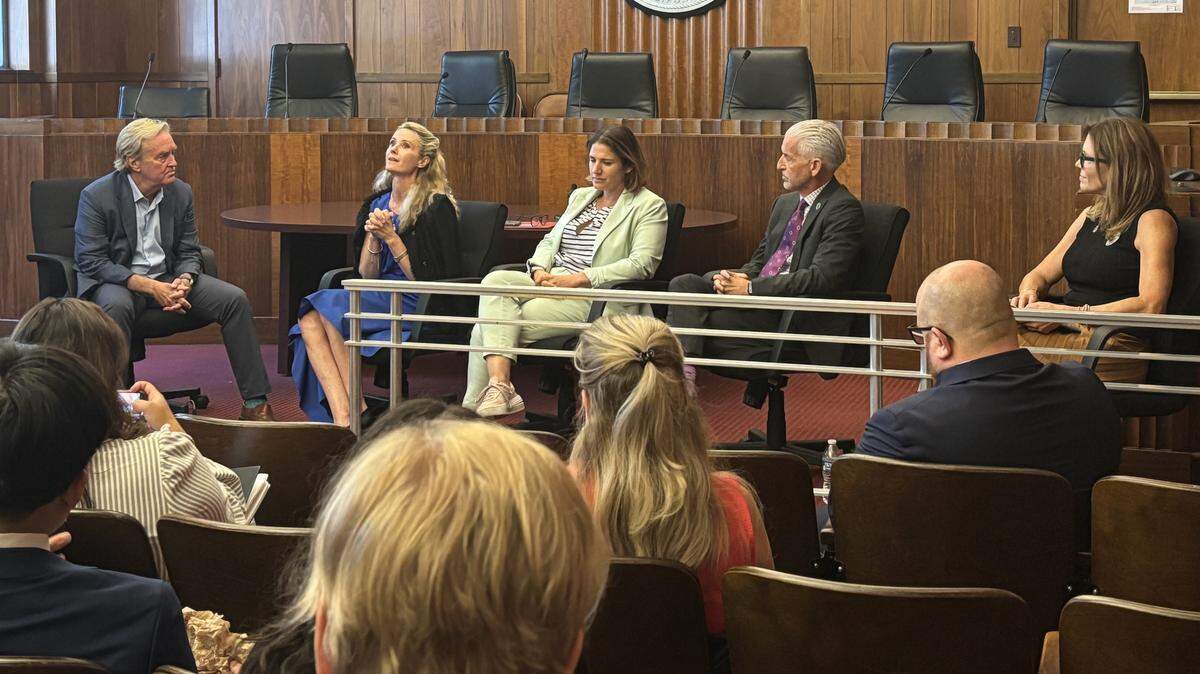
Siebel Newsom spoke on a panel discussion Wednesday held by Common Sense Media, a main player in the fight for tech consumer protections, and Tech Oversight California, an extension of a D.C. outfit that advocates for technology regulation. At times, the first partner spoke through tears about the negative impact of tech on teens.
“Regulation is essential, otherwise we’re going to lose more kids,” she said. “I can’t imagine being one of these tech titans and looking at myself in the mirror and being OK with myself.”
She said she and Gov. Gavin Newsom kept their oldest kids off of social media until they were 14 and wishes she’d waited longer.
Some of the biggest social media bills currently on the table this session include AB 56, by Rebecca Bauer-Kahan, D-Orinda, which would add warning labels to social media, and SB 53, by Scott Wiener, D-San Francisco, which aims to increase AI transparency. Both still need to make it past their second House Appropriations committees.
The main question may be whether Newsom will pass them. He vetoed a stronger version of SB 53 last year, saying publicly that he worried it would have a “chilling effect” on innovation.
“Remember: He’s running for president,” said Common Sense Media founder Jim Steyer, during an interview before the panel. “He needs money from the tech industry. That’s really the equation.”
That equation isn’t lost on lawmakers.
“This is a little awkward sitting next to the first partner,” said panelist Bauer-Kahan regarding her bill’s chances on the governor’s desk. She added that she believes Newsom acts from his conscience as a father.
Bauer-Kahan and Assemblymember Josh Lowenthal, D-Long Beach, both serve on the Committee on Privacy and Consumer Protection, which hears much of the legislation. In his remarks, Lowenthal mourned how his children are disengaged at the dinner table but said he doesn’t “blame them for their [tech] addiction.”
The assemblymember said he’s looking at legislation that would prohibit children from getting social media until they’re a certain age, otherwise known as “age-gating.” That effort would likely get approval from Siebel Newsom, if not her husband.
“I think we’ve just let people off the hook for way too long, and I think that we are just getting started,” she said.
WHO RUNS THE WATER?
Via Amelia Wu…
California water boards are not proportionately representing the people they are serving — primarily women and Latino communities, according to a recent study from the UC Davis Water Management Lab.
Sponsored by Water Education for Latino Leaders, or WELL, the study revealed that women only make up 27% of all water board positions, despite making up about 50% of the population. The nonprofit trains Latino elected officials about California water policy.
Additionally, Latinos make up 42% of the state population but make up 15% of positions on executive boards, according to the study.
During a news conference highlighting the study’s findings, UC Davis professor of water resources management Samuel Sandoval Solis called out the $50 billion water industry for lacking transparency. He said while conducting the study it was difficult to find members of county water boards.
He added 15% of boards don’t post agendas online and only 2% of boards translate agendas to Spanish.
Finding information on becoming a board member is also difficult, according to the study’s findings. Only 36% of the agencies made public documents with instructions for becoming a board member.
Assemblymember Celeste Rodriguez, D-San Fernando, an alum of a WELL fellowship, said representation on decision-making committees is important. She grew up in the San Fernando Valley, and comes from “a community of a failed water system,” she said.
Assemblymember Anamarie Ávila Farías is also an alum of the WELL program.
“We have to be the voice here in the Legislature,” Faris said. “We can’t claim ignorance or we don’t have time. As two Latinas that went through this program, I feel a social responsibility to figure out with our community what are the next steps.”
QUOTE OF THE DAY
“I have tremendous respect for how Governor Newsom has approached this. He’s put forward a smart, measured approach in California, designed to address a very particular problem at a very particular moment in time.”
-Former President Barack Obama, lending his support for California’s redistricting initiative in a post on X.
Best of The Bee:
- Gavin Newsom goes national, tells fellow Democrats to play ‘hardball’ with Trump via David Lightman
- US citizen arrested in Sacramento immigration raid faces vandalism charge via Sharon Bernstein
- Sacramento leaders question ICE about detained immigrants sleeping on floor via Mathew Miranda