
Central Valley congressman caught in the middle in a bitterly divided Washington
AI-generated summary reviewed by our newsroom.
- Rep. Adam Gray seeks bipartisanship in a sharply divided 2025 Congress.
- Gray backs GOP-led bills on defense, border security to appeal to centrists.
- Gray’s budget abstention reflects demand for extended healthcare subsidies.
Rep. Adam Gray once again is in the lonely political middle as Congress and President Donald Trump barrel toward a potential government shutdown.
It’s a shaky place he can’t escape. The Merced Democrat won his Central Valley congressional seat last year by 187 votes in a district Trump won easily.
Now he’s faced with keeping a politically split constituency on his side as he works in a Congress where nearly everyone acts fiercely, unapologetically partisan.
At the moment, virtually all Republicans and Democrats are fixed, at least publicly, on what they want before they vote to keep the government funded past Tuesday night.
The last time the House voted on a stopgap budget, on Sept. 17, Gray didn’t vote.
His position: He doesn’t want a shutdown, and the GOP-authored plan that passed the House that day appears to lack Senate support. But Gray wants a plan that would keep expiring health insurance subsidies going past 2025, which wasn’t in that House bill.
Silent Republicans
Since arriving in Washington in January, Gray has sought common ground with Republicans. It’s gotten him nowhere.
Gray and like-minded Democrats wrote to House Republican leaders shortly after Congress convened last winter, saying they’d be happy to discuss legislation.
They got no response.
They tried again this summer to make a pitch for bipartisanship. Again, no response.
House Speaker Mike Johnson’s office did not respond to a request for comment.
Gray, a veteran lawmaker who served 10 years in the California Assembly before coming to Washington nine months ago, said he’s been surprised at the lack of desire for bipartisanship.
“’I’ve spent my first nine or 10 months now in Congress making every effort to achieve bipartisanship,” he told The Sacramento Bee in an interview. “I’ve voted with Republican colleagues on their priorities that were not my priorities in an effort to compromise and build consensus.”
But this is not the Congress of generations past. Even though Republicans control 219 votes, or two more than a majority, they have consistently built support for major bills by lobbying other Republicans.
It’s not an atmosphere friendly to Gray’s politics.
Gray is “trying to position himself as a moderate rather than a progressive Democrat, somebody who does not reflexively vote against all Republican legislation. He is likely to have a tough race next year and does not want to alienate moderate swing voters,” said Thomas Holyoke, professor of political science at California State University, Fresno.
A divided district
Gray represents a San Joaquin Valley district that has swung back and forth between Democrats and Republicans in recent years.
Rep. John Duarte, a Republican, beat Gray by 564 votes for the House in 2022, a year when the GOP did well as voters rebelled against high inflation during President Joe Biden’s administration.
Gray barely beat Duarte two years later, even though Trump won the district by 5 percentage points. Gray’s was one of 13 congressional districts in the country that both Trump and a Democratic House candidate won. The district includes Merced County, much of Madera County and some parts of Fresno, Stanislaus and San Joaquin counties.
If California’s Proposition 50 is passed in November, Gray’s district would be slightly redrawn to give it a more Democratic edge. But not a huge one.
Whether it’s the current district or one with new lines, what Gray is doing “is still good politics even in a polarized environment,” said Christian Grose, professor of political science at the University of Southern California.
“Gray wants to avoid being hit as a far-left Democrat in a district where voters like Democrats who cross party lines. Adam Gray is a good fit for either district given his strategic abstentions and voting with Republicans sometimes,” Grose said.
Voting with Republicans
This month, Gray was one of 17 Democrats to join Republicans in passing a defense bill that included tough restrictions on transgender people.
Gray explained the $831.5 billion bill “will enhance military readiness, improve quality of life for our service members and give all members of our military a pay raise,” Gray said. Military personnel got a 3.8% pay boost from the bill.
Democrats objected, though, because of the inclusion of amendments aimed at restricting rights of transgender people.
Gray voted for five of the amendments. None got more than 10 Democratic votes Among the amendments: Barring gender transition procedures from military insurance coverage, barring transgender women from participating in service academies’ women sports programs and requiring everyone to use restrooms based on their reproductive system.
“There’s a lack of consensus on what fairness is,” he explained. “I think you’ve seen that repeatedly throughout the country. Even our governor in California, who’s a Democrat, commented on it.”
In his podcast in March, Gov. Gavin Newsom said having transgender people compete in sports was “an issue of fairness. It’s deeply unfair.”
“Everyone should choose to live their life in every manner they want to live it,” Gray said. “How that relates to what we do as a community is different. That’s where you have to build community consensus. We don’t have that right now in this country.”
A few days later, Gray was one of 11 Democrats siding with Republicans on Sept. 11 to pass a tough border security bill.
The bill would mandate prison terms of up to five years for someone entering or reentering the country illegally and stiffer penalties for those who commit certain crimes.
“The American people, not just in California but across the country, sent a pretty clear message in recent elections that they want Congress to take securing the border more seriously,” Gray said.
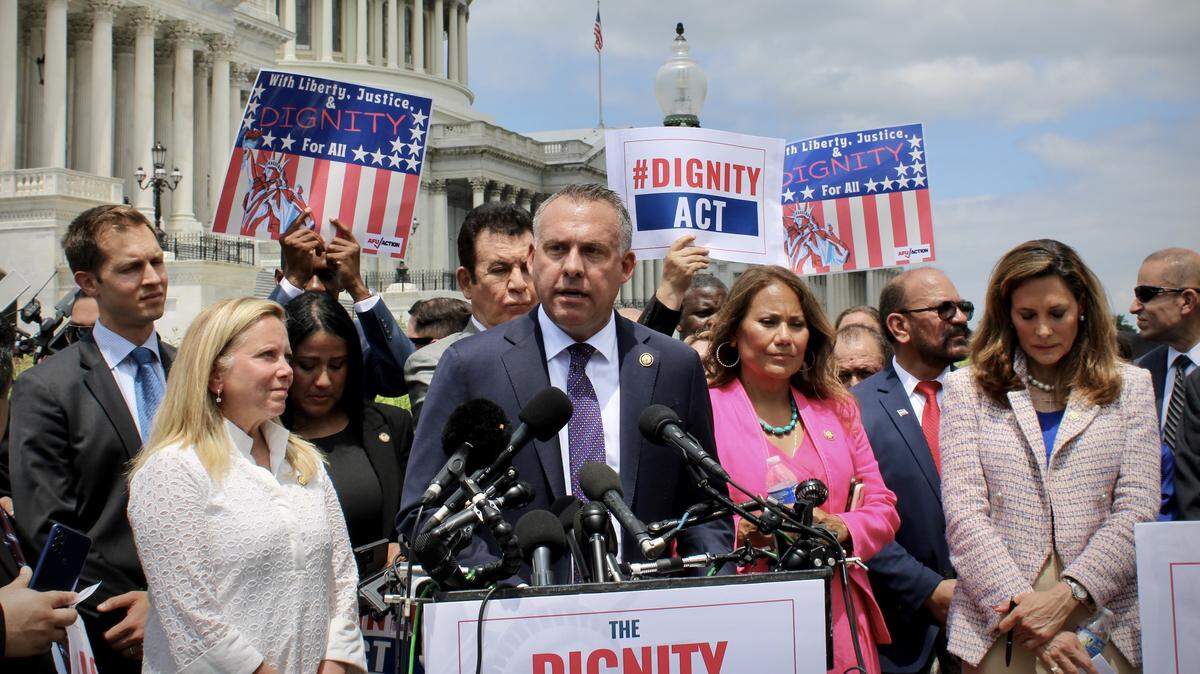
He’s trying for bipartisanship on immigration by pushing the Dignity Act along with other Democrats and Republicans.
It would give legal protection and status to undocumented immigrants already living in the United States, streamline the asylum screening process and boost border security.
Gray’s challenge
Republicans are hammering Gray daily for one thing or another.
Lately, the GOP has aimed at his stand on the budget.
“Instead of protecting families’ paychecks, out-of-touch Democrat Adam Gray refused to vote, ducking responsibility while risking a government shutdown that would bring financial pain to millions. Californians deserve better,” said Christian Martinez, National Republican Congressional Committee spokesman, in an organization email Friday.
Ben Rodriguez, Gray’s chief of staff, called his boss’ stance on the budget vote an “abstention” that “demonstrates that he remains open to bipartisan compromise” to accomplish his goals, notably an extension of the healthcare premium subsidies.
The NRCC, which works to get Republicans elected to Congress, insists that by not voting for the budget, Gray is backing a shutdown. Responded Gray: “I don’t want to see the government shut down.”
As of today, Democratic leaders are adamant, saying they won’t back a budget without a continuation of the health insurance premium subsidies.
This can be settled, said Gray, if we just talk to each other.
“I want to see Washington move forward with bipartisanship,” he said.
This story was originally published September 26, 2025 at 10:35 AM.
.jpg)