
Judge permanently bars Trump from deploying National Guard troops in Oregon
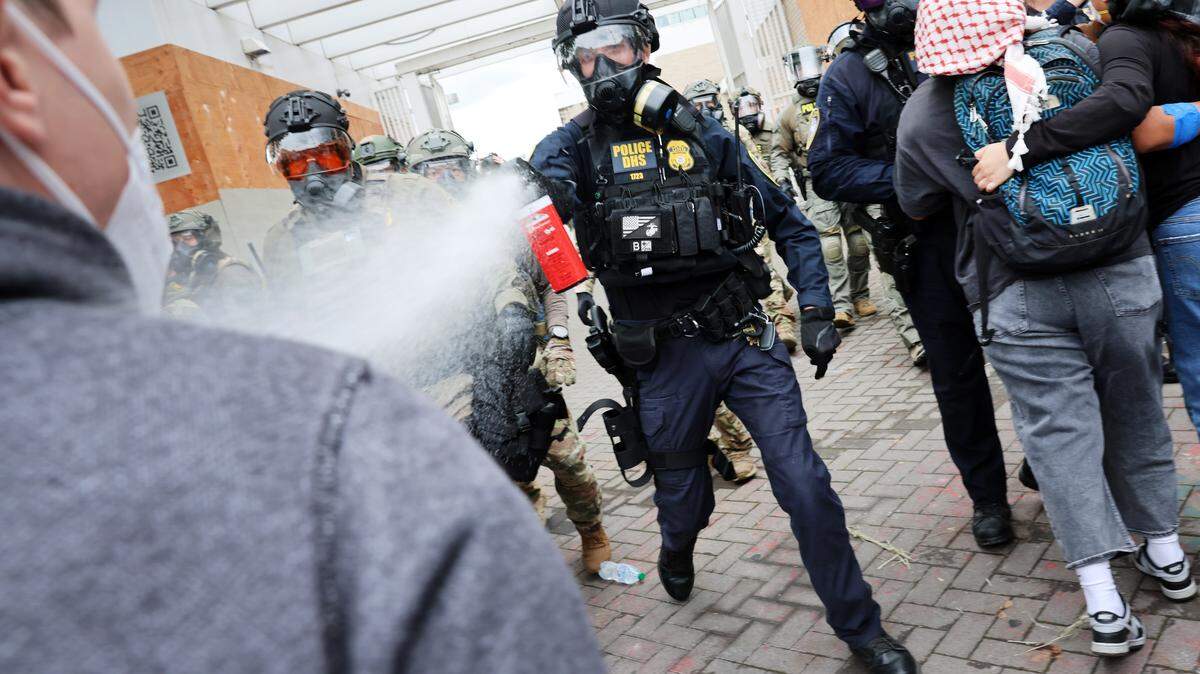
A federal judge has permanently blocked President Donald Trump from deploying National Guard troops — including from California — to Portland, Oregon, ruling that the administration failed to meet the legal threshold for federalizing state forces.
U.S. District Judge Karin Immergut issued the 106-page ruling Friday, finding Trump lacked legal grounds to federalize Guard units even though he was entitled to “great deference” in calling them up.
The case focused on Trump’s September order to deploy federalized Guard troops — including 200 from California — to protect a U.S. Immigration and Customs Enforcement building amid ongoing protests. California Guard members were among the troops Trump sent to Oregon after a judge initially blocked him from deploying Oregon’s own Guard.
“The trial record showed that although protests outside the Portland ICE building occurred nightly between June and October 2025, ever since a few particularly disruptive days in mid-June, protests have remained peaceful with only isolated and sporadic instances of violence,” Immergut wrote. “The occasional interference to federal officers has been minimal, and there is no evidence that these small-scale protests have significantly impeded the execution of any immigration laws.”
The White House contended that troops were needed in a city Trump described as “war-ravaged.”
In a statement, a White House spokesperson said Friday that Trump “will not turn a blind eye to the lawlessness plaguing American cities and we expect to be vindicated by a higher court.”
California Attorney General Rob Bonta, whose office helped challenge the Portland deployment and previously sued to block Trump’s attempted Guard deployment to Los Angeles under similar circumstances, said the court’s decision should resonate beyond this case.
“Once again, a court has firmly rejected the president’s militarized vision for America’s future,” Bonta said in a statement after the ruling.
“This case is just one part of a broader effort by the president to trample on state sovereignty and reshape the American presidency,” Bonta said. “We celebrate this victory with eyes wide open and firm resolve to see this fight through to the end.”
Oregon Gov. Tina Kotek said Trump and Defense Secretary Pete Hegseth, who called in Guard personnel from California, should “send all troops home now” after being stationed in the city for 38 days and California troops for just over a month.
“This ruling, now the fourth of its kind, validates the facts on the ground,” she said. “Oregon does not want or need military intervention, and President Trump’s attempts to federalize the guard is a gross abuse of power.”
The decision caps a three-day bench trial last week in Portland, where attorneys for California, Oregon and the city of Portland argued that Trump’s deployment was politically motivated and legally baseless.
Federal law allows the president to use military force domestically only in cases of insurrection or when enforcement of federal laws becomes impossible through civilian agencies. Immergut ruled those conditions were not met.
The judge’s ruling marks a significant blow to Trump’s broader attempts to use military personnel in U.S. cities led by Democratic officials. In addition to Oregon, the administration faces similar legal challenges in Illinois, where a federal appeals court has also halted troop deployments in Chicago.
Lawyers for the White House had argued that Trump had wide discretion to deploy troops based on prior violence, even months earlier. While smaller appellate panels have sometimes agreed with that view, the 9th U.S. Circuit Court of Appeals granted a rare full-panel review. All 11 judges will now consider an appeal of Immergut’s orders.
Gov. Gavin Newsom, who is traveling to a climate forum in Brazil, had yet to comment publicly on the ruling as of Friday evening, but his office previously criticized the use of state Guard troops as politically motivated deployments.
Immergut, who was appointed during Trump’s first term in office, emphasized that her ruling does not prohibit the future use of reservists “if conditions on the ground justify the Guard’s intervention” — only that the facts in Portland failed to meet the legal threshold, violating both federal law and the 10th Amendment, which reserves powers to the states not granted in the Constitution.
“Defendants ignore the nature of the calling forth power,” Immergut wrote. “It is not simply another tool in the executive’s federal law enforcement toolbox that (Trump) may pull out at any time to ‘take care that the laws be faithfully executed.’ … It is the wielding of an entirely different kind of power, the military power, of which the founders ‘always asserted and enforced the subordination … to the civil arm’.”
The 9th Circuit’s decision could ultimately determine how — and whether — a president can send state military forces into U.S. cities over objections from governors.
For now, Trump remains blocked from sending National Guard units from any state to Portland. Immergut’s injunction allows federalization orders to technically remain in place but prohibits troops from being deployed in Oregon without clear legal authority.
This story was originally published November 7, 2025 at 7:33 PM.