‘Evidence!’ Judge demands as lawyers spar over Trump’s National Guard takeover
AI-generated summary reviewed by our newsroom.
- Breyer demanded evidence that local police could not control unrest without troops.
- Administration defended indefinite federalization power via presidential memo.
- Judge said he would rule soon on extension of federal control of Guard.
Lawyers for the Trump administration and California Gov. Gavin Newsom returned to court Friday, arguing over whether the president had the authority to unilaterally extend his federalization of the state’s National Guard in a hearing that turned particularly contentious.
U.S. District Judge Charles Breyer dominated the discussion in federal court in San Francisco, at times raising his voice as he pressed Deputy Assistant Attorney General Eric Hamilton on the administration’s claim that Trump could extend the Guard’s service indefinitely.
“What evidence is there?” he asked, referring to the federal government’s contention that the troops were needed to quell violence in L.A. months after raucous protests that prompted their deployment had subsided.
“Evidence!” the judge nearly shouted.
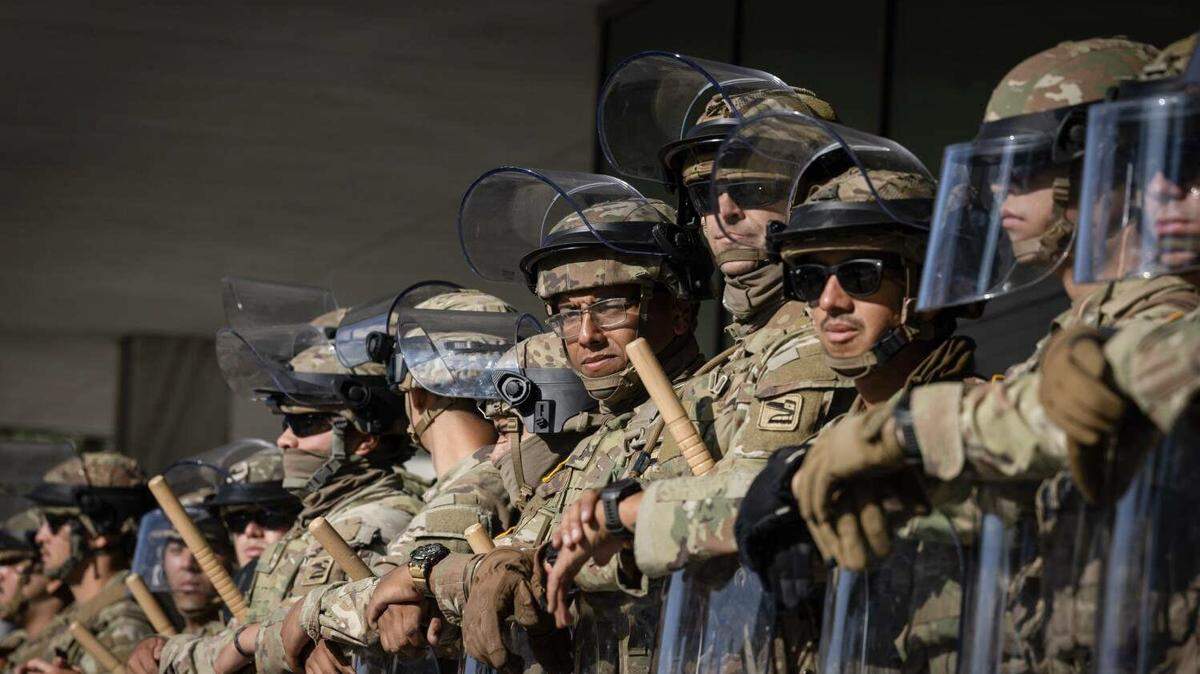
The case is one of several around the country testing the president’s power to take control of a state’s National Guard over the objection of its governor. The series of legal clashes over the use of the Guard began in California last June, when Trump activated soldiers in the wake of violent protests in Los Angeles over the administration’s aggressive immigration enforcement efforts in the nation’s second-largest city.
During the protests, Trump activated the Guard over Newsom’s protests, ultimately increasing the number of troops to about 4,000, according to the state. He also sent about 800 marines, arguing that they were necessary to protect federal agents and property.
Newsom sued, and the case has moved between Breyer’s courtroom and the 9th Circuit Court of Appeals since June. Breyer previously issued an order against the call-up, but it was overturned. A related order remains under appeal.
The matter under consideration Friday involved Trump’s decision to extend the Guard’s deployment beyond its original 60-day limit.
Breyer said the law governing the Guard’s deployment outlines when the president can shorten a call-up, but does not specify how to extend it beyond the time initially authorized.
But Hamilton said the administration addressed that issue by mentioning in the memo calling up the troops that they could be used for longer than 60 days if the Secretary of Defense determined they were needed.
Breyer challenged the rationale, saying the administration’s own decision to reduce the number of troops in Los Angeles to about 100 suggested a declining need.
Because the Guard was federalized under a provision allowing the president to act when regular forces are insufficient to enforce the law, Breyer asked for evidence that the Los Angeles Police Department or the L.A. County Sheriff’s Department were unable or unwilling to respond to incidents.
Hamilton responded by pointing to California’s laws and policies protecting immigrants, saying so-called sanctuary jurisdictions have limited the types of assistance that local law enforcement can provide to immigration agents. Moreover, he said, the courts do not have the power to question the president’s decisions regarding the necessary head count of federalized guard troops.
This prompted a powerful response from Breyer, who said neither example amounted to the evidence he sought that local law enforcement were not up to the task of policing minor incidents months after the June protests subsided.
He asked Hamilton if the administration was saying it had the right to call up troops indefinitely.
“So in other words, like diamonds, it’s forever?” Breyer asked, referring to a phrase used in a long-running jewelry ad campaign and a James Bond film.
“The consequence of your position is that the as long as the president believes, in his discretion, that there exists a situation which would justify the federalization of the National Guard, it can last forever,” Breyer said. “Game over. Match done. That’s the end of the inquiry.”
Hamilton confirmed that was the administration’s position. He said the Guard remained authorized to serve under Trump’s command through the end of January, with about 100 troops in Los Angeles and another 200 in Oregon. He expected that number to drop to a total of 100 in the coming weeks.
Meghan Strong, the California Deputy Attorney General representing Newsom, said that local police were able to respond to any incidents in Los Angeles, and that the extended call-up should be considered invalid because it was beyond the president’s authority.
“It’s not about whether there are the right number of troops in Los Angeles,” she said. “It’s about the fact that there is no legal basis to have even a single soldier in Los Angeles.”
Breyer did not issue a ruling in the case on Friday, but said he expected to do so soon.