
Labor to Gov. Gavin Newsom: Put guardrails on AI if you want support in 2028
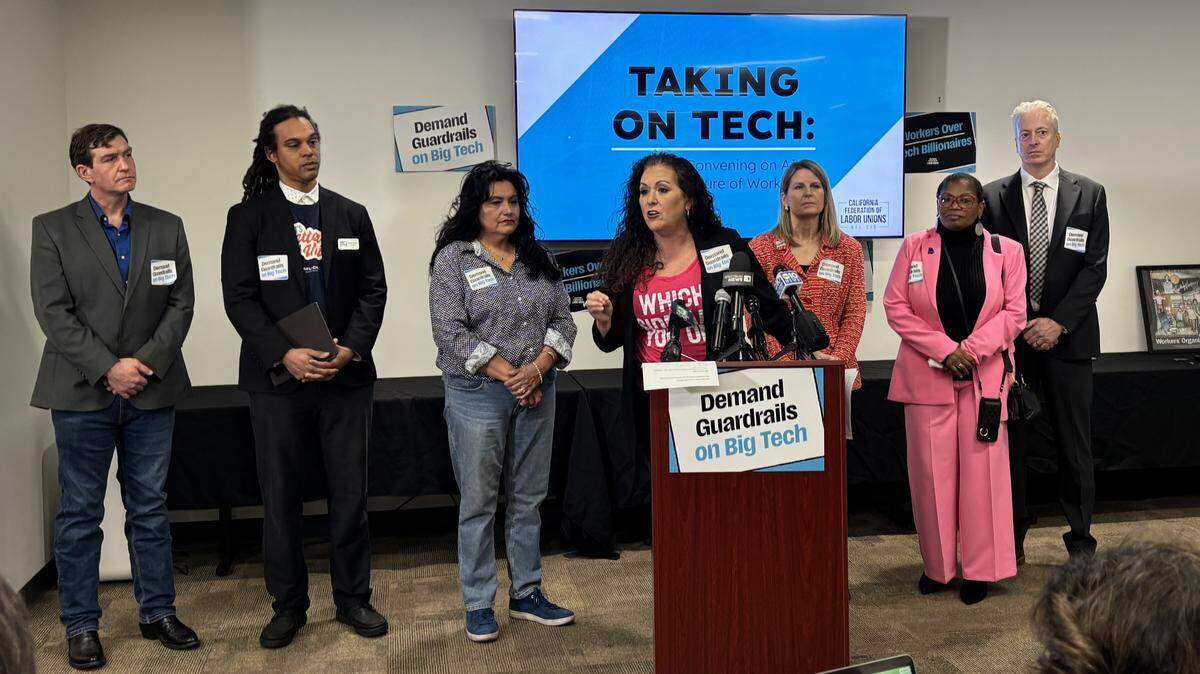
California’s labor muscle is taking a stand as the state’s legislative session gets underway, calling on Gov. Gavin Newsom to support their 2026 proposals on AI or lose their support in his widely expected 2028 run for president.
To put even more heft behind their pitch, they brought out the president of the powerful national AFL-CIO, Liz Shuler, as well as labor leaders from the presidential battleground states of Iowa, Nevada, North Carolina, and Georgia — union power Newsom will certainly need if he mounts a bid for the highest office.
During a news conference Wednesday morning in Sacramento, the leaders spoke about artificial intelligence as an “existential threat” to working people and urged the governor to do more to stand with workers.
“I know this is a little bit of a show,” said California Labor Fed. President Lorena Gonzalez. “It’s extreme steps we have to take in California to get our governor’s attention.”
During her remarks, Shuler said AI is the most urgent issue that working people are facing in the U.S. and across the world. She pointed to a San Francisco start-up’s “Stop Hiring Humans” billboards and a man suing Tesla after he was knocked unconscious by a robotic arm at Tesla’s Fremont factory.
“This governor is fond of saying California is the vanguard, and that is true,” she said. “Unfortunately, it might be for all the wrong reasons when it comes to AI and working people.”
In an emailed statement, Newsom spokesperson Tara Gallegos refuted the allegations the governor hasn’t done enough to regulate AI.
“No Governor has done more than Governor Gavin Newsom to regulate AI in a way that protects workers without killing jobs or innovation,” she wrote.
“Under his leadership, California has taken the most comprehensive, worker-centered approach to AI in the country. While the Trump administration has abandoned working people, Governor Newsom delivers — raising the minimum wage for millions and expanding sick leave, paid family leave, and life-saving worker protections.”
Some proposals are already moving through the Legislature
In recent years, the labor federation has made small wins on AI guardrails. Those include Assembly Bill 701, which forced employers to tell their employees what quotas they were subject to, and several laws that require consent of actors or their estates if a company wants to create an AI replica.
However, last year the governor drew labor’s ire when he vetoed SB 7, the No Robo Bosses Act, which would have prohibited companies from using automated decision systems to make employment decisions. Another bill, AB 1331, would allow employees to leave behind monitoring devices when they go into certain spaces, like the bathroom, and stalled in the Senate.
Those two bills are back again this session, and The Labor Federation expects to release at least a dozen more bills before the end of February.
Newsom has walked a tightrope with AI — trying to protect the burgeoning industry while dealing with widespread public opinion polling calling for regulations on AI, even if development slows.
Gonzalez reminded the governor of labor’s leverage in a pointed message:
“You cannot just win with money,” she said. “That is the reminder. We are the boots on the ground.”