Amid historic avalanche tragedy, backcountry skiers and riders confront worst fears
Even for the most cautious backcountry skiers and snowboarders, the specter of an avalanche is never far away.
For its adherents, the sport always boils down to calculations of risk. Plunging down steep, powder-filled mountainsides is the ultimate endorphin rush, but the steeper and more snow-loaded the slope, the greater the risk of triggering an avalanche.
By any measure, however, Tuesday’s avalanche at Castle Peak was a nightmare scenario — and to many, a seemingly avoidable one. In the Sierras and across the country, backcountry skiers and snowboarders found themselves confronted with the sport’s deadly risk in painful, starkly tragic terms. Fifteen people seeking to exit a popular backcountry zone off Interstate 80, often explored by beginners and advanced skiers alike, were caught in a massive avalanche that stretched the length of a football field. Eight of them were killed and a ninth remains missing.
“My first reaction is a mix of confusion and heartache,” Kit Anderson, a 25-year Truckee resident and skier, told The Bee.
Heartache because of the staggering loss of life, which spread grief through the close-knit Tahoe ski community — particularly because at least the guides on the trip were area residents. A member of the volunteer search and rescue team that braved the blizzard to rescue the survivors Tuesday night lost their spouse in the avalanche, officials said Wednesday.
Confusion because the large group was out in the backcountry during a storm that had driven warnings of high avalanche risk.
“My head immediately goes there: ‘why were they out on a day like that?’” Anderson said. But he urged people grappling with the deaths to also leave some leeway for further information to come out about what decisions the touring company, Blackbird Mountain Guides, may have dealt with, including the choice to leave a set of backcountry huts and travel back toward the road.
“Hold judgment,” Anderson said. “Those were not rookies out there, and we don’t know what happened yet.”
In an Instagram post made to the company’s account over the weekend, Blackbird guides noted the incoming blizzard would pile onto a layer of snow that could fail and lead to dangerous slides. “This weak layer could lead to some unpredictable avalanches,” the post warned. Multiple people killed in the slide were mothers of children in the Sugar Bowl Academy, a ski racing program hosted at a ski resort not far from the avalanche site.
“We are an incredibly close and connected community,” the school’s director said in a statement. “This tragedy has affected each and every one of us.”
While officials are still examining what drove the slide, that layer appears to be part of the equation. Chris Feutrier, a supervisor with the U.S. Forest Service’s Tahoe National Forest, told reporters the avalanche path was triggered when a “persistent weak layer” of snow collapsed under the heavy load of new snowfall.
Skiers can trigger avalanches both by being on top of slopes that are steep enough for the snow to give way, or by traveling beneath them. Under the most dangerous conditions, even a skier on a flat piece of ground runs the risk of triggering an avalanche on slopes above them.
According to the Sierra Avalanche Center, which monitors snow pack, this week’s blizzard brought in enough snow to trigger a natural avalanche cycle. In such conditions, avalanches can occur without a human trigger.
“Natural avalanches are likely, and human-triggered avalanches large enough to bury or injure people are very likely,” the center reported.
The group was close together when the avalanche hit, Nevada County Sheriff Captain Rusty Greene said. Survivors told rescuers that someone spotted the oncoming snow slide. “Someone saw the avalanche, yelled ‘avalanche,’ and then it reached them rather quickly,” Greene said.
Authorities have not released the cause of deaths for the eight people killed. And though a search continued Wednesday, they said it had switched from a rescue operation to an attempt to recover bodies and bring them out of the backcountry — indicating rescuers believe the missing ninth person likely did not survive.
Between seeking their own thrills amid the deep new powder snow, skiers and snowboarders around Truckee pondered the tragedy, and how it brought the often backgrounded risks of the sport into sharp focus.
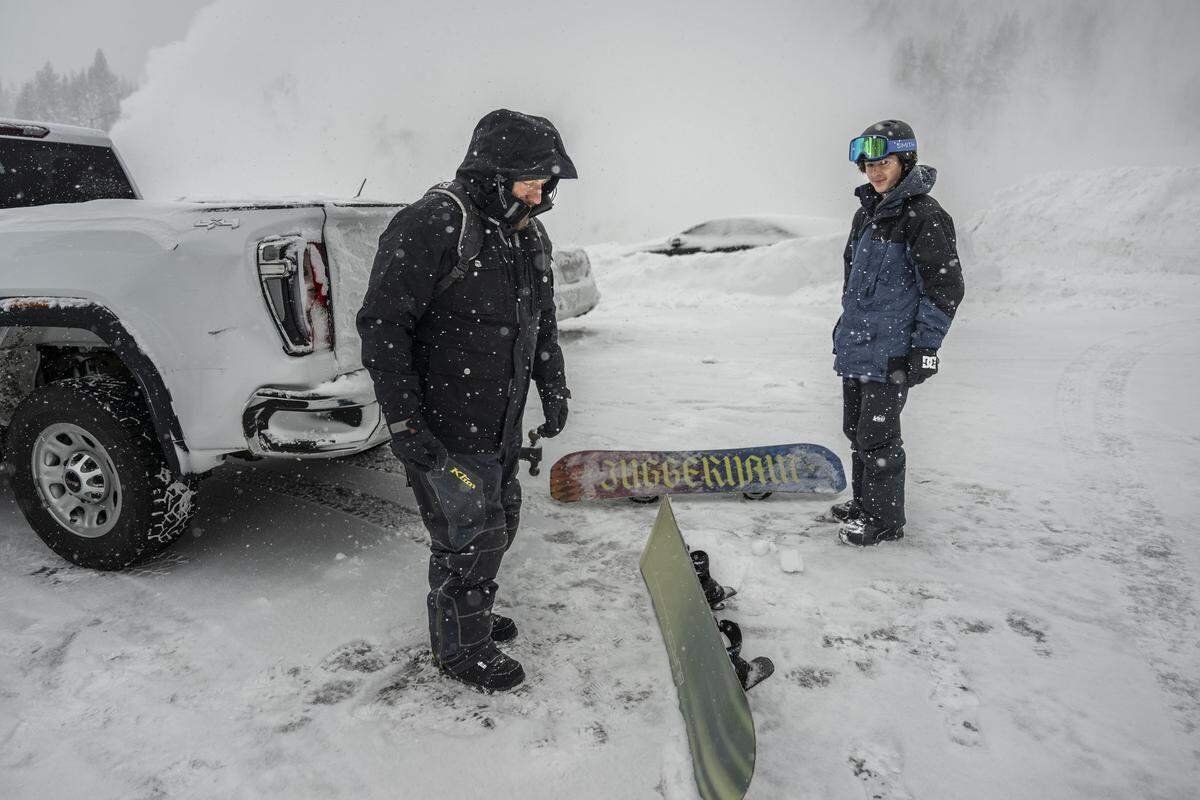
“All of us who grew up in this area are aware of avalanche danger, and you know when to check and when to be careful,” said Justin Kucera, who was gearing up for a day of riding with his son on Wednesday morning at Boreal Mountain, a ski resort across the mountain pass from the Castle Peak turnout and trailhead.
“I mean I get it, I’ve always been a risk-taker,” added Kucera, who had come from Chilcoot, further north in the Sierra. “I’ve gone out on days when it wasn’t good.” But, he said, mountain guides carried the added responsibility of keeping their clients safe.
In downtown Truckee, Mac Coppes was still wearing his snow pants and had a flush on his face from skiing at Sugar Bowl Resort before his shift at RMU Truckee, a combination ski shop and bar that is popular with the apres-ski crowd. He pulled a beacon — the location-transmitting device backcountry skiers wear so that they can be found if buried by an avalanche — out of his pocket, remembering to turn it off when approached by a reporter.
A three-year resident of the area, Coppes said the threat of avalanches is always there for backcountry skiers, but that it’s a fear that can fade in intensity over time. Tuesday’s tragedy had ripped through the consciousness of skiers nationwide — he noted friends on the East Coast had reached out to him about the news.
“It just makes it more real for everyone,” he said.
Some skiers did not want to discuss the event with reporters at all.
“It’s just really hitting home for all of us,” said one man who works in the industry but did not share their name and otherwise declined to comment.
The Bee’s Hector Amezcua contributed to this story.
This story was originally published February 18, 2026 at 8:03 PM.