State’s role in investigating Stanislaus ICE shooting isn’t clear, despite past rhetoric
Though California’s elected leaders have for months sought to create bulwarks against overreach by federal immigration agents, after the shooting of a man in Stanislaus County by ICE officers, it was unclear what role, if any, state officials will have in investigating the incident.
Video footage captured by a passing motorist’s dash camera showed ICE agents shooting Carlos Ivan Mendoza Hernandez early Tuesday, apparently through the window of his car, following a traffic stop on a freeway overpass in a rural corner of the Central Valley, near the town of Patterson.
The incident was the first time ICE agents have shot someone in California since the January deaths of Minneapolis residents Renee Good and Alex Pretti. Those two fatal shootings, of U.S. citizens by ICE agents, drove widespread public outrage and the eventual shutdown of the U.S. Department of Homeland Security over Democrats demands for agency reforms.
In California, elected leaders responded to Pretti and Good’s deaths by promising to bring transparency and accountability to ICE activities in the state.
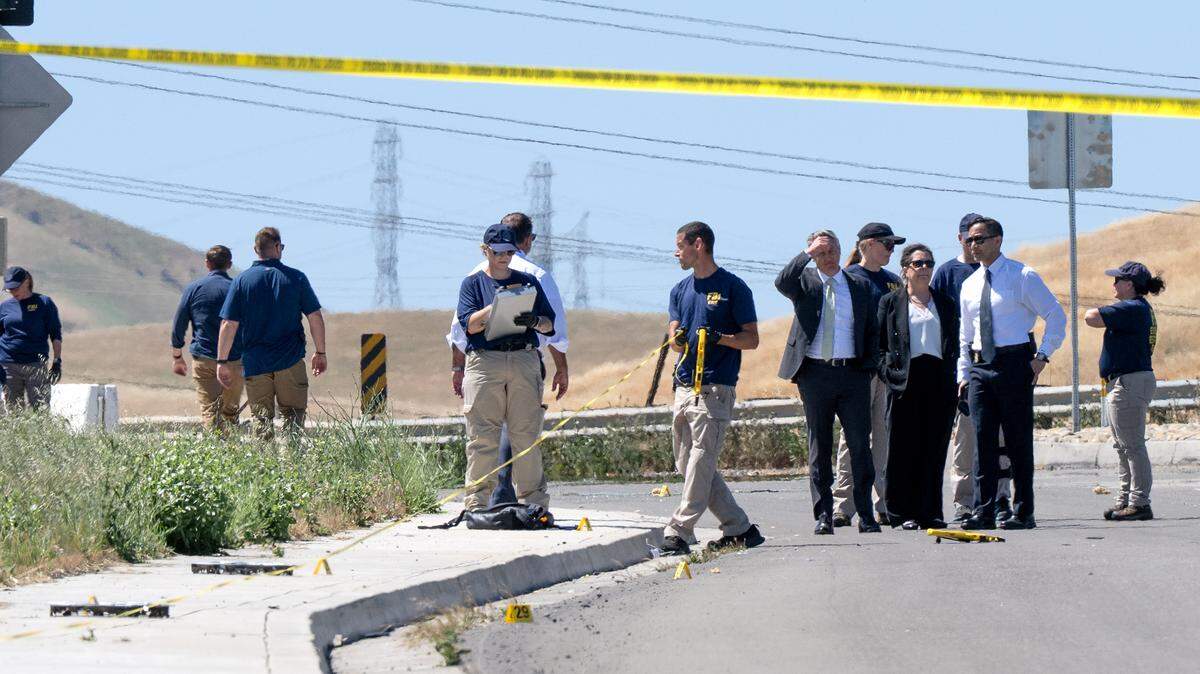
But at least in its immediate aftermath, investigations of Tuesday’s shooting appear to be firmly in the hands of the federal government, without any clear interventions by state officials.
After the Minnesota deaths, Gov. Gavin Newsom and Attorney General Rob Bonta vehemently condemned ICE. On Jan. 27, they published guidance to state and local law enforcement telling them they had “concurrent jurisdiction to investigate potential state law crimes committed by federal agents,” and that the California Department of Justice was prepared to support local and state law enforcement in asserting their rights to do so.
Newsom and Bonta warned local agency heads in the statement that events in Minneapolis and elsewhere made it clear that President Donald Trump’s “administration not only will not investigate such incidents but will attempt to thwart other agencies from doing so.”
But in Patterson Tuesday, Stanislaus County Sheriff Jeff Dirske indicated the federal government would take the lead on any investigation into the shooting of Hernandez.
“Because this incident involves a federal agency and does not involve any local law enforcement as involved parties, the FBI has assumed primary responsibility for the investigation,” Dirske told reporters. He went on to describe the federal agency as “stalwart partners throughout the last few years and especially today.”
It was unclear if Bonta would open an inquiry on his own. State agents did not appear to be present collecting evidence at the scene on Tuesday. A Stanislaus County sheriff’s office spokesperson on Wednesday said the agency had not heard from California DOJ officials about the shooting.
“Everything is being handled by the FBI,” Sgt. Veronica Esquivez said in a text message.
“To protect their integrity, we are unable to comment on, even to confirm or deny, potential or ongoing investigations,” a California DOJ spokesperson told The Bee. On Wednesday, in response to follow-up questions, the spokesperson sent a link to the January statement and provided no further information. The California Highway Patrol is also not conducting an investigation of the incident, a spokesperson for that agency said.
On Thursday, however, officials from the Attorney General’s Office and the sheriff’s office contacted The Bee to say there had, in fact, been communication between the two agencies. “DOJ has been in contact with both the Stanislaus County Sheriff’s Office and the FBI since the early hours after the incident,” the spokesperson said.
Echoes of Minneapolis shootings
Within a few hours of the Stanislaus County shooting, acting ICE Director Todd Lyons had described Hernandez as a member of a dangerous El Salvadoran street gang, and said that agents had shot at him after he “weaponized his vehicle in an attempt to run an officer over.”
Under the second Trump administration, Homeland Security officials have been quick to label victims of shootings by immigration enforcement officers as dangerous criminals and have on several occasions accused people of trying to run agents over with their vehicles. Administration officials labeled Good and Pretti domestic terrorists and said Good, who was also behind the wheel of her car when shot, was trying to run officers over.
In both cases, video evidence later refuted those claims.
In the latest California shooting, Patrick Kolsasinksi, an attorney representing Hernandez’s family, has challenged Lyon’s claim that his client was a dangerous gang member. Hernandez was a family man with an American fiancée and child who was on his way to his job in the Bay Area, the attorney said Wednesday morning, and the case was at best one of ICE getting “bad information and acting on it in a way that is in line with bad training, and that is just the pattern that happens again and again.”
In Kolsasinksi’s view, the video shows Hernandez trying to drive away from officers following an aggressive stop, but does not show him trying to run ICE agents down when they shoot him, the attorney said.
Federal officials have been quiet about the incident since Tuesday afternoon. Hernandez’s fiancee told reporters at a news conference Wednesday she had not even been able to find out how many times he had been shot, though she was told he was in stable condition.
Efforts at change moving slowly
After the Minneapolis shootings, California state lawmakers promised quick efforts to make sure that if ICE agents shot someone in California, the landscape would look very different than what has unfolded so far in Stanislaus County. Gathering around Assembly Speaker Robert Rivas and Senate President Monique Limon on Jan. 26, Democrats promised a swift response to keep federal agents operating in the state in check.
“We will do everything in our power to protect California residents from ICE’s out of control illegal violence,” Rivas said.
Among the flurry of bills championed that day were at least two that could have had an impact in the aftermath of Tuesday’s shooting. A proposal from Assemblymember Jesse Gabriel, D-Encino, would require the California Attorney General to open an investigation into any shooting by federal immigration officers within the state’s borders — removing any doubt about whether Bonta’s office would be investigating Tuesday’s incident.
On Tuesday, Gabriel said the Hernandez shooting underscored “the need for a thorough, transparent, and independent investigation of any shooting involving federal agents. Assembly Bill 1806 will ensure transparency and accountability.”
Another measure, from Sen. Scott Wiener, D-San Francisco, had already been moving through the Legislature and would make it easier for California residents harmed by ICE agents to sue for damages in state, rather than federal, courts. (Kolsasinksi on Wednesday said it was too early to discuss legal action in the Hernandez case.)
The state senate passed Weiner’s bill 30-10, above the threshold legislation needs to be fast-tracked into law immediately after the governor signs it, in late January. Wiener at the time called on legislative leadership to act quickly,
“We need the Legislature and the governor to pass this into law immediately,” he said at the time.
Since then, however, Wiener’s “No Kings Act” has been awaiting action in the Assembly. Gabriel’s bill is scheduled for an April 21 committee hearing.
The Legislature, designed to be a deliberative body, moves slowly by nature, and has through the end of August to send bills to Newsom for his signature or veto. But legislative leadership has in other cases demonstrated a willingness to react quickly to the Trump administration. Within a day in February, for example, the Legislature passed out a $90 million appropriation to counter the federal government’s block on Medicaid dollars going to Planned Parenthood clinics.
So far, that hasn’t been the tactic with measures to rein in ICE.
The Hernandez shooting came as the Legislature returned from its spring recess and engaged in a flurry of committee hearings to vet bills across all topics. On Tuesday, the Assembly Judiciary Committee advanced a different Gabriel bill, that would put restrictions on federal immigration agents using state property to stage operations. Legislative staff members say most of the ICE-related bills unveiled after the Good and Pretti shootings requires committee hearings before any sort of package that could be fast tracked through the chambers can emerge.
A spokesperson for Rivas declined to comment on plans for Wiener’s No Kings Act bill.
Wiener, however, on Wednesday again called for quicker action.
“ICE is a direct and present threat to the safety of Californians,” Wiener said in a statement. “The No Kings Act will end the impunity that’s powering their rampage across our state, and the Legislature should pass it as soon as possible to protect our communities.”
This story was updated after its initial publication online on Wednesday, April 8, 2026, to include information provided by the California Attorney General’s office on Thursday, April 9.
This story was originally published April 8, 2026 at 5:31 PM.