
John Seymour, California’s last Republican US senator, dies at 88
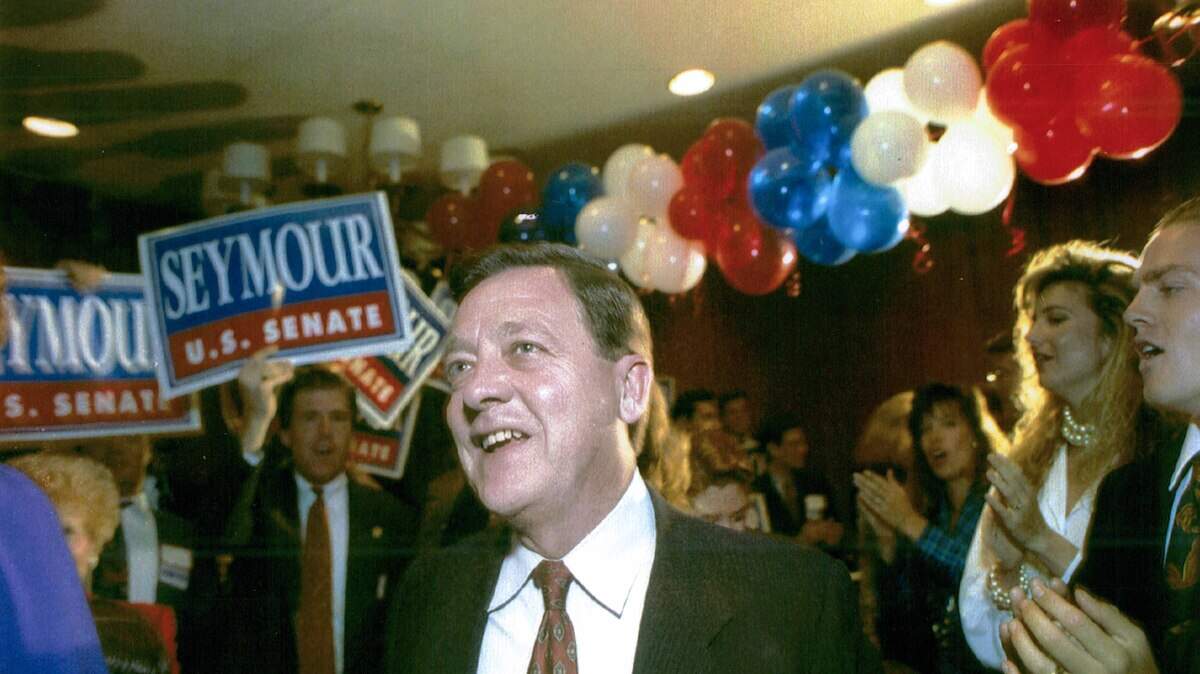
Pop quiz: Who was the last Republican to represent California in the U.S. Senate?
The answer is John Seymour, the longtime Orange County political force who was appointed to the Senate by then-incoming Gov. Pete Wilson in 1991 and left after losing an election for the full-time job, in 1992, to former San Francisco Mayor Dianne Feinstein.
But all that’s just political trivia. And Seymour, who died April 18, in Carlsbad – after a long stint living in the Riverside County desert – at the age of 88, was a lot more than that.
He spent much of the 1970s embroiled in the politics of Anaheim, first as a planning commissioner and later as a member of the city council and then as mayor. He spent much of the 1980s embroiled in the politics of Sacramento, representing north Orange County in the state senate.
Then, after his two-year stint in Washington, D.C., Seymour spent much of the 1990s and early 2000s in a decidedly non-political job in Rancho Cucamonga – carving out a second career running a fledgling nonprofit that still helps very low-income people get housing.
None of it was trivial.
If his professional life had a theme – and the record suggests it did – it was housing and real estate. Owning a home was, in Seymour’s view, the ticket from just scraping by, or even living on the streets, to financial stability. He spent much of his life, initially in business and, later, in politics and in decades of nonprofit management, trying to make sure anybody could get that ticket.
“After he lost the Senate, he took a break and was asked to serve as executive director of the California Housing Finance Agency. Then, a couple years after that, he became the first chief executive of the Southern California Housing Development Corp, and that was a nonprofit,” said Seymour’s oldest son, John Seymour Jr., 63.
“That’s when you could tell he was really back to high octane,” he added.
“He was in the office at 6 a.m. and didn’t leave until 6 p.m. He was creating real housing: sticks and bricks. It was for people who really needed it, people who couldn’t necessarily get it from somebody else.”
The nonprofit initially served lower-income people and veterans and first-time homebuyers in San Bernardino and Riverside counties before spreading to Orange and San Diego counties. Today, the nonprofit runs under a different name that reflects its new scope – National Community Renaissance.
“When he started with them, the focus was primarily on lower-income families, very low-income seniors and veterans. Then it slowly started to evolve into solutions for homelessness,” said Seymour Jr., who has worked for the nonprofit since the mid-1990s.
“And that’s what the focus is today, helping the homeless; along with the transformation of the communities; bettering them with infrastructure and sidewalks and parks. It’s the complete development of the neighborhood, along with wrap-around services for people who need them.”
Seymour, who was born in Chicago and raised in Pennsylvania, moved to Southern California after leaving the Marine Corps. He studied finance at UCLA and moved to Orange County in the 1960s to start a company that eventually operated as Seymour Realty and Investments, a do-it-all operation that bought, sold, fixed up, and re-sold all types of properties.
Initially, Seymour’s focus was on Anaheim at a time when tens of thousands of union jobs in the building trades and aerospace were paying enough to finance homeownership in Anaheim and other inland Orange County communities. Later, Seymour Realty helped develop higher-priced Anaheim Hills, and, eventually, his company had offices throughout the county.
His transition into politics was so familiar it’s almost cliché. He wanted something from the city, in 1970, and was urged to join the Planning Commission. Four years later, he was elected to City Council and, in 1978, he won the election for mayor, a job that meant stepping away from his real estate business.
During this period, Seymour also was president of the California Association of Realtors, leading roughly 120,000 licensed home sellers.
As mayor, he also helped woo the Los Angeles Rams away from the Coliseum to play in what was then known as Anaheim Stadium. Later, when he was out of politics and the team was contemplating another move, to St. Louis, Seymour was part of the unsuccessful effort to keep the Rams in Southern California.
At the time, Seymour even said it would be OK with him if the Rams moved back to Los Angeles if it meant keeping the team in Southern California. It was a huge concession given his role in connecting the team to Anaheim in the first place.
“The revenue that came with the Rams was important for the city and the small businesses. But he always said the real importance of the Rams deal, for the city, was the pride of having an NFL team in Anaheim,” Seymour Jr. said. “It was the prestige.”
But beyond politics and real estate and nonprofit work, Seymour Jr. said his father claimed to love a bigger job in his life – father of six.
Seymour and his first wife, Fran, had three children, including Seymour Jr. After that marriage ended, when Seymour Sr. was 34, he married Judy Seymour, who came to their marriage with a son, and the couple went on to have two more children, bringing the kid count to six.
“It was sort of the real-life version of ‘Brady Bunch’ but in real life,” Seymour Jr. said. “Our family was, and is, very close.”
When his father was a state senator, and spending work-week time in Sacramento, the family home was on a cul-de-sac in Anaheim. When Seymour Sr. was back in town, the street became a makeshift field for a full range of sporting events: football, baseball, soccer – they played anything.
And the elder Seymour, a slight man, did not sit on the sidelines.
“Not only did he play, he was the most competitive of all of us,” Seymour Jr. said.
“It almost got out of control,” he added, laughing. “He’s a poor loser. We had to put him in his place a few times.”
Later, when Seymour Jr. asked his father what role in life he liked most – being a Marine or running a business or in elected office – his father, apparently still working his political muscles, said “family.”
“We had this thing, at dinner, where he’d ask us the question of the day. It would be some question like, ‘What do you think of the prison system?’ or “Should marijuana be legalized?’ And we were all told to let everybody at the table answer the question completely. We weren’t allowed to interrupt.
“It taught us a lot about listening,” he said. “But it also taught us about making a coherent argument.”
Throughout his political life, Seymour was a Republican. And though it’s easy today to view past eras as less combative than the current version of American politics, Seymour’s political style wasn’t soft. During the 1992 campaign for Senate, for example, he bashed Democrat Feinstein’s ethics, noting that the Fair Political Practices Commission had sued her over violations related to campaign reporting and spending. He also suggested that votes she had cast during parole board hearings in the 1960s meant the former San Francisco mayor was “soft on crime.”
But after she beat him soundly in that year’s election, Seymour called Feinstein to say he’d do everything he could to help her as a representative of California.
“He was a big supporter of hers. They had differences, of course, but he was a big supporter of many of her policies. And they were alike in terms of style,” Seymour Jr. said. “They were both interested in finding a consensus.”
Seymour Jr. demurred when asked if his father would be a Republican today. Seymour’s focus on helping lower-income people doesn’t align with the GOP’s spending priorities, particularly in the wake of last year’s “big, beautiful” bill that calls for pulling more than $1 trillion out of social safety net programs related to food, health care and housing.
But Seymour Jr. said if his father did run for office, as a Republican or otherwise, he would win.
“If he could get in front of people, he’d convince them.”
Seymour died at home in Carlsbad, surrounded by family. He leaves his wife, Judy, and children Seymour Jr., Lisa, Shad (deceased), Jeffrey, Sarena and Barrett, as well as nine grandchildren and eight great-grandchildren.
The family asks that anybody hoping to honor Seymour consider a donation to the Hope Through Housing Foundation, a Rancho Cucamonga-based nonprofit that provides social services for lower-income people.