Student aid agency needs $500k for cybersecurity. Newsom’s budget leaves it out
A backup server. Annual IT maintenance. And an IT staffer.
Among other requests, the California Student Aid Commission — the agency that administers financial aid programs for college and university students — asked California’s final budget for $503,000 for its information technology needs. Secure and modern systems, it said, were necessary to ensure smooth-sailing access to resources for the 2.2 million students who apply for aid annually.
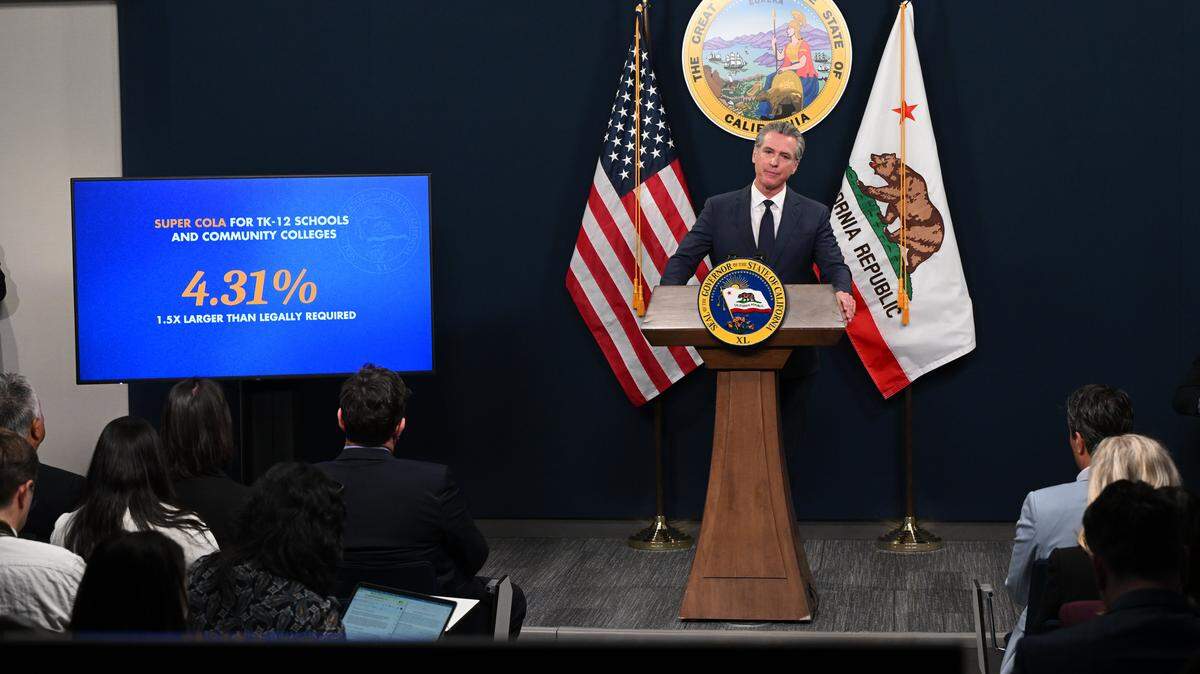
This expenditure, however, did not make it into Gov. Gavin Newsom’s revised 2026-27 budget released Thursday. It was not in his January budget proposal either, and will now likely be the subject of discussion between agency representatives and legislators before the final budget is passed in June.
“At a time of escalating cyberattacks targeting educational institutions nationwide, CSAC’s mission-critical request for a backup server and essential IT staffing was not included in the May Revise — despite recommendations from the California Department of Technology to the administration that CSAC needs redundant server infrastructure to meet modern data protection and continuity standards for administering state and federal financial aid,” Nicole Kangas, the commission’s spokesperson, said.
This comes at the heels of a massive cyberattack against learning management system Canvas last week. Used by thousands of educational institutions including the University of California, California State University and California Community Colleges systems, the Canvas data breach and outage meant millions of students lost access to course materials, assignments and grades only weeks before finals season.
If a similar attack were to compromise the student aid commission’s “sole server,” Kangas said, it could result in Californian students losing access to financial aid systems for weeks. The stakes, she said, were especially high for undocumented students with sensitive personal information stored in the server.
The Department of Finance said it rejected the request for funds finding that the agency’s needs could be met through its existing unspent funds and a grant from the California Department of Technology.
“Our department denied the commission’s IT request after our analysis of their proposal confirmed that they have sufficient fiscal resources to support their needs in 2026-27 without impacting grantees or institutions in the coming year,” spokesperson H.D. Palmer said.
Since $316,000 of the $503,000 requested was for the 2027-28 year, Palmer said it would be considered in a future budget.
For the student aid commission, the IT funds were not the only source of disappointment. In an official statement, Executive Director Daisy Gonzales said she appreciated the governor’s “continued dedication to higher education” but was worried the state’s commitment to expand access to higher education was not matched with the requisite funding.
“At a time when education is being systematically defunded at the federal level, we urge the state administration and legislature to consider pathways that maximize drawing down federal aid and prioritize investments to mitigate challenges for students, skill our future workforce, and preserve California’s position as the fourth-largest economy in the world,” she said.
She urged legislators to consider in the upcoming weeks funding beyond Newsom’s proposal for the Middle Class Scholarship, which provides low- to middle-income undergraduate students with scholarships to attend public institutions in California, and the Golden State Teacher Grant Program which acts as a pipeline for the school system.
California’s three major higher education systems were largely supportive of Newsom’s proposed budget. But they also said they would continue to lobby for outstanding needs ahead of the June 15 budget deadline.
Newsom’s proposed budget includes $50 billion for higher education. This includes $31.2 billion from the General Fund and local property tax and $18.8 billion from other funds — which is slightly lower than the total funding proposed in January.
The governor’s May Revision requires all community colleges and TK-12 schools to provide all employees with 14 weeks of paid pregnancy disability leave beginning in 2026-27. Costs will be absorbed within a discretionary cost-of-living adjustment provided in the budget proposal.
California Community Colleges Chancellor Sonya Christian acknowledged the revised budget’s continued support for the system’s priorities. Christian specifically highlighted the Adult Learner Demonstration Project which helps low-income workers move into stable and higher-paying jobs and the Common Cloud Data Platform, which would create shared data infrastructure to improve timely reporting, analytics and student support across the system.
She said Newsom’s budget “reflects strong confidence” in the system.
“California Community Colleges have never been more agile in providing students and communities with education and training that lead to real opportunity,” Christian said in a statement. “Our colleges are building workforce-focused pathways, preparing students with practical skills and with the agency to adapt, think critically, navigate complexity, and shape their own futures with purpose and resilience.”
In a separate statement, the Faculty Association of California Community Colleges highlighted the inclusion of paid family leave for employees as a big win.
“FACCC has long co-sponsored legislation to secure paid maternity and family leave for K–12 and community college educators, and we will continue advocating to ensure this is included in the June budget,” President Sarah Thompson wrote in a statement.
Still, the association voiced its continued frustration with “unpredictability and inequities” of the Student Centered Funding Formula which determines how individual colleges receive state funding, pushing for a larger overhaul of the system.
For the California State University and University of California, revised budget provides no major change from the January proposal.
In a statement, CSU Chancellor Mildred García said the system was encouraged by the “strong bipartisan support” it continues to receive and was hopeful the Legislature would consider using one-time funds to supports its “significant facilities needs.”
Similarly, UC President James Milliken said he was looking forward to working with the legislature towards a budget that “fully funds UC” in the face of federal funding uncertainty and rising operational costs. He did not detail the specifics of the UC system’s outstanding needs.
This story was originally published May 15, 2026 at 5:00 AM.