California sues Trump over new student loan limits for some healthcare workers
Come July 1, students seeking advanced degrees in nursing, physician assistant studies and physical therapy among other professions will not be able to borrow more than $20,500 per year or $100,000 total in federal student loans.
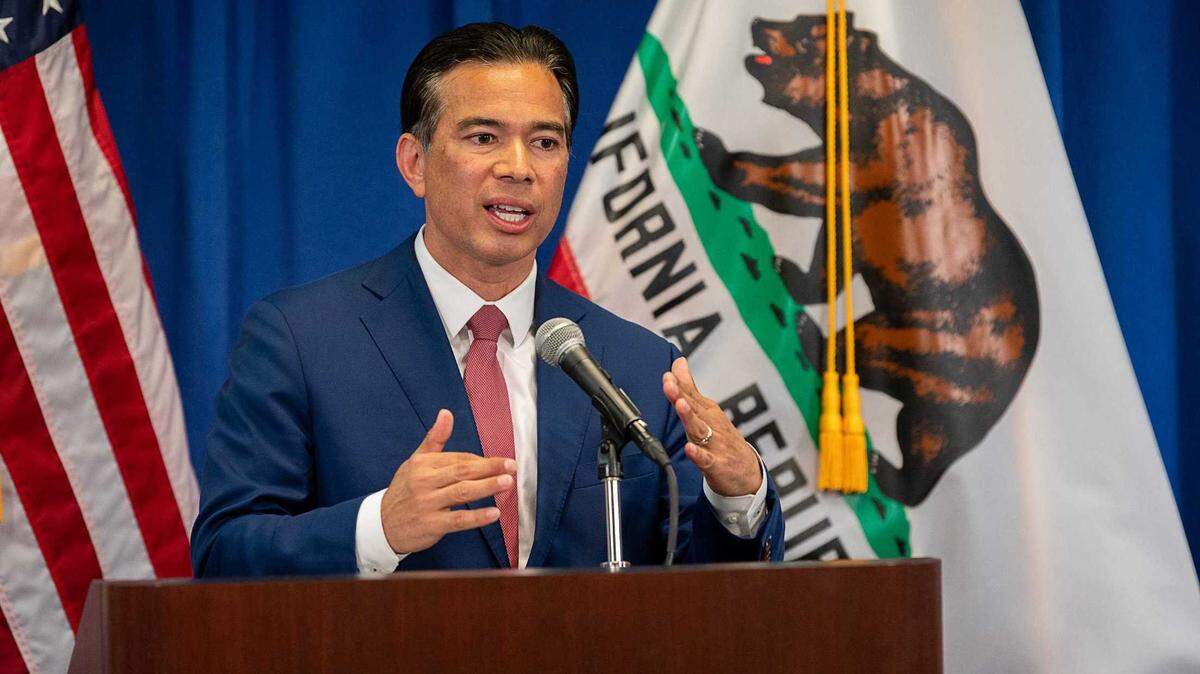
California Attorney General Rob Bonta joined 23 attorneys general and the governors of Kentucky and Pennsylvania in filing a lawsuit against the U.S. Department of Education Tuesday to block the loan limits from taking effect.
“Across the nation, healthcare systems are underwater, with doctors, nurses, and other health professionals stretched to meet the needs of their communities. Nurses, physician assistants and other health professionals are absolutely vital to keep our healthcare system running,” Bonta said in a statement. “Now, the Trump administration is threatening to make this crisis even worse by limiting students’ access to the federal student loans that make it possible to pursue the professional degrees needed for critical specialized work.”
As part of Trump’s One Big Beautiful Bill Act last summer, Congress established annual and aggregate borrowing limits on federal student loans for graduate programs. Before this, students could borrow up to the full cost of their program. The law also created different limits for “graduate students” and “professional students.”
For graduate students, those caps were set at $20,500 annually or $100,000 in total. Professional students, meanwhile, will be able to borrow a maximum of $50,000 annually or $200,000 in total.
On May 1, the U.S. Department of Education released a “final rule” that defined a professional degree as one that signifies completion of the academic requirements to begin practice in a given profession and a level of skill beyond what’s normally needed for a bachelor’s degree. These professions, it added, generally require licensure.
The final rule limited “professional” status to the 10 degrees listed in a federal regulation as examples: medicine, osteopathic medicine, dentistry, pharmacy, chiropractic, optometry, podiatry, veterinary medicine, theology and law. It later added clinical psychology to the list as a result of negotiations.
Groups like the American Nurses Association California and the American Physical Therapy Association had urged the federal government to include degrees like nursing and physical therapy in the “professional” bucket.
The lawsuit challenged what it called a narrowing of the definition of a professional degree. It also opposed the U.S. Department of Education’s “arbitrary and capricious” exclusion of transfer and re-enrolling students from a provision that would protect currently enrolled students from the new loan limits.
If the new loan limits go through, the Attorney General’s Office said in a statement, it will discourage potential healthcare workers from entering the field at a time when the system needs more dedicated professionals.
Nurses, physician assistants and other graduate health professionals fill healthcare gaps by seeing patients, prescribing medication and manning helplines — often in underserved and rural communities, Bonta said in a statement.
In a May 6 press release, the U.S. Department of Education said the new loan limits will help prevent accumulation of debt and put pressure on higher education institutions to reduce inflated tuition costs across the board.
“Are these universities all going to lower their cost of attendance to a $100,000 or $200,000 in aggregate? I doubt it. It seems like wishful thinking,” Bonta said at a press conference Tuesday. “Those who lose out are the graduate students and professional students who not only have a dream that should be supported, but we need them in the workforce.”
According to the California Board of Registered Nursing, the cost of a master’s degree program in nursing ranges from about $40,000 at San Francisco State University to $251,510 at Malibu’s private Pepperdine University. Meanwhile, the cost of a physical therapy doctorate program for an in-state student varies from $79,068 at Fresno State to $228,452 at the University of Southern California, according to an American Physical Therapy Association database.
Now, the coalition of states behind the lawsuit are hoping to prevent the student loan caps from being imposed July 1.
This lawsuit marks California’s 68th against the second Trump administration. Bonta was joined by the attorneys general of Colorado, Maryland, Nevada, New York, Arizona, Connecticut, Delaware, the District of Columbia, Hawai‘i, Illinois, Maine, Massachusetts, Michigan, Minnesota, New Jersey, New Mexico, North Carolina, Oregon, Rhode Island, Vermont, Virginia, Washington and Wisconsin, as well as the governors of Kentucky and Pennsylvania.
This story was originally published May 20, 2026 at 4:30 AM.