No robot or AI instructors: Bill would mandate CSU courses be taught by humans
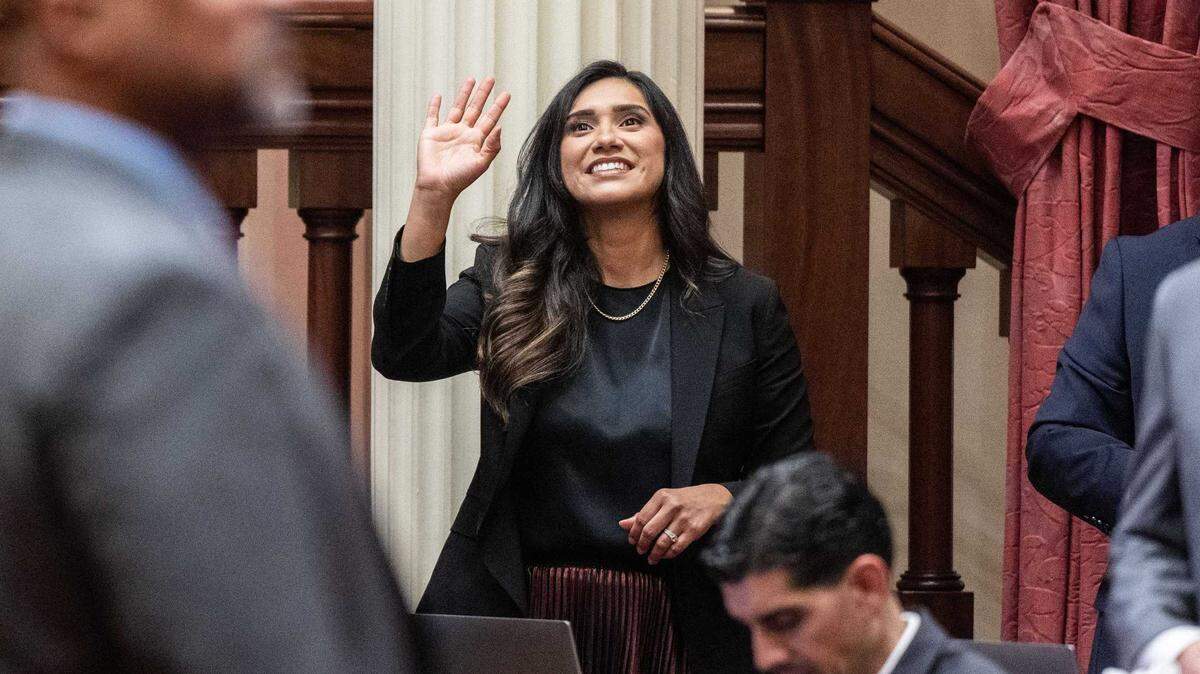
A new bill seeks to restrict who can and cannot teach a course at the California State University’s 22 campuses. The criterion, though, is pretty simple: to be a professor, you must be human.
Senate Bill 928, authored by state Sen. Sabrina Cervantes, D-Riverside, and sponsored by the California Faculty Association, would mandate that the instructor of record for every CSU course be a person who is qualified to serve as a faculty employee. As artificial intelligence makes its way into university classrooms, the operative word in the bill is “person,” not “qualified.” The goal? To prevent faculty employees from being replaced by AI tutors. The bill clarifies that it will not prohibit employees from using AI tools to assist in their work.
“Faculty are irreplaceable,” Cervantes said. “AI should support educators, not replace them. SB 928 protects the human connection that helps CSU students succeed. (The bill) proactively ensures that CSU students will have access to teachers who are expert scholars in their fields.“
After its unanimous passage by the California Senate in April, the bill must now pass with a majority vote in the Assembly before it can be sent to Gov. Gavin Newsom’s desk for final approval. It is modeled after legislation authored by Cervantes in 2024 and 2025 to create similar protections for faculty in the California Community Colleges system.
“This (bill) is entirely prophylactic,” said Kevin Wehr, bargaining chair of the California Faculty Association which represents 29,000 professors, lecturers, librarians, counselors and coaches in the CSU system. “We are really wary about closing the barn door after the horse has already gotten out. We’re trying to be very proactive in all realms regarding AI in higher education.”
The push for the bill comes amid the CSU system’s attempt to position itself as a global leader for the “impactful, responsible and equitable adoption of artificial intelligence” in higher education. Last year, the system announced a “first-of-its-kind public-private initiative” with leading tech companies including Google, Intel, NVIDIA and OpenAI to create an “AI-empowered higher education system.”
In 2025, it entered into a $17 million agreement with OpenAI to provide access to ChatGPT Edu to its 470,000 students and 63,000 faculty and staff for 18 months. Last month, the CSU renewed the controversial contract for three years at an annual price of $13 million. The system also entered into an agreement with OpenAI to pilot the company’s certification courses on AI skills at its campuses.
According to union leaders, the CSU has already attempted to outsource some faculty work to AI agents.
Patrick Oberle, a Sacramento State professor and CFA leader, said the National Institute on Artificial Intelligence in Society launched at his campus in 2023 produced template language on AI use that it recommended faculty add into their course syllabi. This included a “statement to the effect that it was acceptable to use AI in the place of mental health counseling,” he said. Faculty leaders at Sacramento State, he said, opposed it because they felt it was inappropriate for NIAIS to offer guidance outside its area of expertise. The union, which includes counselors, also wanted to protect its members’ work. Those recommendations from the institute were not endorsed by Sacramento State.
Before the NIAIS was shut down in April 2025 due to budget constraints, it also offered a ”College and Career with AI” course to teach high schoolers and university students to use artificial intelligence as an “information aggregator, coach and counselor” in the classroom and job market.
“Folks were understandably concerned that if they were coming for counselor work, they might come for librarian work, coach work or classroom work,” Wehr said. “I have great concerns that as the largest public university system in the country, we can be seen as a target for experimentation. I’m very worried about experimenting with AI on the student population because I fear that AI could end up delivering a subpar educational experience and our students deserve more than that.”
While the bill has cruised through all the votes it has been put through so far, Assemblymember Carl DeMaio, R-Valley Center, said at a committee hearing June 9 that he supported the bill, but “with caution.” His concern, he said, was that the protections provided by the bill for faculty should not extend to cover clerical and administrative support positions.
“AI does offer efficiency in some positions,” DeMaio said. “But we also have credentialed positions like faculty that we expect to be done by credentialed faculty members. So my hope is that as this is implemented, we don’t see an expansion in this definition to positions that I don’t think the author would intend to be covered under the bill.”
The California State University Employees Union, which represents staff and student assistants at CSU campuses, is not a sponsor of the bill, but said in a statement that it is in strong support of it.
“CSUEU members support SB 928 because students deserve investment in the people who teach, support, mentor and serve them,” said union leader Jessica Dalton. “AI can be a useful tool, but it cannot replace the expertise, judgment, mentorship and real-time problem-solving that define a quality educational experience. Staff and student assistants work with faculty every day to support instruction, maintain learning environments, and resolve a myriad of daily challenges to help students succeed.”
A union spokesperson did not answer whether CSUEU plans to push for similar protections for its member employees.
In addition to CFA, SB 928 is supported by the California Alliance for Retired Americans and the California Federation of Labor Unions. There is no known opposition on file.