No deal: California billionaire tax heads to expensive November ballot brawl
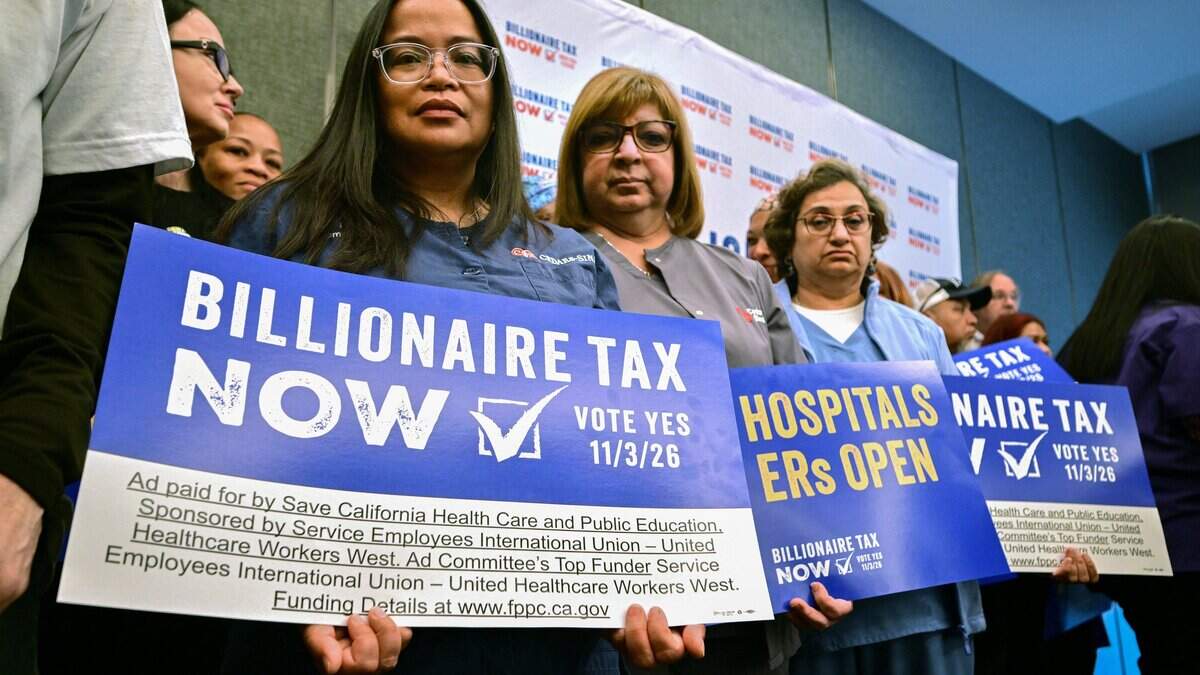
A proposed 5% tax on billionaires will appear on Californians’ ballots this November after negotiations to sideline the measure failed.
That outcome is likely to drive hundreds of millions of dollars in spending from billionaires, business groups and some unions who are aligned against it, as well as the major healthcare union backing it.
The proposed wealth tax would levy a 5% tax on billionaires’ assets if they were California residents as of Jan. 1, 2026.
Backers say it will raise $100 billion to backfill healthcare cuts caused by the Republican megabill signed by President Donald Trump last year. Without the tax, they warn clinics and hospitals will close and patients will die. The measure is sponsored by SEIU-United Healthcare Workers West, which represents 120,000 healthcare workers, and has drawn support from U.S. Sen. Bernie Sanders, D-Vt., and U.S. Rep. Ro Khanna, D-Fremont.
On a call with reporters Thursday, SEIU-UHW President Dave Regan said discussions with Gov. Gavin Newsom, who is opposed to the tax, broke down because he would not entertain any idea that taxes billionaires.
Regan said he expected the movement to draw 50,000 volunteers, and his chief of staff, Suzanne Jimenez, said the measure’s backers would actively fundraise for a fight that will likely cost hundreds of millions of dollars.
Critics warn the measure could spook some of California’s highest earners into moving out of fear of future taxes, jeopardizing the state’s long-term fiscal health. California’s finances are unusually dependent on high earners, especially stock market gains that drive their taxable income.
Critics have included some union and progressive groups, including the California Teacher’s Association and Planned Parenthood Affiliates of California, who said they’re concerned about the impacts of the tax on state revenues. Some of those groups formed a coalition that is already running digital ads slamming the proposal as a “reckless wealth tax experiment.”
Critics also include traditional business interests, including the California Business Roundtable whose president, Rob Lapsley, argued the tax would ultimately affect non-billionaires.
“Strip away the spin and this measure forces every California taxpayer, not just billionaires, to file a sworn declaration of their net worth with the Franchise Tax Board under penalty of perjury,” said Lapsley in a statement.
In an open letter to Newsom last week, the Billionaire Tax Now Coalition offered to lower the proposed tax to 2% “in the spirit of unity.”
But Newsom disagreed, and the opposing sides of the measure failed to reach a compromise ahead of the Thursday deadline to withdrawal a measure.
Speaking to reporters, SEIU-UHW Vice President Debru Carthan said Newsom had “no plan” to prevent steep healthcare cuts and argued that he was “in lockstep with Donald Trump and billionaires like Peter Thiel and Sergey Brin on this issue.”
On the same call, U.S. Representative Khanna called arguments that billionaires would flee “hogwash,” citing the AI boom in Silicon Valley and San Francisco.
“People who are opposing this are just totally out of touch where folks are in our state and in this country,” Khanna said.
The lack of a deal sets up a multipronged fight involving several measures.
One would require extensive audits for any new spending created by a statewide ballot measure, and another would bar retroactive taxes or new taxes on personal property, including retirement accounts. While the group backing them insists the proposals are independent from the billionaire tax, both are heavily funded by Google co-founder Sergey Brin, and would effectively neutralize the billionaire tax were it to pass in November.
It’s likely to be a closely contested fight. A Public Policy Institute of California poll last month showed 54% of likely voters support the proposed tax and 45% are opposed.
Speaking at a panel at American Association of Political Consultants’ California in Sacramento on Tuesday, longtime ballot strategist Brandon Castillo said he wouldn’t be surprised to see $400 million spent “on one side” of the billionaire tax fight.
Castillo likened running a “yes” ballot campaign to being a Major League Baseball pitcher aiming to avoid the one errant pitch that results in a home run.
“You have to have a near perfect measure with your yes campaign that can withstand the rigors of a funded opposition campaign,” he said.
Another panelist, Democratic strategist Erica Kwiatkowski Nielsen, said ballot opponents have a simpler job.
“You have to just make sure people are either confused enough or don’t care enough to say, maybe, ‘I shouldn’t be voting on that,’ so they just either vote no or stay away,” Nielsen said.
This story was originally published June 25, 2026 at 5:11 PM.