Lawsuit, fraud allegations fail to stop UC Davis from axing varsity equestrian
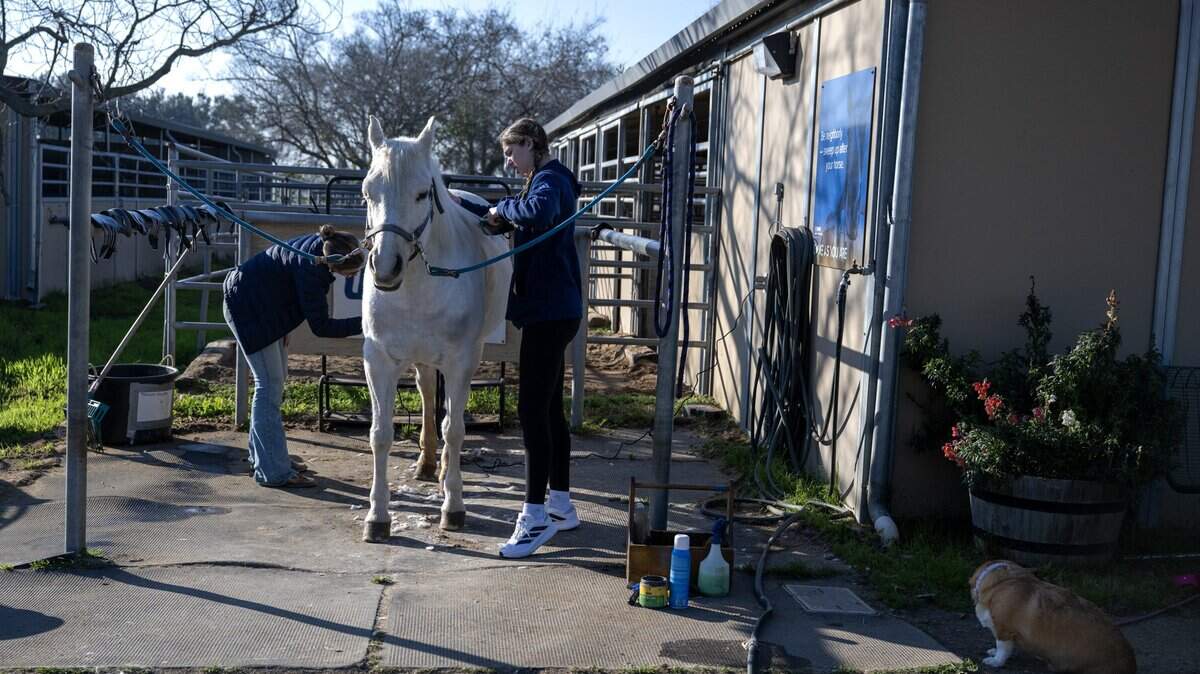
It’s official. After eight years and three conference championships, the University of California, Davis women’s equestrian program will transition back from varsity status to a club sport Wednesday, disrupting team members’ athletic careers and breaking the hearts of their supporters.
In the nearly six months since the downgrade was first announced, the team’s supporters — a coalition of team members, alumni and parents that calls itself Keep Davis Riding — collected 41,000 signatures, raised $32,000, and filed a lawsuit against UC Davis athletics leaders alleging fraud and intentional infliction of emotional distress. Calling for reinstatement of the team, the group said the school’s decision was based on false information and amounted to gender discrimination under Title IX. Still, the university’s stance remained unchanged.
UC Davis has maintained the decision was largely financial. In a February statement, the school said it conducted a comprehensive analysis that concluded that varsity equestrian was one of the “most resource-intensive sports to sponsor” due to the specialized care, housing, veterinary services and training required for the horses.
In addition, the school said it hired an external firm to review the intercollegiate athletic landscape and found that with just 14 schools competing at the highest level in equestrian, and just two in California, the “long-term competitive sustainability” of the sport was low.
Members of the team and their families, however, did not trust the independence of that review or the financial data the school used to conclude the equestrian program was too expensive. They have alleged that the school was still actively recruiting players and soliciting donations for the equestrian team even as it contemplated ending the varsity program. They have also accused UC Davis of committing Title IX violations by depriving female student-athletes across the board of equal athletic financial aid, treatment and benefits.
“Normally, when teams get cut, people get sad obviously,” said Sigrid Elschot, a professor at Stanford University whose daughter was a sophomore on the UC Davis equestrian team during the 2025-2026 school year. “But what’s transpired at Davis, I cannot emphasize this strongly enough, is so outside the scope of anything any of us have ever seen that it defies explanation. There aren’t strong enough words to describe what’s transpired: egregious, criminal, all of it.”
While the university maintains that the decision to axe the varsity equestrian program was made “appropriately,” its Audit and Management Advisory Services wing initiated a review in April to evaluate if program finances were accurately represented to decision-makers and whether budgeting, planning and fundraising activities complied with relevant policies and laws. This audit, according to a campus spokesperson, is “close to finalization.”
A sudden announcement
A few weeks before they kicked off spring season, the equestrian team of about 35 student athletes was informed at a meeting Jan. 9 that their varsity days would soon be over. According to a team member, when they received the text that day asking them to convene at 3 p.m., they had no idea what it would be about.
“We thought that we were in trouble for something,” said the athlete, who asked to remain anonymous for fear of retaliation. “Getting cut was just not even on our minds and our coaches weren’t thinking that either. No one had any idea. The second he (athletics director Rocko DeLuca) said it, everybody in the room started sobbing. It was pretty terrible.”
DeLuca, she added, told the team not to fight the decision because there was nothing they could do to change it.
That same day, UC Davis Athletics issued a press release announcing its “strategic adjustment” which included transitioning STUNT, a competitive form of cheerleading, from club sport to varsity status beginning in July. STUNT, it said, was one of the fastest-growing women’s sports in California and nationally and the move a reflection of UC Davis’ commitment to “expanding competitive opportunities for women and strengthening gender equity across athletics.”
The statement said the equestrian athletes would retain their athletics-related financial aid through the completion of their undergraduate degrees at UC Davis and that coaching contracts would be honored until the end of their current terms. It added that the team members would be able to continue competing at the club sport level and the athletics department would provide support during the transition.
But club sports differ greatly from varsity athletics in terms of funding and visibility. While varsity teams are part of the official National Collegiate Athletic Association program, and as such are highly selective and university-funded, club teams are student-run, relying on fundraising and fees and offer far less exposure.
In a February statement, UC Davis said that equestrian athletes who wished to continue competing at the varsity level at another institution would be supported in exploring transfer opportunities. However, most other teams’ fall rosters were already filled by then, Elschot said, making these promises seem hollow and unrealistic. And a majority of application deadlines would have also passed by then.
The timing of the sudden announcement has become the focus of a lawsuit against DeLuca and UC Davis senior associate athletics director Heather Hunter. The lawsuit, filed by a first-year member of the team under a pseudonym in the Yolo County Superior Court in March, alleges that DeLuca made the decision to cut varsity equestrian as early as Feb. 2025 when he submitted the athletics department’s upcoming budget.
However, the department gave team members no indication that this elimination was being considered, the lawsuit says, and continued recruiting more students for fall 2026 and soliciting donations for the program as late as December. A fundraising gala to support the team was hosted at the Sutter Club on Dec. 6, per UC Davis Equestrian’s official Instagram page, about a month before the varsity program was axed.
“The main claim involves fraudulent recruitment,” attorney William Janicki said. “The plaintiff transferred from another university. In the summer of 2025, she was being recruited by the (UC Davis) equestrian team to compete for them. She decided to enroll in August. We’ve discovered through various documents that the athletics department decided to terminate the team around March-April of 2025. Essentially, they were recruiting the plaintiff to come to a team that was already eliminated.”
According to UC Davis spokesperson James Nash, the athletics department began considering elimination of varsity equestrian as well as other budget reduction options during spring 2025.
“Like all other campus departments and units, athletics presented proposals for budget reductions last June,” Nash said. “The final decision to designate equestrian as a club sport was not made until shortly before it was announced to the public in January.”
In a February statement, UC Davis said the announcement felt sudden to some community members because “decisions of this nature involve confidential planning and analysis prior to public announcement.”
To make up for loss of career opportunity and emotional distress, the student’s lawsuit seeks compensatory damages and a reversal of the school’s decision through the duration of the plaintiff’s enrollment at UC Davis. The defendants have filed a motion to dismiss the complaint which is set to be heard next month.
A similar complaint filed by the same attorney in February was dismissed by the federal court in Sacramento over lack of jurisdiction. That lawsuit had two current and two incoming team members as plaintiffs and named the Regents of the University of California, UC Davis Chancellor Gary May and several others as defendants.
Questioning the data
While some are challenging the school in court, the Keep Davis Riding coalition launched an online petition and fundraiser to reinstate the varsity team and “keep the Aggies in the saddle.” The GoFundMe, which is funding the supporters’ “awareness campaigns,” was started by parent Dawn Gonzalez and has collected more than $32,000 so far.
The petition, which has garnered more than 41,000 signatures online, asks for public support in demanding that UC Davis reconsider the team’s elimination on the premise that the school’s decision was based not on necessity but on “manipulated financial data.” These claims are based on the parents’ analysis of public records they requested and Atlanta-based firm Collegiate Consulting’s study that was used to justify the school’s decision.
The parents said they found that $700,000 in in-kind donations of horses for the team were misrepresented to inflate costs of the equestrian program in the data provided to the consultant.
Under the NCAA’s regulations, in-kind donations are to be reported as both expenses and revenue so that the net impact on the bottom line is zero while accounting for the contribution. The parents allege that UC Davis included what was meant only to be an expense offset for the in-kind donations of horses in calculating the total cost of the equestrian program. This, they said, made the cost of the program seem a lot higher than what it actually was.
“(The) analysis wrongly assumes that UC Davis relied on NCAA-reported data as the basis for internal discussions about the cost of the equestrian program,” school spokesperson James Nash said in response. “UC Davis Athletics prepared separate financial analysis for presentation to the university budget office.”
Keep Davis Riding also said that, in estimating revenue that the program brought in, the study failed to account for the high proportion of out-of-state equestrian athletes who bring in greater tuition revenue. The study does not account specifically for out-of-state tuition netted by any of the sports it analyzed.
And the group alleged — based on internal emails they accessed — that UC Davis had already made up its mind when it hired Collegiate Consulting to do the study. In one August email, they said, a financial analyst on the school’s staff approved the elimination of equestrian contingent on external review “to confirm this approach.”
Title IX concerns
In analyzing the series of events that led to cutting varsity equestrian, the athletes’ parents say they discovered a worrying trend that extends beyond just their sport: UC Davis Athletics, they said, was violating Title IX which prevents sex-based discrimination in any education program that receives federal financial assistance.
They said financial aid for female athletes was not proportional to their participation, facilities and travel conditions were better for men’s teams than women’s and the school highlighted male athletes’ achievements on social media more often than it did for female athletes. UC Davis has maintained, however, that it is fully compliant with Title IX requirements.
Arthur Bryant, who describes himself on his website as “the nation’s top Title IX athletics lawyer,” took on the parents’ case. In March, he sent a letter to UC Davis Chancellor Gary May in which he said that UC Davis was depriving its female intercollegiate student athletes of equal athletic financial aid and equal treatment and benefits. The school did not respond to a request for comment on this.
In his letter, Bryant cited the Collegiate Consulting report, which states in a Title IX section that women make up 59% of the school’s student athletes but receive only 56% of student athlete financial aid. This discrepancy, per the report’s projection, will worsen in the 2026-27 school year when STUNT replaces equestrian as a varsity sport. Bryant says that data submitted by UC Davis to the U.S. Department of Education confirms this inequity.
Similarly, he said the Collegiate Consulting report shows that the school spends less than 50% of its athletic operating budget on women’s sports. While Title IX does not require exactly equal expenditures, he said an expenditure gap of this magnitude cannot be reasonably attributed to such differences.
Finally, the school spends less than 25% of its recruiting dollars on women athletes per federal data, Bryant said.
Bryant said he is hoping to reach an agreement with the school to resolve these issues. If not, he is ready to file a class action lawsuit to seek damages for affected women athletes. Earlier this year, fifteen former women student athletes represented by Bryant reached a $300,000 settlement with San Diego State over unequal athletic financial aid.
“UC Davis is an extraordinary educational institution,” Bryant wrote in his March letter. “It could—and should—be a model for Title IX compliance and gender equity in sports nationwide. It should not be a defendant in a class action lawsuit for discriminating against its female student-athletes.”
As these legal complaints shake out, and UC Davis audits its own processes, former members of UC Davis’ championship-winning equestrian team are figuring out how to move forward. Some are taking their horses home with them, some will continue riding as a hobby and others may give up the sport altogether.
“My daughter spent her childhood cleaning stalls for the chance to ride,” Elschot said. “She got the chance to get recruited. She turned down an offer at Dartmouth — she was an academic and loved to study too. But she turned down other offers to come here. And now all those offers are gone.”