Tony Thurmond criticizes ‘undemocratic’ plan to overhaul superintendent’s role
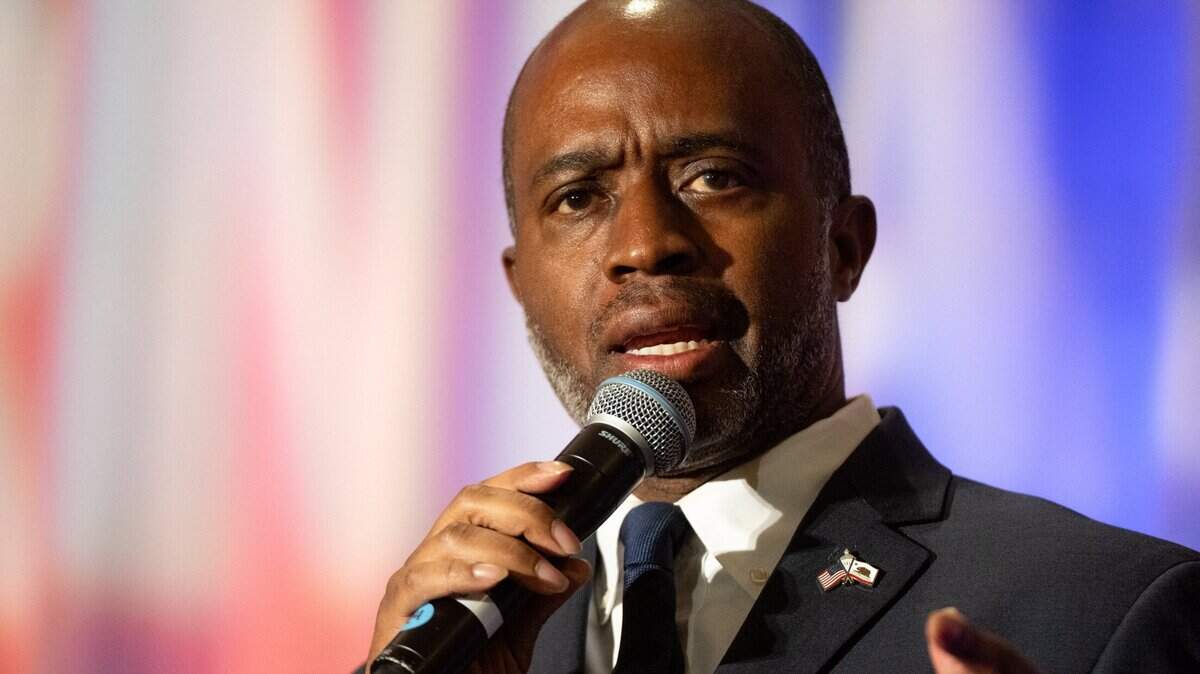
Superintendent of Public Instruction Tony Thurmond said he first learned last year via text message that Gov. Gavin Newsom intended to overhaul his office. Newsom teased last January a plan to shift control of the state Department of Education to the executive branch by appointing an education commissioner, who would report to the governor and oversee the state public school system, which serves 6 million students.
In an interview, Thurmond said he exchanged “a few messages” with Newsom’s staff but heard few details until the Legislature narrowly passed a related bill as part of its budget package on Monday. Under that blueprint, the superintendent will be added to the state Board of Education, which will expand from 11 to 13 members, and largely be relegated to evaluating state educational policies.
Newsom first introduced the reform proposal in January, saying it would centralize authority over the state’s 1,000 public school districts and eliminate confusion and red tape in line with recommendations from a paper published in December by the Policy Analysis for California Education research center.
Thurmond was first elected superintendent in 2018. He was criticized in his first term for allegedly fostering a toxic workplace and hiring an out-of-state associate to oversee equity. During the pandemic, he kept a low profile as state leaders faced backlash for keeping schools closed off to in-person learning longer than other states.
Despite that, he won reelection in 2022, and will likely serve as the last superintendent with executive power, leaving his successor with a diminished role. Richard Barrera, a San Diego school board trustee who is running against Chino Valley Unified school board president Sonja Shaw for the position, called the legislation a “rushed, behind-closed-doors” process in a Tuesday statement.
Thurmond said his other qualm with Newsom’s proposal was that it hasn’t been tied to a “a single educational outcome or metric” for improvement.
He said he welcomed reform, pointing out that most state superintendents are appointed, not elected. He characterized the legislative approach as the governor’s sidestepping the will of voters, who have rejected four attempts to reform the superintendent’s role dating back to 1920.
“I just wish that they had done it by going to the voters and giving the voters a chance to vote on it, because if you do it any other way, what you’ve done is kind of an end run on the Constitution,” Thurmond said. “What they’ve proposed as the alternative duties for the state superintendent are a complete weakening of what’s already a very weakened position.”
Alex Traverso, a State Board of Education spokesperson speaking on behalf of the governor’s office, said in an email that “the critical reforms will bring greater accountability, clarity, and coherence to how we serve our students and schools.”
The shift to an appointed education commissioner position would empower the superintendent to have “more time and capacity after being freed up from day-to-day management responsibilities to foster needed alignment and coordination of education policies from early childhood through postsecondary education for the betterment of California’s students,” Traverso wrote.
Newsom has previously tied the passage of the budget to policy priorities, like when he made signing last year’s budget conditional upon the Legislature’s passing a bill overhauling parts of the California Environmental Quality Act to spur development.
David Goldberg, the president of the California Teachers Association, criticized that tactic as “undemocratic.”
“That’s not how something this consequential…should be done through that mechanism,” he said. “That’s undemocratic, no matter how strongly anyone feels about this.”
Traverso said the “studies and reports calling for this type of governance change are almost too voluminous to list,” pointing to several reports dating back to 1990 by the Little Hoover Commission, now-defunct state Constitution Revision Commission, and Legislative Analyst’s Office.
Thurmond said he was concerned the legislation would relegate the next superintendent “to the basement,” and said the proposal would factor into his support for Newsom if the outgoing governor runs for president as expected in 2028.
“I’ve known this governor for a long time. We’ve been allies for a very long time,” Thurmond said. “I know that he’s going to run for president, and on most days he’s somebody that I would support, but this proposal to me is kind of a gimmick. I would say nine out of 10 times I’ll vote for him, but on the 10th day, if he’s putting forward things that I know are a gimmick and will not advance strong educational outcomes, then I’m going to be like, why should I support that?”