Ramos’ California Indian Freedom Act draws opposition from business, utility groups
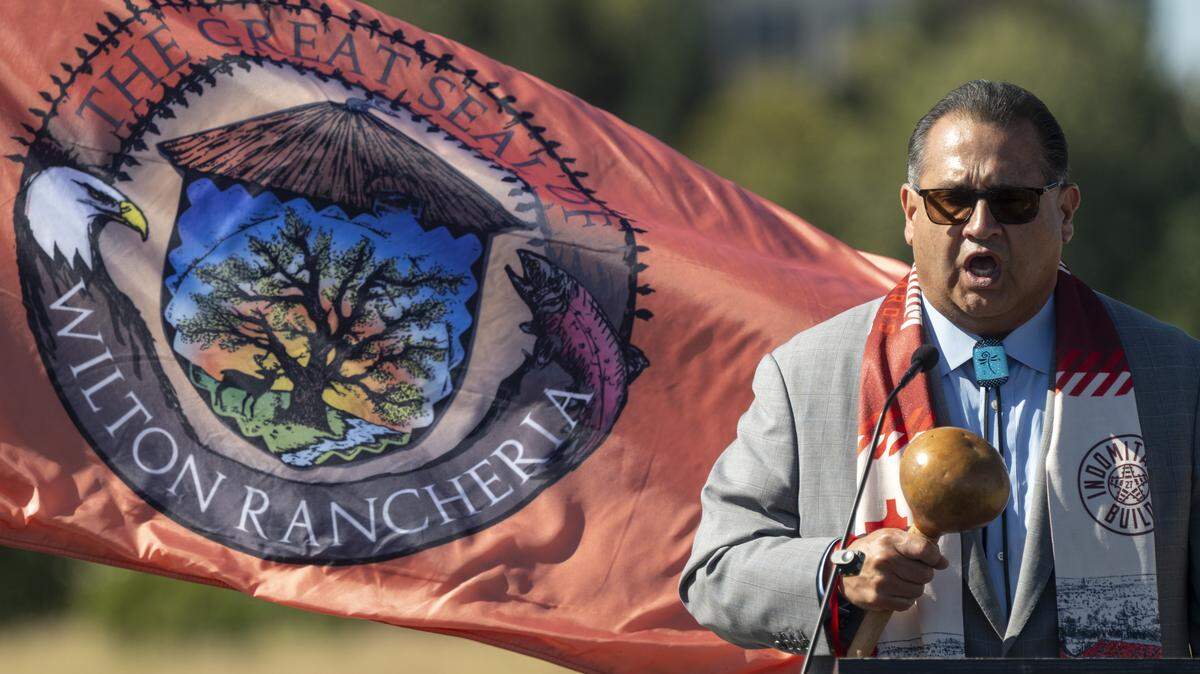
As the California Legislature’s first and only lawmaker who is an enrolled member of a Native American tribe, Assemblymember James Ramos, D-Highland, has spent his seven years in the Legislature repeatedly pushing the body to take up the concerns of Indigenous people.
It’s a role that has largely been embraced by his colleagues.
“If there was ever a time we should waive the time limit for speaking, it's when (Ramos) is telling us something that's critically important and bringing a voice to this house that has never existed here before,” said Assemblymember Isaac Bryan, D-Jefferson Park, on May 27, as the Assembly was debating Ramos’s Assembly Bill 1881, the California Indian Freedom Act.
That bill, through which Ramos seeks to protect Native Americans’ access to state land and waterways for conducting ceremonies and other spiritual practices, likely ranks among the lawmaker’s more audacious efforts so far. Though his Assembly colleagues passed it unanimously, it’s drawn fierce opposition in the state Senate from a powerful set of special interest groups including the California Chamber of Commerce and associations representing building interests, water agencies and utility companies.
The legislation would require government agencies to secure tribal consent before building projects on state land that might affect Indigenous spiritual practices. And it allows tribal governments and individual members to sue if their rights to those practices are violated. Opponents fear it would hand California tribes a heavy legal cudgel — in effect, a veto power — over infrastructure projects. They also say it’s duplicative to existing law like the California Environmental Quality Act
“This bill is about much more than access, it is about the way land and water are managed,” said CalChamber lobbyist Kristopher Anderson at a June 30 Senate Judiciary Committee hearing. “The consequences of this bill would have severe ramifications for the water supply reliability of communities and local economies around the state.”
Ramos has expressed willingness to compromise on the legislation. He’ll likely have to, with Senate Judiciary Chairman Tom Umberg, D-Villa Park, saying that he was allowing the bill out of his committee on the presumption that Ramos would work with its opponents to find an acceptable middle ground.
“If we don’t get some of these issues worked out I won’t be able to support the bill on the floor,” Umberg warned.
Beyond apologies
In 2019, Gov. Gavin Newsom issued an apology on behalf of the state for wrongs committed against Native Americans. Ramos and other tribal leaders applauded that step and this year, Ramos is advancing a bill to issue a similar apology on behalf of the Legislature.
Ramos described the staunch resistance to his California Indian Freedom Act as a sign that efforts to win recompense for the wrongs the state government historically visited on Native Americans were moving beyond apologies, and into more material matters — most notably water, which ranks high among the weightiest of topics in the American West.
“As we seek to correct history, a wrong history against California’s first people, we’re getting to the point where the state has acquired these resources and hold them as their own,” Ramos told the senators. “And yet the tribal voices are saying ‘wait, let us conduct our customs and traditions.’ So what we’re really up against is the state of California. How far is it willing to bend? How far are the words that were spoken true?”
Opponents say regardless of its intentions, Ramos’s bill would make water infrastructure projects, already challenging to carry out, even more expensive and difficult. Tribal governments and individual members would gain substantive new legal tools against projects that might interfere with their religious practices.
“The available remedies — declaratory relief, injunctive relief and attorney’s fees — are broad and potent,” Anderson wrote in a late June letter to Umberg’s Senate Judiciary Committee.
The bill further stacks the legal deck by putting the burden of proof on the state in court, and by ordering judges to review that proof under the strict scrutiny standard, the most stringent bar in constitutional law.
“Codifying this standard for tribal interests would elevate tribal religious freedom of expression, spiritual practices, sacred sites, objects and ceremonies above all other competing interests, with no clear limiting principle,” Anderson wrote.
CalChamber was joined in the letter by the Association of California Water Agencies, the California State Association of Counties, the League of California Cities, the Agricultural Council of California, the Western Growers Association and some regional and local water agencies.
Native Americans are asking for the same protection of their religious practices that other groups in the United States enjoy, Ramos told The Sacramento Bee in an interview. The strict scrutiny standard is used by the courts to determine the constitutionality of government actions that threaten people’s core individual rights, such as freedom of speech or religion.
“If you could look at it and liken it to any other religious group getting infringed upon, they have the right to sue,” Ramos said. “Shouldn’t California’s first people have that same right?”
The bill also requires the state to seek “free, prior and informed consent,” from tribal entities, if government officials know a project would destroy a sacred site, block access or privacy or spur “long-term environmental degradation affecting religious and spiritual practices,” according to legislative analysts’ review of the bill. That requirement again gives Native Americans too much power over infrastructure projects, opponents warned.
“This shift from consultation to mandating consent marks a fundamental change in California land use law and could effectively grant a single tribe the power to halt or indefinitely delay any project,” Anderson wrote in the letter. It would add a complicated and disruptive new legal step to bureaucratic processes that already require consultation with tribal governments, he wrote.
A spokesperson for the California Chamber of Commerce directed The Bee to the letter when asked for comment on the bill.
Ramos said he will seek to find a compromise and propose amendments ahead of the legislation’s next stop, which is with the Senate Appropriations Committee. Appropriations committees in both chambers often kill legislation that may be politically popular but is opposed by special interests, because they do not take public votes on the measures.
Opponents of Ramos’s bill suspect it will face opposition in the Senate committee, and as currently written, it carries a large price tag at a time when Legislative leadership is calling for fiscal restraints. The State Water Board estimated it would have to spend $28 million a year on more than 100 new employees in order to assess the impacts of new projects to tribes. Those costs are largely tied to the consent requirement.
Language echoes United Nations declaration
Though opponents are portraying that requirement as extreme, it’s not new language, Morning Star Gali, the director of Indigenous Justice, which is sponsoring the bill, told The Bee.
“This is the baseline, basic standards for Native peoples, in terms of rights-based frameworks,” she said.
Notably, the requirement for tribal consent to state building projects is included in the United Nations Declaration on the Rights of Indigenous Peoples, a human rights agreement the United States at first rejected, but that President Barack Obama agreed to in 2010.
The Trump administration in 2025 expressed support for that declaration, but also offered their own understanding of consent.
The administration “understand(s) free, prior, and informed consent to call for a process of meaningful consultation with tribal leaders, but not necessarily the agreement of those leaders,” a statement from the U.S. envoy to the United Nations reads.
The bill’s backers want to force agencies to treat tribal consultation as more than a box they have to check on the road to approval, Gali said. Too often, it feels like the agencies say: “’We got their feedback, and we’re still not going to incorporate their feedback,’” she said, “so that’s why we say consent, not consultation.”
Ramos already compromised on the bill once, restricting the proposal to just state-owned land in an effort to remove the opposition from counties and cities. Those local governments remain opposed, out of concern for their ability to protect municipal and agricultural water supplies. Now, he’s seeking a middle ground that will give Native Americans more say over projects that impact their ancestral waterways, which are often at the center of tribal spiritual practices.
“We hit the point to where those that took those resources, feel that they own it. And anybody that’s going to change it, they're going to fight back,” Ramos said. “But there should be an allowance of a (Native American) voice to come in.”