
Sen. Alex Padilla, faith leaders defend voting rights in democracy roundtable
AI-generated summary reviewed by our newsroom.
- Sen. Alex Padilla convened an interfaith roundtable in Washington, D.C.
- Speakers condemned President Trump's proposed SAVE America Act requiring ID.
- Panelists said the recent Supreme Court Louisiana ruling was a setback for voting rights.
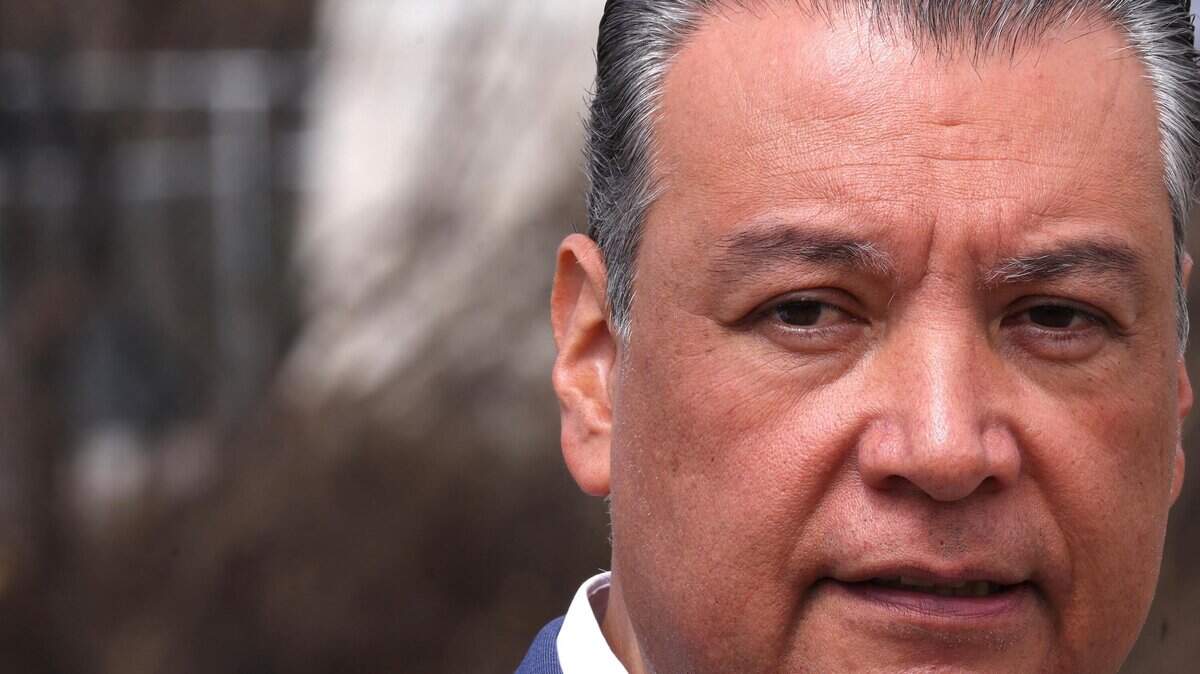
California Sen. Alex Padilla convened faith leaders and political figures in a Thursday roundtable discussion to defend voting rights and remember the legacy of civil rights hero John Lewis.
The Washington, D.C., gathering took place a day before the sixth anniversary of Lewis’ death. Lewis, a Democrat who represented Georgia’s 5th Congressional District from 1987-2020, inspired discussion among attendees on the state of civil liberties in the U.S. today. Speakers also explored the intersection between faith and democratic values, condemning discriminatory law enforcement practices and cutbacks of voting rights.
Lewis was also known for his advocacy on voting rights, gun control and, when necessary, creating “good trouble” by protesting when circumstances required it.
Padilla channeled Lewis in his closing remarks, urging continued action by lawmakers to defend democracy and advocate for those facing discrimination.
“Based on the work that we do or don’t do, we are deciding what kind of country and what kind of democracy we are choosing to leave to our children and grandchildren,” said Padilla, a Democrat. “You cannot have a country, a democracy, that is by the people and for the people unless it is of the people.”
Trump’s proposed changes to election laws
Several speakers earlier had decried President Donald Trump’s proposed “SAVE America Act,” which would require documentary proof of citizenship and photo identification to vote in federal elections. The act would also mandate that states establish programs to remove noncitizens from existing voter rolls, according to reporting by NBC.
Trump’s prime-time address to the country Thursday evening, which is expected to focus on election security and discuss the 2020 presidential election results, was an undercurrent of the roundtable. Trump has long claimed that the election was “stolen” and subject to foreign interference, using these assertions to justify more restrictive voting laws.
The discussion, titled “Interfaith Democracy Roundtable,” began with remarks from Bishop William J. Barber II, president of Repairers of the Breach and co-chair of the Poor People’s Campaign. Barber advocated repentance for political inaction on issues such as poverty and racial discrimination and urged intersectional activism to defend democratic values.
“Systemic racism, systemic poverty, ecological devastation, denial of healthcare, the war economy, the militarization of our communities and…religious nationalism are the interlocking injustices that we must challenge together with an intersectional moral fusion movement that begins from the bottom up,” Barber said.
Rabbi David Saperstein, director emeritus of the Religious Action Center of Reform Judaism, expressed alarm at what he called an “attack on democracy” characterized by restrictions on speech, press and association.
“These next elections will determine which direction our nation goes as we approach the crossroads of democracy and authoritarianism,” Saperstein said.
A cross-section of interfaith leaders
The roundtable discussion began with Rev. Paul Raushenbush, president and CEO of the Interfaith Alliance. Others in attendance included Maya Wiley, president and CEO of the Leadership Conference on Civil and Human Rights; Haris Tarin, vice president of Policy and Programming at the Muslim Public Affairs Council; Harman Singh, executive director of the Sikh Coalition; Bishop Vashti McKenzie, president of the National Council of Churches; and Rev. Carlos Malavé, president and founder of the Latino Christian National Network, among others.
Many focused on the necessity of protecting voting rights, especially in the shadow of the Supreme Court’s Louisiana v. Callais decision. The 6-3 vote struck down Louisiana’s voter map, ruling that lawmakers illegally used race to draw a new majority-Black district. Dissenters to the ruling argued that it marked a dismantling of civil rights law.
“As others have noted, the recent Supreme Court ruling is another substantial setback in voting rights in this country,” Singh said. “Efforts to roll back voting rights are just one part of a larger malignant campaign, which also includes efforts to limit opportunities to vote, depress turnout with misinformation and intimidation and attack the legitimacy of elections and pluralistic democracy in general.”
Malavé advocated for the Latino community in the U.S., which has in recent years faced increased persecution due to heightened Immigration and Customs Enforcement (ICE) activity. According to the American Immigration Council, the number of people in ICE detention expanded by 75% during Trump’s first year in office. UCLA’s Luskin School of Public Affairs found that over 90% of those in detention are Hispanic or Latino.
“We will not let anyone step on our community and abuse our community and persecute our community,” Malavé said. “We will do what we need to do to give a future to the Latino community in this nation.”
.jpg)