
California parents’ rights activists say movement is growing, despite political setbacks
In 2022, Californians across the state elected a slate of school board candidates who ran on a parents’ rights platform — a platform founded on the idea that school staff, therapists and doctors are actively hiding important information from parents and promoting LGBTQ ideology.
The movement experienced a heyday during the COVID-19 pandemic shutdowns, which saw the creation of groups like Moms for Liberty that vilified vaccines, masks and other public health measures. But as schools began to reopen, the parents’ rights movement, and its newly elected representatives, shifted gears to focus on other issues — namely, “gender ideology” and the issue of transgender rights on school campuses.
School board members in the movement passed “parental notification” policies, which mired school districts in national news coverage, heated board meetings and ongoing legal battles. They also prompted broad philosophical questions around the privacy of minors, the role of the public school teacher, and the hierarchy of the state and the home.
Still, it would be easy to argue that despite the headlines made in the last two years, the parents’ rights movement in California has failed to make any lasting political impact.
The California Legislature last summer banned parent notification policies — a key movement priority that requires school staff to inform a student’s parents if they are using different pronouns or going by a different name — by passing a bill that proponents and opponents were so passionate about, a physical fight nearly broke out on the Assembly floor. A ballot initiative led by parents’ rights activists that would have let voters decide on parent notification policies and gender-affirming health care for minors failed to amass the requisite number of signatures to make the November ballot.
In school districts where parental notification policies did pass, they did so amid such fervent protest that a small handful of parents’ rights board members were ousted in special elections while local teachers’ unions, political action committees and student groups spent over a year organizing and fundraising in opposition.
Key players in California’s parents’ rights movement tell a different story, one of grassroots underdogs chipping away at the supposed proliferation of gender transition among minors.
“There’s a silent majority who are against this,” said Erin Friday, a Bay Area-based lawyer and lifelong Democrat who helped organize the ballot initiative and wrote the first slate of parent notification policies in school boards across the state.
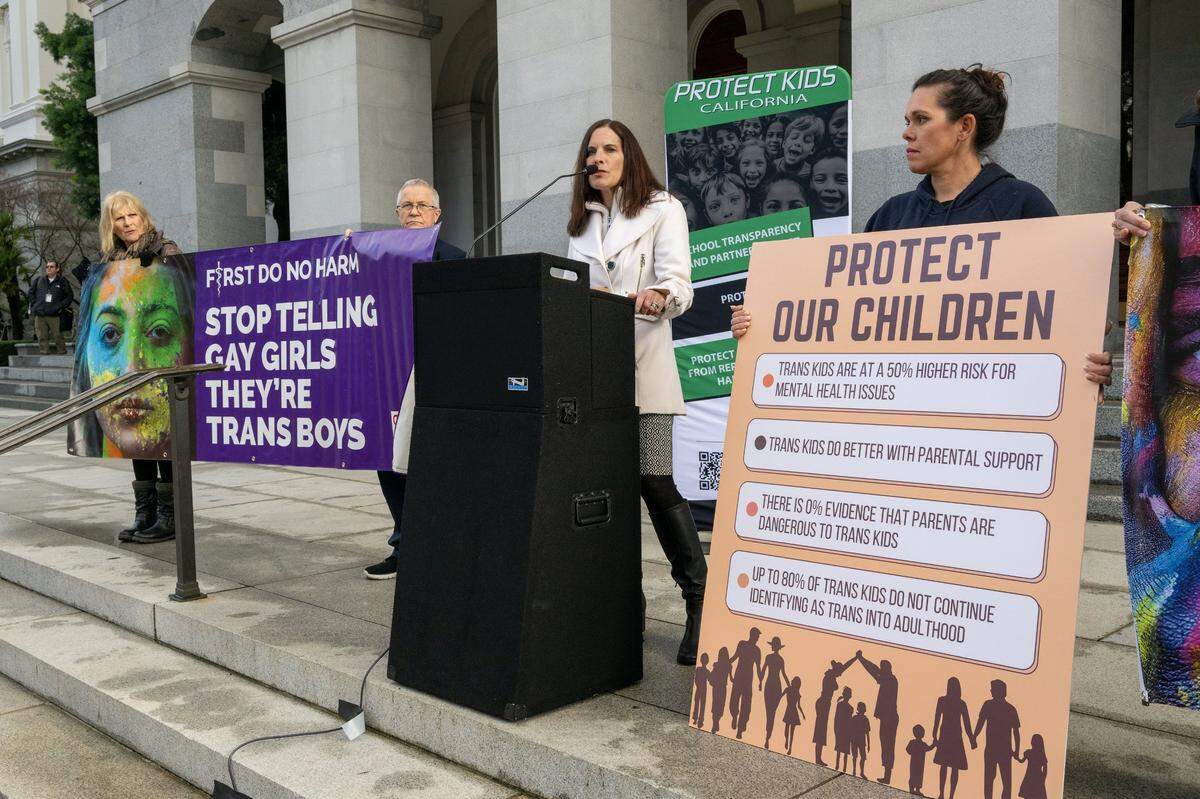
“Obviously, we’re not going to get very far on the statewide level anytime soon,” said Jonathan Zachreson, a school board member in the Roseville City School District who fought to reopen public schools when students were forced to learn remotely in 2020, and who was also a key organizer of the ballot initiative.
“But locally, we can go far.”
The parents’ rights battle ground
The tension between parents’ rights activists and their communities reached a tipping point in one Placer County school district last year.
The Rocklin Unified School District became one of the first to pass a parental notification policy in September 2023, in a 4-1 vote. Community members lined up for hours to speak on the policy. A majority spoke out against it.
One dissenting community member is Rocklin parent Price Johnson, who is now running for a seat on the board. He hopes to replace trustee Julie Hupp, who served as board president at the time of the vote.
Johnson has two children in the district, and told The Bee he feels he has tremendous access to his childrens’ teachers and school administrators, and knows what’s going on in his kids’ lives. He believes that parents’ rights have been “co-opted” by bad-faith players with their own agendas.
“The term ‘parental rights’ has been co-opted by a group that wants you to believe there are people in schools with ulterior motives that want to keep secrets from parents, and want to push parents out of the equation,” he said. “And that is just so blatantly the opposite of what I’ve seen.”
In late October, a group of teachers in the Rocklin Teachers Professional Association — a local affiliate of the California Teachers Association — gathered in Rocklin to prepare to knock on doors for Johnson and another RUSD school board candidate, Jen Brookover.
Both Johnson and Brookover received endorsements from the local teachers’ union, as well as thousands of dollars in campaign contributions.
The union members “are concerned, very concerned, with the fact that the (parent notification) policy puts our credentials on the line, and we’re never going to support anything that puts our members’ jobs and credentials on the line,” said local union vice president Kari Ustaszewski-Begley who has been with the district for 24 years.
“We’re here to support all our students. And a majority of the teachers, regardless of the credential aspect, feel that they’re there to support all students.”
As far as “promoting transgenderism,” Ustaszewski-Begley said there is simply not enough time in the day to do that.
“I know that there have been some people that talked about (teachers) trying to ‘indoctrinate.’ I’m trying to get through all of the curriculum,” she said. “I don’t have any interest in that. Give me the name of the teacher that’s doing that and I will go confront them, because we need to be focused on teaching, and learning, and what’s best for these kids.”
It’s why the teachers’ union has thrown so much money — almost $29,000 — behind Johnson and Brookover. The union voted this year to allocate more funds to the local Rocklin political action committee due to concerns members have about the current board members’ agenda.
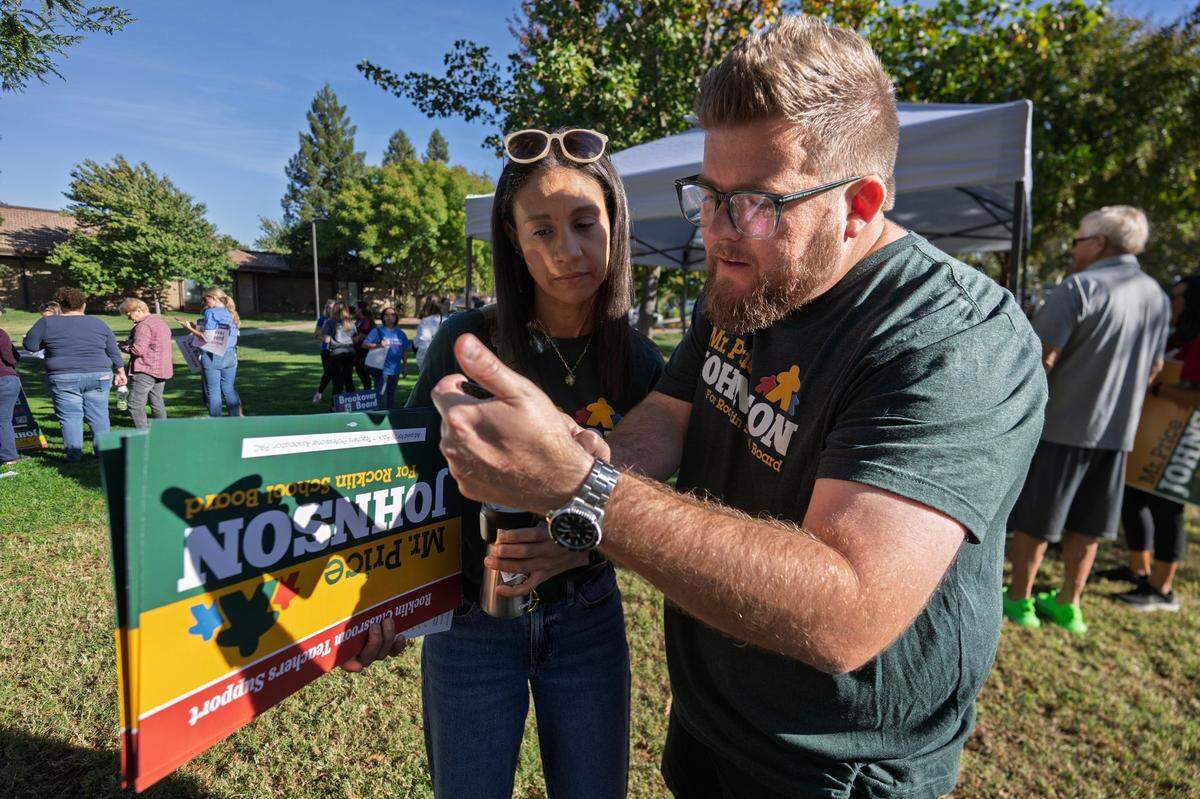
“To even have a voice for these candidates, we have to go up against outside interests,” Ustaszewski-Begley said. “This money is coming from our members ... We’re going up against The American Council, Destiny Church, the Mormon Church. We’re going up against outside entities that have been dumping money for a long time. So we just want to even the playing field.”
Both Hupp and fellow parents’ rights incumbent candidate Rachelle Price are members of the Church of Jesus Christ of Latter-Day Saints. Price received a $10,000 campaign donation from a fellow church member who lives in Loomis. Board president Tiffany Saathoff is a former pastor of Destiny Church, whose staff members created The American Council political action committee, which promotes bringing “biblical values” into public office. Saathoff became chief of staff for Republican Assemblyman Joe Patterson, R-Rocklin, whose Assembly re-election committee donated $600 to Hupp’s campaign.
There are 600 members of the RTPA, and just two of those members have opted out of contributing to the union’s political action committee, which makes campaign donations.
“I live in Rocklin; my kids go to Rocklin schools. I teach here. A lot of teachers live here and have their kids in schools here,” said Ustaszewski-Begley.
“We have just as loud a voice, if not louder.”
Don’t call them ‘fringe’
The issue of parents’ rights has historically been a Republican project.
“I believe, and I might be wrong, that more of the COVID (parents’ rights) movement was right-leaning,” said parent’s rights advocate Friday.
One such movement is Moms for Liberty, which launched in Florida in 2021 and now has hundreds of local chapters. Some of Moms for Liberty’s most prolific members in the Sacramento area, such as Beth Bourne in Davis, have made headlines for protesting on school campuses, haranguing teachers and principals at board meetings for hanging Pride flags, and isolating themselves from their trans children.
Most parents’ rights activists are less vocal than Bourne — and Friday said the amount of concerned parents is growing, especially among Democrats like herself. (Bourne is a lifelong Democrat, and Zachreson of Roseville has said that he was a No Party Preference voter and his now a registered Republican, and he has earned endorsements from the local Republican Party and prominent area Republicans.
“The gender movement is everyone,” Friday said. “Democrats are waking up to the fact that their parental rights are being trampled on, and that they should be really quite terrified of what’s happening at their kid’s school,” she said.
Friday has spoken publicly about what brought her into the parents’ rights movement: During the pandemic, her daughter began to identify as transgender. Friday said she had to look out of state for a counselor who didn’t affirm her child’s gender dysphoria, but rather treated the co-existing mental health issues she was facing. Now, Friday says, her daughter no longer identifies as trans.
As a key legal source for all things parents’ rights, Friday is often the first call parents in California make when they think something inappropriate is happening on campus. Friday told The Bee these parents fear being associated with “extremists” for questioning whether or not their child is actually trans or should use different pronouns or a different name.
Even in deep-blue California, it’s not an uncommon fear.
A Public Policy Institute of California survey from earlier this year showed that people in the state are deeply divided about the topic of trans rights in public schools.
The survey showed that 51% of public school parents oppose letting their children choose their pronouns, while 48% support it. Opposition falls primarily along party lines, with a majority of Republicans (83%) opposing and a majority of Democrats (70%) in support.
Californians are similarly split on public schools providing literature with stories about trans kids; 50% of adults support it while 49% do not. When it comes to parents with kids in public schools, 57% oppose it, while 42% support it.
“When we ask people about transgender rights in general, or same-sex marriage, there’s broad consensus when we’re talking about adults,” said Mark Baldassare, survey director at the PPIC.
“But how these issues should be handled in public schools, the public is divided almost right down the middle.”
Friday and other parents’ rights activists are adamant that they are not extreme, but simply believe that no child is born in the “wrong body” and that school teaching about transgender issues endorses that false concept.
“This is not a fringe movement,” Friday said.
Which parents? Which rights?
In the world that parents’ rights activists live in, teachers, counselors, therapists and doctors are actively promoting gender transition and “transgenderism” to students. Many of these parents seek to shut down LGBTQ acceptance clubs, and remove certain books from circulation that depict same sex relationships.
In Elk Grove, just south of Sacramento, one parents’ rights group is petitioning to have an elementary school teacher and school principal fired for allowing a lunchtime club called the Rainbow Club to continue to run, despite broad support from local parents whose students love the teacher in question and love participating in the lunch club.
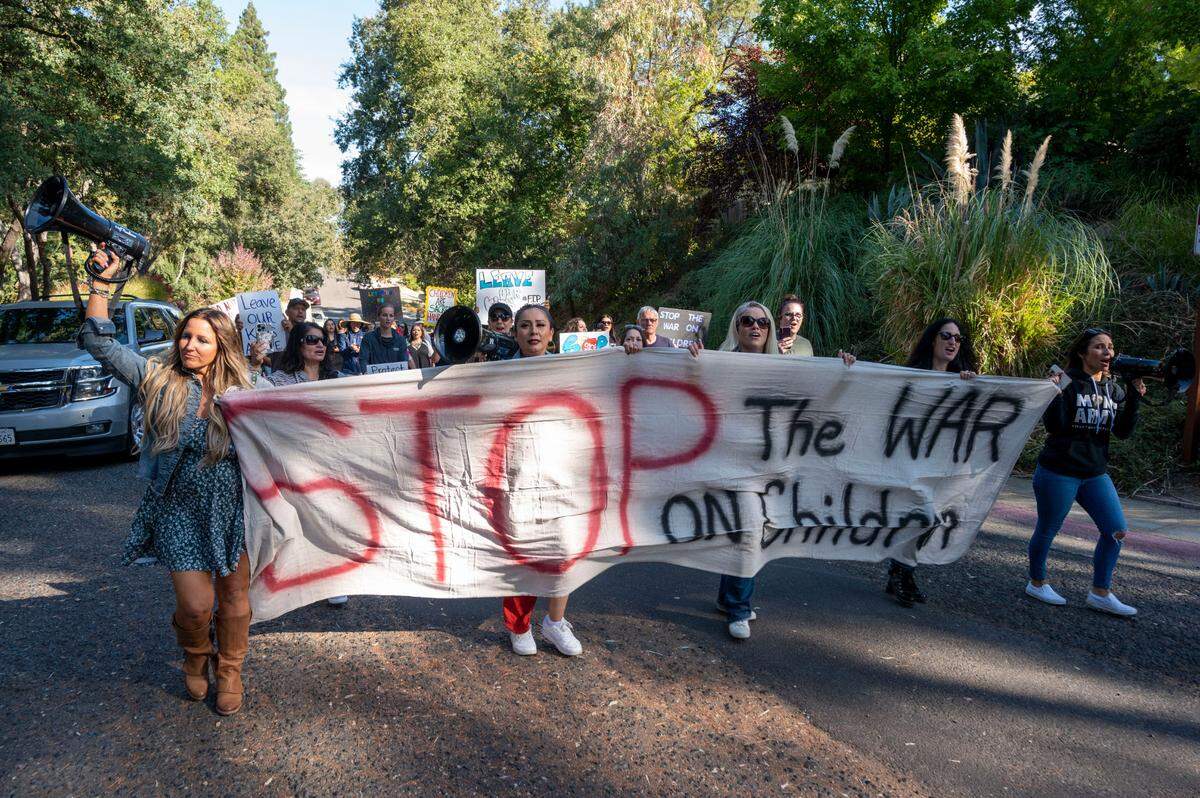
There are also many parents of transgender children across the state who take issue with the rhetorical devices of the parents’ rights movement.
Assemblywoman Lori Wilson, D-Suisun City, told The Bee that it’s been sad to see the parents’ rights movement has become “centered” on LGBTQ issues.
“As if they weren’t vulnerable enough, we have this whole parent movement against trans kids,” Wilson said.
Wilson spoke about her experience raising a trans child last summer when the Assembly voted to send a bill that bans parent notification policies to Gov. Gavin Newsom’s desk. Wilson said she was notified by her son’s teacher that he was transitioning.
“I was disappointed to hear it from that teacher, and not my son,” she said in June.
The measure Friday and Zachreson sought to get on the November ballot would have not only required parental notification policies at every school in California, but banned gender affirming health care for all minors, whether or not their parents approved of the transition.
“The first thing parents’ rights activists get wrong is, they don’t believe being trans is real,” Wilson said.
What’s next for parents’ rights?
So what is it that parents’ rights activists in California want?
Activists and elected officials in the movement say they want to see parent notification policies in every school. They want to end gender affirming health care for anyone under the age of 18. They want to prevent trans kids from playing on sports teams that do not align with their biological sex. They want to remove literature, teaching material, or any other school materials that “promote” a transgender identity.
The upcoming election, and keeping voting power on school boards, is one small part of the larger effort to accomplish these goals; activists have their sights on higher offices, not just in California but nationwide.
“There’s going to be a finale that is going to happen rather soon, because the Supreme Court is ultimately going to have to weigh in on whether parents have a right to know that their child is suffering with a mental health issue,” said Friday. “Because that’s what gender dysphoria is. And I suspect the Supreme Court will come on the side of parental rights.”
Jonathan Zachreson, the school board member up for re-election in Roseville City School District, said the issue is a “David versus Goliath situation.”

The movement is gaining steam, even if parents — particularly those who are Democrats — are only just beginning to talk about the issue out loud.
When their ballot measure received more than 400,000 signatures, Friday did not see that “as something to be embarrassed about.”
“We were having boxes and boxes of signatures coming in ... One more month and we would have done it,” she said. “It’s gotten to a point where (parents’) fear is not as strong as their desire to protect their children.”
This story was originally published October 31, 2024 at 5:00 AM.
CORRECTION: This story has been updated to reflect that Jonathan Zachreson is now a registered Republican, and was previously registered as a No Party Preference voter.