California Proposition 32’s wage hike threatened by a quiet campaign and economic concerns
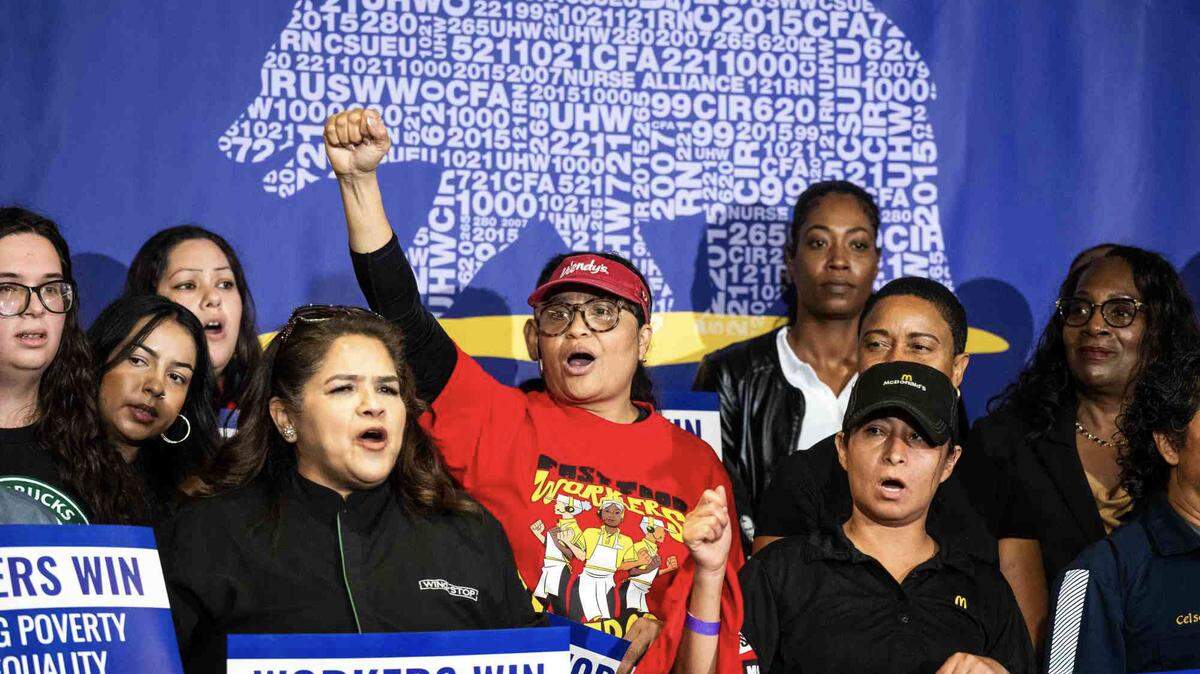
With mailers overflowing mailboxes and an onslaught of political spots on television and radio, campaigns are making their final pitch to voters with less than a week before election day. But some voters might be surprised to see a ballot measure that would increase the statewide minimum wage, Proposition 32, on their ballots.
Both Prop. 32’s supporters and opponents have run notably quiet — and inexpensive — campaigns.
And California voters who have broadly support progressive labor policies in the past, may not be feeling so generous this election season, with favorability for an increase to the statewide minimum wage to $18 dropping in recent polls.
“Voters are just tapped out and they’re not in a giving mood,” said Brandon Castillo, a ballot measure campaign strategist with BCFS Public Affairs.
The ballot measure would require businesses with 26 or more employees to pay $18 an hour starting next year. Smaller companies would have until 2026 to make the jump. The current statewide wage floor of $16 an hour would immediately be raised to $17 if the measure passes.
State law currently mandates that the hourly pay be raised annually by the consumer price index or 3.5%, whichever is lower.
Minimum wage is a topic that has always evoked strong opinions from voters and economists about the impact of increasing the hourly rate. Prop. 32 is no exception. And the measure’s supporters are confident that when California voters read Prop. 32 on their ballots, the majority will ultimately support the progressive policy.
Higher wages’ minimal impacts
The minimum wage measure was originally meant to appear on voters’ ballots in 2022, but a missed deadline pushed the proposition back two years.
Since then there have been other increases for minimum wage workers in some California cities and certain sectors that now exceed Prop. 32’s target of $18 an hour.
Earlier this year, California set a new wage floor for fast-food workers at $20 an hour; a recent law will gradually increase pay for employees of healthcare systems over the coming years to an eventual minimum of $25 an hour; and several Bay Area cities have minimum wages that exceed $18 an hour.
A recent report from UC Berkeley’s Institute for Research on Labor and Employment found that the $20 wage requirement has not resulted in overall job losses and has increased prices by marginal amounts.
The evidence that higher wages don’t lead to job losses or higher costs to consumers was an encouraging sign, said Joe Sanberg, an investor and anti-poverty advocate who is the chief architect behind Prop. 32.
Sanberg said the Prop. 32 campaign doesn’t need to spend as much money compared to other ballot measures. Normally, he said, propositions are complex and require resources to educate voters. This one is simple.
“You either support the minimum wage going up to 18 bucks, or you don’t,” Sanberg said.
Asked if the recent polling result concerned him, Sanberg said he didn’t have much faith in the recent survey conducted by the Public Policy Institute of California which showed support for Prop. 32 fell to 44%.
He noted that the PPIC poll was conducted before minimum wage advocates conducted a text-message campaign targeting working-class voters.
Voters haven’t seen television spots or received mailers encouraging them to vote “yes” on Prop. 32 because, in part, Sanberg believes there was a much higher return on investment in text messages over television.
As to the minimal spending on Prop. 32 recently, Sanberg said a lot more money was spent earlier in the campaign while collecting signatures to get the measure on the ballot. He estimated that his side has spent more than ten times the amount the “no” campaign has put forward fighting the proposal.
An erosion of voters
Others have read the latest polling results as a warning sign, given how support for the measure has fallen in just the last year. Last November, 67% of likely voters supported gradually increasing the minimum wage to $18.
Castillo, the campaign strategist, said recent polling did not bode well for the minimum wage increase. He pointed out that only 65% of Democrats polled indicated a “yes” vote.
“You’re seeing an erosion of the base voters that you need to pass this kind of measure,” he said.
Castillo’s belief in the recent dip in the polls stems from voters’ hesitancy to approve a measure that might impact their pocket books. Concerns over inflation and high costs of living are at the forefront of voters’ minds, Castillo said.
He added that the recent law securing a $20 wage floor for fast-food workers may also have turned some voters off from another minimum wage increase.
That argument has been central to the opposition’s message.
The California Chamber of Commerce said its involvement in the opposition campaign has focused on educating members about the potential impacts of an $18 wage floor on businesses. CalChamber said Prop. 32 would result in job loss for low-wage workers and higher prices for consumers.
“Just like everybody else in California, our smaller businesses, our employers, they’re struggling with high costs right now and this increase will only add to those costs,” CalChamber President and CEO Jennifer Barrera said on a recent podcast released by the group.
The opposition campaign has also largely been under the radar. The website listed as “Against” the ballot measure on the Secretary of State’s Voter Information Guide, StopProp32.com, still appeared to be under construction less than a week until the election.
Unlike previous fights between labor and business, the campaign over Prop. 32 has been notably cheap.
In 2020, companies such as Uber and Lyft spent tens of millions of dollars to push a “yes” campaign on Proposition 22, which would allow those businesses to continue classifying drivers as independent contractors instead of full-time employees. Labor groups also put up millions of dollars to fight the measure, but ultimately were outspent by considerable margins.
This year, Prop. 32 received the least campaign amount of money of all ten measures on the November ballot.
With only $1.6 million raised in total since the last reporting period. Supporters of the minimum wage increase have raised slightly more — 56% — than Prop. 32 opponents.
Castillo contrasted that sum to two other ballot measures — Propositions 2 and 4, the school and climate bonds on voters ballots — which have raised over $14 million and over $3 million respectively.
Persuading the public
Enrique Lopezlira hasn’t seen much of a campaign to rally support for the $18 wage increase. The director of the Low-Wage Work Program at the UC Berkeley Labor Center contrasted the quiet of the Prop. 32 campaign with the much more visible and concerted “Fight for $15” movement.
“I haven’t seen [digital ads], maybe I’m not the target market,” Lopezlira said. “But it’s hard to persuade the public if there’s no real effort to do so.”
Lopezlira said the real world is more complicated than economic theory. Therefore, it’s difficult to dissuade voters from the notion that prices are directly tied to increases to the minimum wage.
Businesses can choose to raise prices to consumers, or they can choose to take a smaller profit margin to pay their workers more, Lopezlira said. In the end they might do a little bit of both, but usually most of that business cost comes from profit margins.
This story was originally published October 31, 2024 at 9:00 AM.