
New SEIU president wants to slash union dues, end politics spending. ‘I have to produce.’
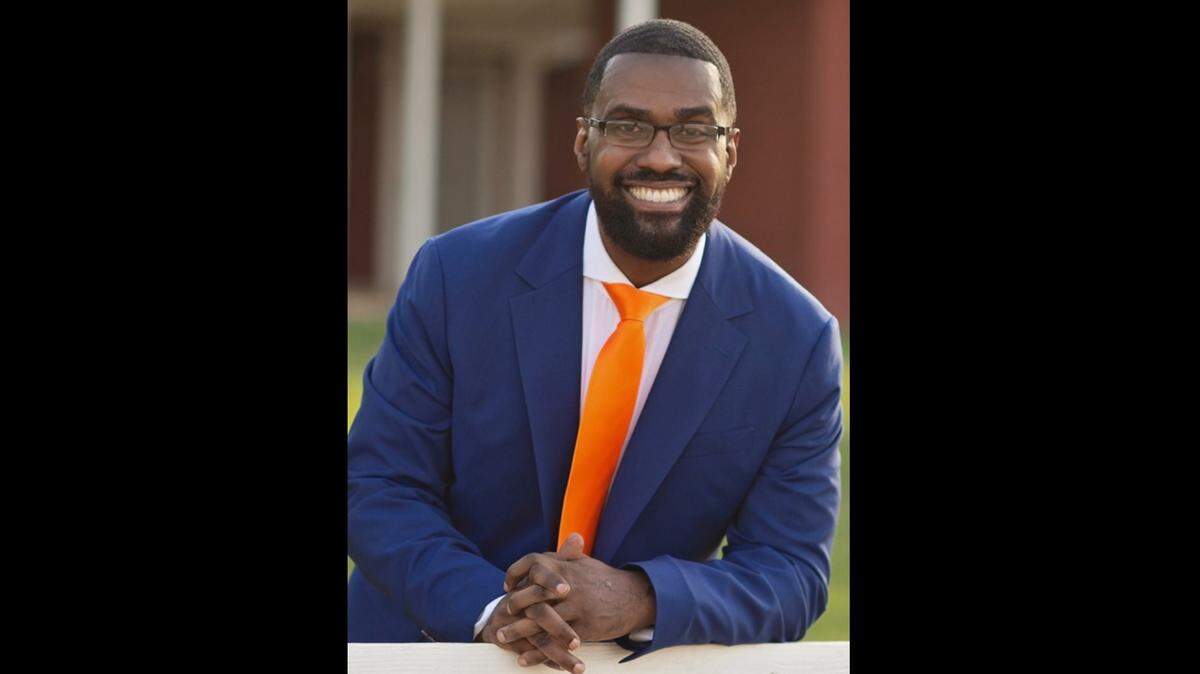
Richard Louis Brown acknowledged the difficulties that await him as the newly elected leader of California’s largest state worker union even as he basked in his election victory Tuesday.
Brown, 51, of Oak Park, inherits the challenges of uniting and invigorating the sprawling group of roughly 100,000 employees from all corners of state government who make up SEIU Local 1000.
Fractures within the union grew more pronounced over the last three years, as president Yvonne Walker remained at odds with a trio of vice presidents who were elected in 2018 on promises of change.
One of the three, vice president for organizing and representation Anica Walls, won re-election. New candidates won election to the other two vice presidential posts.
All of Brown’s opponents during the campaign were at the receiving end of Brown’s social media accounts, from which he hurled insults accusing them of everything from apathy to corruption, often with Caps Lock on.
Now he must work with them — and their allies on the union’s 60-plus member board of directors — to accomplish several of the big-ticket items in what he has called his 10-point campaign platform.
And one of the first things he has pledged to do is eliminate the stipends the officers, including himself, are eligible to receive for their union work. The union under Walker’s leadership in 2016 expanded those stipends, aiming to better compensate executives leading an organization that at the time had a $60 million annual budget.
“All these things I’ve been running my mouth on, I have to produce,” Brown said in an interview Tuesday. “I’m not going to get any leeway, no one’s going to cut me any breaks. So I’ve got to do as much as possible to fulfill that 10 point platform and bring hope back to the union.”
He has called for Local 1000 to stop spending money on politics, a strategy that is foundational to most unions’ efforts to build power and influence.
He wants to allow non-members to vote in union elections, tossing out another established norm that he called “flat-out wrong.”
And he has said he would reduce union dues by half, which he said he thought would require a vote from the board.
Pay cuts frustrated state workers
Brown said his victory was a product of his determination as well as a constituency frustrated with the pay cuts and working conditions the state imposed when the coronavirus pandemic arrived last year.
He has said he would press for the union to remove the “no strike” clause from its contract, a nearly universal cornerstone of most labor agreements. He said the union should restore furlough protections and fight to prevent job losses such as those that could result from planned state prison closures.
He said he knows how extreme some of his proposals sound.
“I know sometimes I can come across like a crazy person,” he said. “I’m really a nice person. I ask people to bear with me. There’s a method to my madness. We can not sign contracts that give up our money. That has to stop immediately.”
Calls for change in California union
Brown, an analyst with a State Treasurer’s Office advisory committee since 2011, said he received about 600 votes when he first campaigned for the leadership post in 2015. In 2018, he won 2,144 votes. This year he secured 2,637 votes, beating out the four other candidates on the ballot.
His victory reflects a definitive call from members for change, said two of his defeated opponents, education programs consultant Miguel Cordova and office technician Sophia Perkins.
“Really, honestly, what we heard in this election was that they wanted change — to the extent that maybe they didn’t think that we were sufficient change or real change,” Cordova said. “But we thought we would have been.”
Cordova, who campaigned with Walker in 2018, said he told her in November that he didn’t think she could win this time, considering her allies’ losses and the lack of enthusiasm for her campaign reflected in the 2018 results.
He said he urged her not to run again, and said he felt he needed to present himself as an alternative to the other candidates in the race.
“I would not have run if I thought someone else had the experience, could do the things I felt were important,” he said.
Cordova came in third, trailing Walker with 15% of the vote. Together, he and Walker — the two most traditional candidates in the group — together accounted for about 42% of the vote.
Now, he said, everyone has to figure out a way to work together under Brown’s leadership.
“I think it’s not just his opportunity,” he said. “It’s everybody’s opportunity. One thing we all said was divisions have to end after all this.”
Perkins said she would work to support Brown.
“Change didn’t happen as we pictured it,” she said. “But we as members across the state have change, and we need to be willing to work with however the change came.”
Tony Owens, an IT analyst who is currently the vice president for bargaining, said he plans to protest the election’s result, citing what he called irregularities in election procedures.
Local 1000’s election procedures give candidates until June 10 to submit written election protests. The protests are referred to an elections committee by either the president or the secretary-treasurer for review. As long as any protests are resolved, Brown would take office June 30.
Walker, whose leadership spanned three governors, said she would offer to help Brown transition into the leadership role.
“I‘ve laid a good foundation here for the local,” she said. “We’re a good local, we’re stable. We have some good programs, I’ve built good leaders. So I think there’s an opportunity for Richard to take his vision and not have to build a foundation from the ground up. And I wish him the best.”