CalPERS health premium rates are increasing again. How much will insurance cost?
.JPG "The California Public Employees’ Retirement System, or CalPERS, headquarters buildings are photographed Thursday, Sept. 16, 2021, in downtown Sacramento.")
Get The State Worker Bee newsletter in your inbox
This is a preview of our weekly newsletter. Sign up here to receive exclusive tidbits like this one, as well as a weekly roundup of all our state worker coverage. Email tips to wmelhado@sacbee.com.
It’s open enrollment season at CalPERS and, like other employers across the country, California faces another year of growing healthcare costs.
“The health care landscape remains challenging,” Ramón Rubalcava, chair of CalPERS’ Pension and Health Benefits Committee, said announcing the premium increases for 2025 earlier this summer.
For most in the public workforce, premiums will increase 9%. Those opting for a Medicare plan will see much more steep insurance costs.
The reason for these premium hikes, CalPERS said, is the demand for expensive medication and higher costs of medical services.
This follows a similar increase to premiums observed last year, which were pushed by rising demand for non-COVID-related health services, high labor costs and a desire to recoup pandemic-era losses.
“Most employer plans are probably seeing similar increases,” said Dylan Roby, chair and professor of health, society, and behavior with the University of California, Irvine, Joe C. Wen School of Population and Public Health.
CalPERS premium costs are comparable to others in the employer-based health insurance market, Roby said, especially considering that the state “offers high levels of coverage for services and pretty expansive benefits.”
He noted that CalPERS is adding two new benefits in 2025: Doula services to improve health outcomes for pregnant members and travel coverage for medically-necessary care not available locally.
Roby pointed to other pressures such as a more competitive employment market, which is increasing overhead costs for medical groups, as another factor in increases in premiums.
Previously, the cost of insurance didn’t jump so much year to year. Between 2015 and 2019, Roby said broadly premiums increased between 4-5%. During the first two years of the COVID-19 pandemic, 2020-21, premium increases were even lower because healthcare spending was lower than anticipated, he said. But by 2022, actuaries predicted higher healthcare spending coming out of the pandemic, which is when employers started widely seeing double digit premium hikes.
The increase in insurance costs ranges between the plans offered by CalPERS. In 2025, Health Maintenance Organization basic plans will increase slightly less, 8.7%, compared to Preferred Provider Organization basic plans, 9.8%.
Retirees with Medicare plans will see the biggest increases to insurance costs, 22% on average and as much as 34% for one plan. Those steep increases stem from a restructuring and overall drop in federal subsidies for Medicare plans, said Roby.
The open enrollment period began Monday and ends Oct. 11. Members can choose between over a dozen different plans that go into effect Jan. 1, 2025.
How much will insurance cost state workers next year?
In addition to releasing the cost of health insurance for 2025, CalPERS shared how much the state contributes. What’s not immediately clear is how much state employees have to pay each month for coverage.
For rank-and-file employees, the monthly cost of insurance depends on three factors: The type of plan a member selects; the bargaining unit a member belongs to; and who needs coverage.
The table below shows the cost of premiums for 12 basic plans (which excludes out-of-state and Medicare plans). The cost of each plan increases based on the number of people covered: single (1), two party (2), or family (3+).
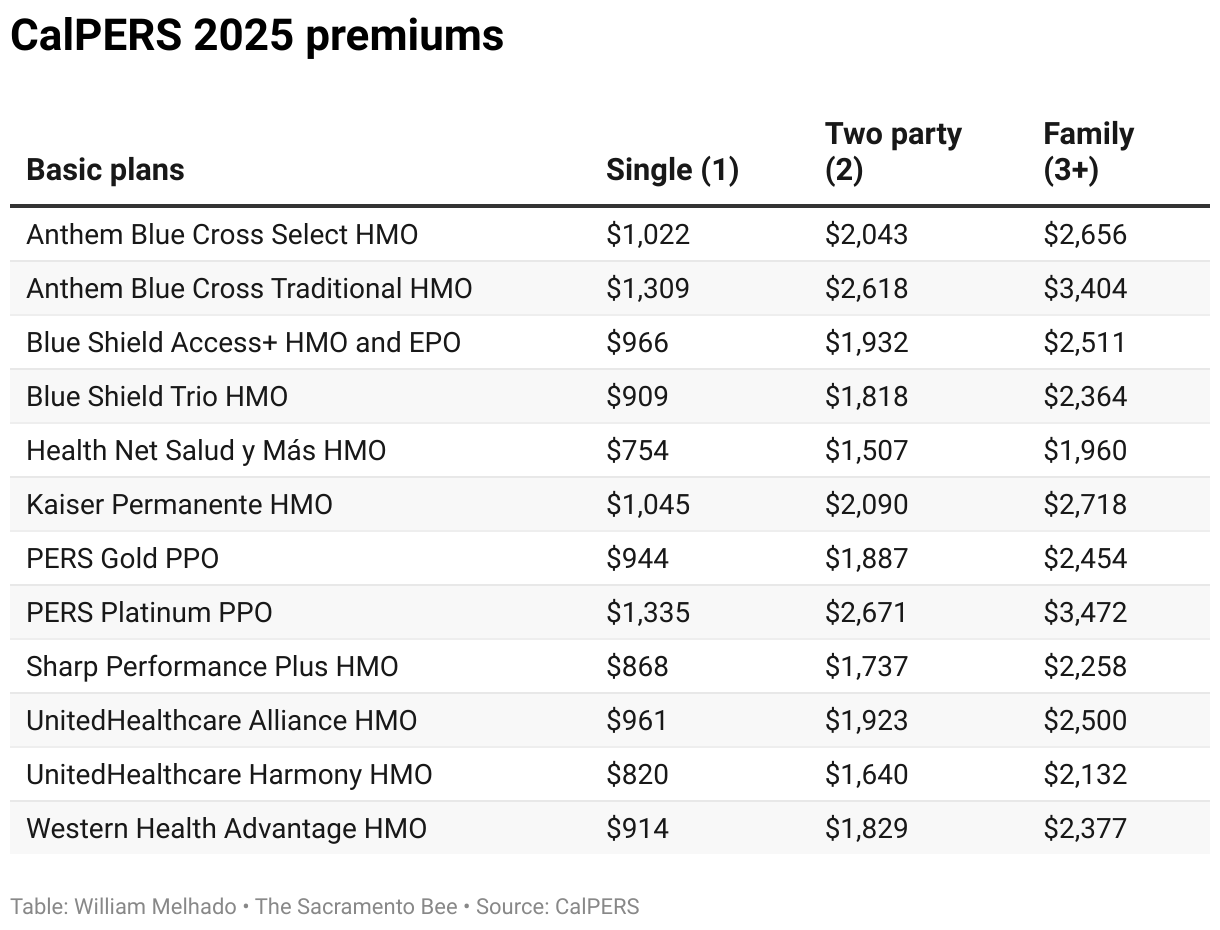
To determine the monthly cost of insurance, state workers will need to identify the employer contribution (found in the tables published here), which is based on the member’s bargaining unit and the number of people who need coverage. Then subtract the employer contribution from the premium listed in the table of premiums, and viola, the monthly cost of health insurance.
As an example, say a state worker who is a SEIU Local 1000 member seeking a health insurance plan for herself only decides the Anthem Blue Cross Select HMO plan is the best option for her: It costs $1,022 per month. She is a member of Bargaining Unit 1, which means the state will cover $974 of her monthly premium. Therefore, the HMO plan will cost her $48 per month.
If the difference is a negative number, as is the case for the Health Net Salud y Más HMO plan, the state covers 100% of the premium.