
Gavin Newsom orders state workers back to offices. What should Sacramento commuters expect?
The COVID-19 pandemic didn’t just disrupt the way Californians work — it rewrote the rules.
What began as a stopgap shift to working from home became a sweeping redefinition of office life. For more than four years, remote work, telecommuting and hybrid schedules blurred the line between home and workplace. Conference rooms gave way to Zoom calls and Teams meetings. Hallway conversations moved to Slack chat threads. What once felt temporary became routine.
Now, for thousands of state workers, it’s back to the office — and back to the commute.
These employees, stationed at the heart of California’s government, are being ordered to return to their desks across the downtown grid and beyond. That means a return to Sacramento’s freeways, thoroughfares and surface streets that funnel them there.
Gov. Gavin Newsom’s back-to-office order for state workers takes effect in July. But transportation experts and advocates are already weighing the consequences — for drivers, cyclists, pedestrians and public transit riders — as congestion looms over the capital region once again.
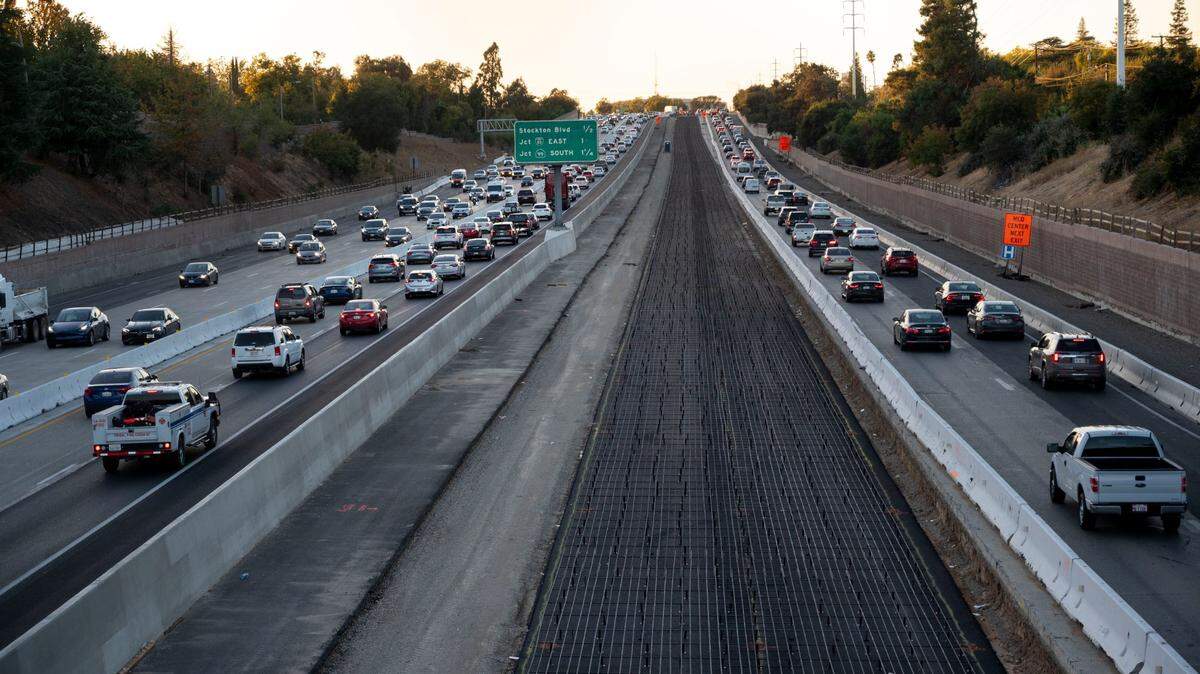
Work on Highway 50 is expected to be completed this summer. But with its maze of construction, detours and delays Highway 50 will be a particular chokepoint for commuters headed downtown, said Masoud Ghodrat Abadi, a Sacramento State civil engineering professor and an expert in transportation planning and traffic safety.
“With state employees returning to the office, I anticipate nightmarish traffic on Highway 50, especially during peak hours,” until that work is complete, Abadi said via email.
Abadi said adding traffic lanes does not necessarily relieve freeway congestion, though that seems to be the most straight-forward approach to solving the snarls.
“Instead, the focus should be on enhancing public transportation and developing better infrastructure for alternative modes of travel, such as walking and biking,” Abadi said. “I hope that the frustration of the next few months serves as a learning opportunity for future transportation planning in the greater Sacramento area.”
Plans such as the San Joaquin Regional Rail Commission’s $1 billion Valley Rail Extension Project to link its passenger rail service from Stockton to Sacramento would include stations and connections in Elk Grove, midtown and Natomas but are still in the works.
Abadi and UC Davis transportation researcher Giovanni Circella can’t help but lament the time lost during the pandemic years in developing and investing in transportation solutions.
“The pandemic gave us an illusion that we could solve some of these problems,” said Circella, the Honda Distinguished Scholar for New Mobility Studies at UC Davis, and a professor of mobility at the University of Ghent in Belgium. He spoke to The Bee from Brussels where he was attending a conference. “It’s difficult to catch up for lost time because it’s difficult to re-propose these projects.”
Abadi, the Sacramento State professor, said: “Imagine state employees could have had viable routes to bike to the nearest transit station, with a variety of efficient and comfortable public transportation choices to reach several destinations. The situation would be drastically different.”
Meantime, Abadi said he expected a surge in demand on the region’s roads especially on roads leading into downtown followed by a slight decrease once drivers adjust to and game out alternate routes and travel times. Others, he said, would likely carpool or seek flexible work hours. But, Abadi said, “even with these adjustments, I don’t expect traffic levels to return to what they are today.”
Five years after the pandemic sent California into lockdown, many workers in the public and private sectors are already back at the office and Newsom is not alone in calling workers back to the office, Circella said.
President Donald Trump ordered federal workers back to their offices while Amazon issued similar directives to its workforce, Circella said.
But Newsom’s call to state workers comes with more complications, Circella said.
Some workers freed by the ability to work remotely in the pandemic’s early days, moved away from Sacramento, just as Bay Area residents flocked to relatively affordable Sacramento and Placer counties, knowing they could report to the office once or twice a week.
Growing homelessness in the city core discouraged would-be commuters from using public transportation, he said, while drivers looking to beat traffic jams were traveling less during peak hours.
Sounds smart, but Circella said the strategy had the effect of stretching peak traffic hours across the entire day.
In the meantime, more motorists will funnel onto Sacramento-area roadways this summer jockeying for position as regional planners search for solutions.
That concerns Isaac Gonzalez, a Sacramento transportation advocate and founder of Slow Down Sacramento. The grass-roots organization focuses on ending vehicle-vs.-pedestrian collisions in the city.
“All of downtown Sacramento is on a high-injury collision network. The propensity presents conflicts. There will be more people down there with fewer safety measures,” said Gonzalez, a member of the city’s Active Transportation Commission. “It’s definitely a concern we have.”
Gonzalez has called for a series of safety measures to protect pedestrians on the downtown and midtown grid, calls likely more urgent with the anticipated increase in traffic.
“Daylighting,” barring parking within 20 feet of intersections and traffic signals; eliminating right turns at red lights; and allowing longer lag times for pedestrians to cross at crosswalks before red signals return to green, are among them.
“Those three would be huge. They would reduce the likelihood of (accidents) happening,” Gonzalez said.
For the anticipated onrush of motorists, a potential Sacramento Carmageddon this summer could be the moment that pushes hide-bound drivers to adopt new travel habits and consider new alternatives to get back and forth, Circella said.
“Breaking habits is difficult. Shock is a way to break those habits and that shock could lead to adjusting that lifestyle quite a bit,” Circella said. “With all these things that state workers have been dealing with, this could be the disruption that changes these habits.”
This story was originally published March 10, 2025 at 5:00 AM.
CORRECTION: A previous version of this story incorrectly spelled Masoud Ghodrat Abadi’s name.
.JPG)