CA wrapped negotiations with last state worker unions. Was the holdout worth it?
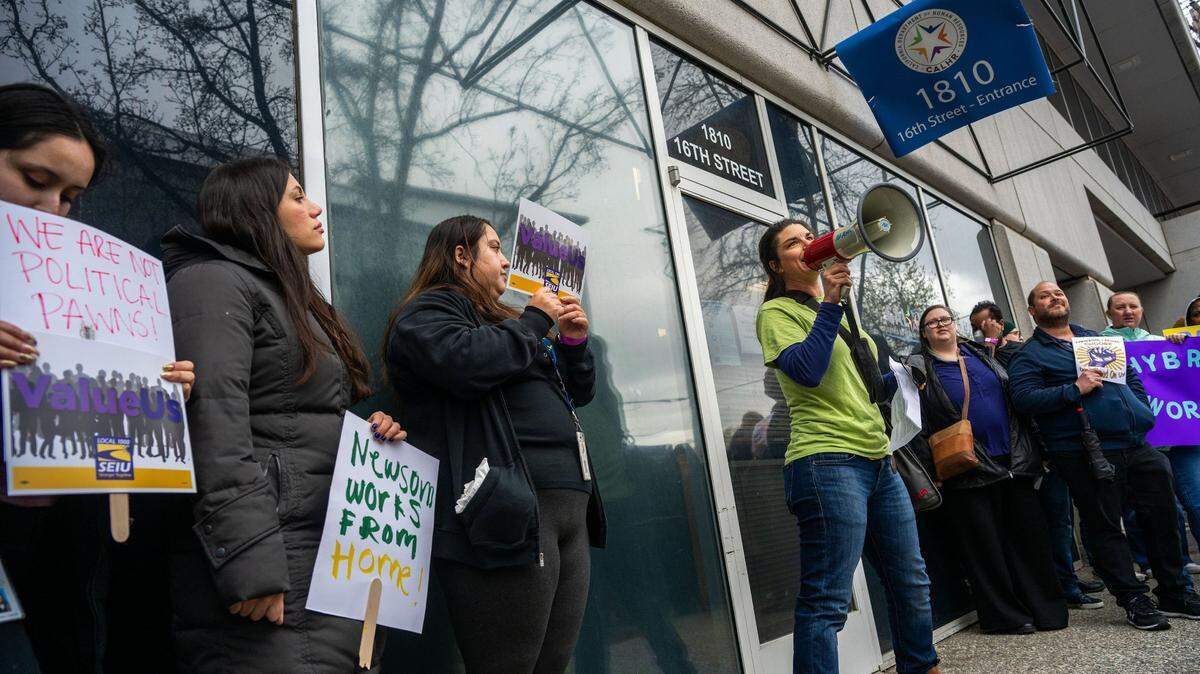
After the California Legislature passed the 2025 Budget Act in late June, unions representing state workers still negotiating with the state faced an uncomfortable truth.
The budget bill lawmakers approved didn’t include money for public employees’ raises that the state had previously agreed to in contracts. No matter how much of a fight unions put up, the Legislature had already approved hundreds of millions of dollars in reductions to state worker compensation to help address the state’s deficit.
The majority of California’s 21 bargaining units quickly adopted agreements with the California Department of Human Resources to preserve what they could. But two unions held firm, adamant that they could hammer out better deals for their members.
“We had every single right to hold out,” said Jacqueline Tkac, the president of the California Association of Professional Scientists, UAW Local 1115. “The Legislature and the governor agreed to our 2026 salary increases and there’s no way — until the Budget Act of 2026 is decided on — we have any interest in negotiating those hard-fought wins away.”
Last week, the scientists union claimed victory, announcing a new agreement with the state, which included the protection of the 2026 raises. Tkac said the extended negotiations enabled the bargaining team to nail down the exact savings the state needed to achieve per the budget act, and preserve as much for its members as possible.
Another union, representing psychiatric technicians, also reached a deal last week. While both agreements included unit-specific improvements for workers, those deals look largely similar to what other units secured in June and July.
Both agreed to leave programs that reduce workers’ pay in exchange for more vacation time that can be banked for use at a later date. Simultaneously, employees will receive raises which offset the pay cuts, but workers won’t see that salary bump in full until the leave programs expire at the end of June 2027.
Workers’ paychecks will grow as a result of recent agreements because employees will not be obligated to fund some retirement benefits for roughly two years, a decision that is expected to increase one of California’s unfunded liabilities.
Despite the similar agreements, both units said their extended negotiations with the state proved worthwhile.
“The thing that I heard over and over again from folks is protecting what we have won,” said Robert Haerr, a district director and member of the CAPS-UAW bargaining team. Last year, the scientists union secured a hard-fought agreement with the state after spending four years without a contract.
Haerr said scientists have seen the state government’s unwillingness to come to an agreement with CAPS-UAW. The wins from last year and this most recent agreement, Haerr added, come from the union’s membership standing in solidarity.
Scientists’ protect 2026 raises
State scientists touted other wins in the recent agreement.
The state agreed to a slight increase to an existing raise, from 3% to 3.5%, for some CAP-UAW employees. The unit also managed to make changes to the telework language in its contract: Departments are now required to notify the union 60 days before altering work-from-home policies, and scientists who work in the field are allowed to count those days as in-office substitutes.
The 2026 raises appear to be a unique feature of the scientists’ side letter. A legislative analysis of this year’s ratified agreements between the state and the other bargaining units indicates that only one union besides the scientists is scheduled to receive a pay raise in fiscal year 2026-27.
California Highway Patrol officers are to receive a 5.1% salary increase next year, but that additional pay will be offset by a second leave program, which comes with a 5.1% reduction in pay. That second leave program will be added on top of the one currently in place.
While the scientists union agreed to a leave program this year that offsets their employees’ salary increases, next year’s raises, which range between 3% and 5%, will not be negated by an additional leave program.
The reason for scientists’ standout raise is because CAPS-UAW was the only unit with a contract that included 2026 pay increases, said Camille Travis, a CalHR spokesperson.
Travis noted that the 2025 Budget Act only addressed pay increases for 2025. Lawmakers would need to sign off on a budget bill to eliminate funding for those 2026 raises. Travis said there is language in the contract allowing the parties to reopen the contract next year, “should that happen.”
“Every negotiation is different, as it is driven by specific circumstances, factors, and the union’s priorities and needs,” Travis said in a statement. “All bargaining units are treated fairly and equitably regardless of when they reach agreement.”
Though many units aren’t scheduled to receive pay increases next year, several — including SEIU Local 1000, the largest representative of state workers — will have the opportunity to draft new contracts. As was seen during this last round of negotiations, unions often replicate aspects of other units’ contracts.
The raises secured by the scientists could be a preview for what other unions might expect to achieve as bargaining units look ahead at future negotiations. Next year, labor groups hope to make inroads on issues other than pay, such as the ability to telework.
Psych techs’ contract: overtime and contracting wins
The psych techs’ tentative agreement addresses some longstanding union concerns, said California Association of Psychiatric Technicians President Eric Soto.
One win, Soto said, was a reduction in the number of mandatory overtime shifts employees can be required to do each month, though that provision goes into effect in 2028. Soto said the union agreed to that timeline so the state has time to prepare for that change.
One recurring issue CAPT sees in state hospitals and prisons, where its employees work, is the reliance on “contract registries,” which involves using employees of private companies to fill in staffing gaps.
In order to monitor the state’s use of these third-party workers, CAPT secured a provision that requires the departments to meet with the union, with the goal of mitigating the need to contract out employees while still meeting staffing requirements.
“The more contract registry that you’re utilizing, you’re taking away opportunities when we could be bringing in folks into state service,” Soto said. “We wanted an opportunity to address that.”