Most state retirees stay in CA, but more are taking their pensions elsewhere
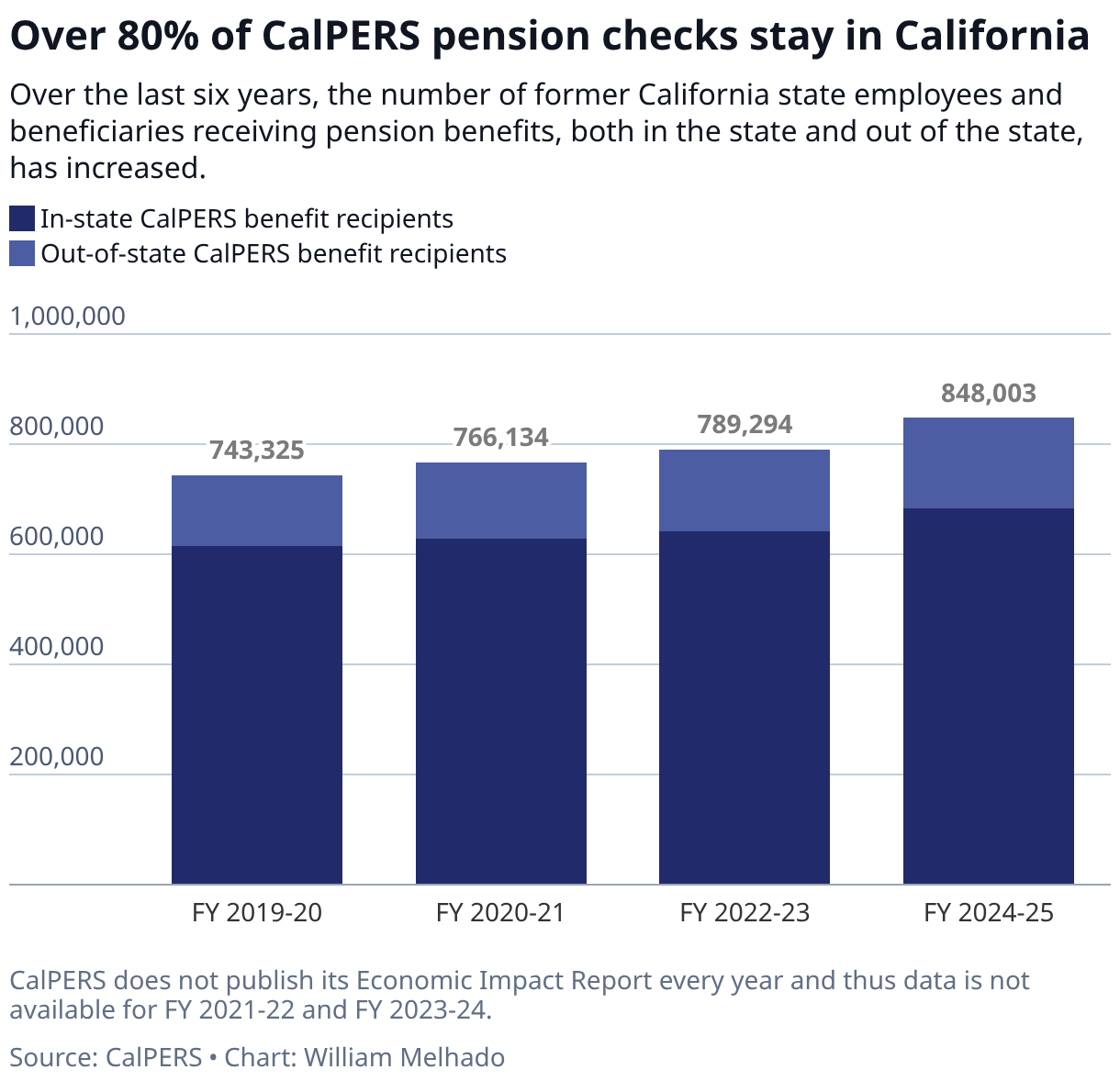
While more than 80% of retired state government employees still live in California, the number of people receiving pension checks from the public employees’ retirement system who live outside the Golden State has slowly, but steadily, increased in recent years.
Between 2019 and 2025, the number of former state workers and their beneficiaries who receive pension benefits while still living in California increased by 11%. Comparatively, the number of California pension recipients living outside the Golden State increased by 29% during those same years.
Hans Johnson, a senior fellow with the Public Policy Institute of California, said these numbers confirm what his research has shown, which is that the number of older Californians moving out of the state has generally increased over the past decade.
Despite this trend, he said, “The reality is that the vast majority of people are not leaving the state,”
CalPERS does not track the reasons retirees or beneficiaries choose to relocate, but an agency spokesperson emphasized that in-state retirees remain the majority.
“In every year of available data, more than 80% of all retirees and beneficiaries reside in California, and in‑state members consistently receive over 81% of total benefit payments,” a CalPERS spokesperson said in a statement.
In fiscal year 2019-20, 16% of the total benefit payments CalPERS distributed went to retirees or beneficiaries out of state. This past fiscal year, the state’s retirement system paid out $34 billion in pension benefits, 18% went to people living outside of California.
Johnson said the most common driver for people to leave California is the cost of housing.
Johnson said it’s difficult to measure exactly why older adults move, often because there are multiple reasons, but he has heard reports of retirees selling their homes and moving to states where their money may go further.
“If you bought your home many years ago — and many older Californians have done that — you have a tremendous amount of equity, because housing prices have increased all over the state, not just in coastal areas, but in places like Sacramento too,” he said. “That leaves some of them to really use that equity as part of their retirement planning.”
CalPERS retirees who move to other states tend to not go too far. The states with the highest number of CalPERS retirees includes Arizona, Nevada and Oregon.
Johnson also pointed out that the average CalPERS benefits paid to those living outside of California during the last fiscal year was lower than the average payment made to those still living in the state.
Those data points appear to support Johnson’s research which has shown that lower income Californians are more likely to move to a different state.
The number of people receiving pension benefits from CalPERS has increased 14% between 2019 and 2025, which is due to partially to the fact that the abnormally large baby-boom generation is in the midst of leaving the workforce, said Michael Stoll, a public policy professor at the University of California, Los Angeles.
Stoll said he was surprised there wasn’t a larger share of CalPERS retirees leaving the state, “given how much we hear about the affordability crisis” in the state.
Stoll attributed this to the fact that despite California’s high cost of living, the state still has significant benefits for retirees such as a favorable climate and recreational opportunities.
It’s long been a pattern for California retirees to take their pension dollars out of state to stretch their money further, Stoll said. Where those retirees have moved to has changed over the years as different destinations, like Oregon, have become more expensive, he said.
Shortly after the beginning of the COVID-19 pandemic there was an uptick in interstate migration, Stoll said. But migration patterns dropped after that initial surge, in part, because of the pandemic’s linger effects on housing prices and availability, which has since reduced overall interstate moves.
“It’s not clear if we’ll get back to the steady state of migration before COVID,” he said.
This story was originally published January 20, 2026 at 2:16 PM.