How CA state worker unions have fared since landmark SCOTUS decision reshaped membership
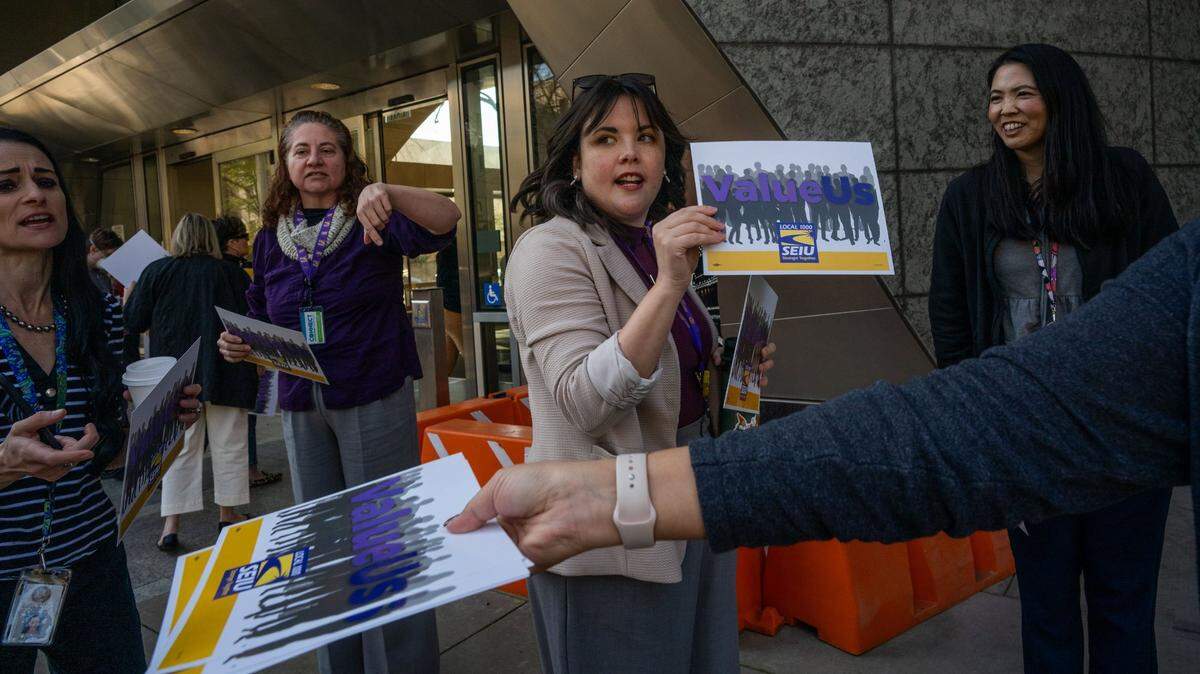
In the years since a 2018 U.S. Supreme Court allowed public-sector workers to opt out of paying for labor representation, the percentage of California’s rank-and-file government employees who are paying dues has fallen by 8%.
The 2018 decision in the Janus v. AFSCME case was celebrated by anti-labor groups and employees who did not want to pay for union representation. For public sector unions that had become accustomed to raising revenue through dues and “fair-share” fees, which non-members paid in lieu of dues, the ruling presented a threat to their power and financial stability.
Following the court’s ruling, several groups have worked to chip away that power in California, sending mailers and emails to union members that encourage them to “opt out.”
Still, state worker union leaders — frustrated by the frequent anti-union messaging — reported that the greatest obstacle to sustaining membership in recent years has not been from Janus, but rather the change in workplaces since the COVID-19 pandemic.
According to eight years of data obtained from the State Controller’s Office on the number of dues-paying state workers, some unions have slowly bled members since the Janus decision. For other bargaining units, the membership level has dropped 20% over that period.
Labor groups representing peace officers and prison staff, however, hardly saw a change pre- and post-Janus. And still other units have increased the percentage of workers who pay monthly membership dues, the data revealed.

Nearly 10 years before the Janus decision, the public’s approval of unions hit a historic low. In 2009, Americans’ approval ratings dipped below 50% for the first and only time since the public opinion polling company Gallup began assessing ratings of labor unions in 1936. In the years since, the public’s opinion of labor unions has improved substantially. Last year, 68% of Americans reported approval of unions.
The challenges to unions that came with the Janus decision, primarily the loss of money from “fair-share” fees, also came with opportunities.
“I think that while (Janus) was intended to be a huge blow for unions …. it has allowed some unions to have more ongoing conversations with represented workers,” said Brenda Muñoz, the executive director of the UC Berkeley Labor Center. “Because they have to be able to demonstrate the value of being part of a union.”
A jump in membership
When Brandon Brown started working for the Department of Pesticide Regulation in 2019, he assumed he was automatically enrolled as a member of the union representing state scientists. This was the case when he was a graduate student, and so he didn’t check to make sure dues would be taken from his monthly paycheck when he started working for the state.
It was two years after starting his civil service career, and at the prompting of a union colleague to check his pay stub to confirm he was paying dues, that Brown realized he wasn’t a member of what is now the California Association of Professional Scientists, UAW Local 1115. He immediately signed up to join.
One year before Brown started working at the state, the U.S. Supreme Court overturned a 1977 decision when it ruled that requiring workers to pay “fair-share” fees violated public-sector employees’ First Amendment right to free speech.
Anti-union groups celebrated the decision as a win for workers’ freedom. Instead of being required to pay “fair-share” fees for union representation, government employees could opt out of paying labor groups completely. Public-sector unions, which are still required to represent workers regardless of whether they pay dues, had concerns that the financial fallout of the decision would limit labor’s ability to advocate for their members and could potentially lead to more people opting out of paying dues.
In the months following the Supreme Court’s decision, several California state worker unions saw a bump in the number of people who wanted to pay dues.

Those increases came from workers who were generally supportive of unions but figured they could save a few bucks by paying “fair-share” fees instead of dues, said Ted Toppin, executive director of the Professional Engineers in California Government. Some of those “fee-payers” started paying dues after the Supreme Court decision so they could get membership benefits, he said.
At the beginning of 2018, PECG’s membership rate stood at 82%. By the end of the year the engineer union membership had increased to 87%.
“I thought the Janus decision was good for union membership in that it had members or employees understand that all you really have in this world is a union,” Toppin said. “If you’re going to make progress on your pay benefits and health care, it’s going to be done collectively. You’re not going to be able to do that individually.”
Both Brown and Toppin’s unions saw jumps in membership in 2018. CAPS-UAW later saw an even bigger jump in membership in November 2023 when the union went on strike after contract negotiations stalled. Brown said membership briefly jumped because people wanted to ensure they had as much protection as possible when they took to the picket lines.
The labor groups representing state attorneys saw the largest relative increase after the Supreme Court’s decision. Pre-Janus, membership at the California Attorneys, Administrative Law Judges and Hearing Officers in State Employment hovered around 50%. The union’s membership ranks swelled to over 63% after the Janus decision.
“We are legal professionals, and, I think, we’re all more aware of things like Supreme Court decisions in a way that other professions may not be as dialed in on,” said Maggie Tides, the chair of CASE’s membership committee.
CASE’s membership level has largely remained static, between 60% and 65%, in the eight years since.
Most of California’s other bargaining units haven’t fared so well.
After Janus, came COVID
The best way to convince new employees that joining a union, and therefore paying dues, is beneficial is through face-to-face conversations, Toppin said. He called those conversations a “staple of organizing and recruitment.”
So when the COVID-19 pandemic forced many state employees to work from home for several years, the impromptu opportunities to talk with colleagues in the office and discuss the benefits of union membership largely disappeared. Membership levels fell as a result.
One of the unions that saw the most precipitous drop during the pandemic was the Union of American Physicians and Dentists, a small bargaining unit that represents less than 1,500 rank-and-file employees. Union membership dropped from 73% to 55% between 2018 and 2025, according to data from the State Controller’s Office.
Dr. Stuart Bussey, the UAPD president, said the union’s membership was impacted by the pandemic in several ways. He said the state brought on new employees in 2020 to help respond to the pandemic, but the union didn’t reach out to encourage them to become members. Additionally, many doctors were providing telehealth, so it was difficult to recruit members in person.
Bussey said another factor was the “demoralization” some UAPD-represented employees felt working alongside privately contracted doctors and dentists, who he said make higher salaries than their state worker counterparts. He said this issue, which the union has attempted to address through negotiations with the state and other avenues, has led to some dissatisfaction with the union and prompted them to wonder why they’re paying dues.
According to state data, the American Federation of State, County and Municipal Employees Local 2620 experienced the largest decrease in union membership between 2018 and 2025. The union did not respond to a request for comment.
While telework has made it more difficult for unions to recruit new members, the topic has animated state workers over the last two years since Gov. Gavin Newsom first directed employees to begin working in-person part-time.
Other unions have managed to stave off the pandemic-related decline, largely because of the nature of their work.
Psychiatric technicians, who provide care to people in state hospitals and other institutions, are required to work in person and so it’s easier to build solidarity with coworkers.
“We’ve got a very strong, always visible presence at all of our local chapters.” said Eric Soto, president of the California Association of Psychiatric Technicians.
Because all the employees in the union generally work the same job, hold the same license and face similar challenges, “it makes it easier for us to focus on certain things,” Soto said.
CAPT has maintained a membership level around 90% since the Janus decision, though Soto’s labor group does not enjoy as much support as unions that represent peace officers.

Practically 100% of employees represented by the California Association of Highway Patrolmen and the California Correctional Peace Officers Association were dues-paying members over the eight years of data obtained. In addition to a culture in these workplaces where everyone is a union member, CAHP and CCPOA have used their significant influence to deliver good benefits to their members. This has created a strong level of loyalty to the unions.
Cal Fire Local 2881 also showed high levels of membership, but the numbers fluctuated due to the state’s practice of hiring a significant number of seasonal firefighters each year.
“The more workers have a chance to talk about their shared experience, to talk about their issues and be able to think about how they’re going to solve it together, the more likely they are to be part of a union,” Muñoz said.
‘Sharpen our tools’
In 2018, the state’s largest bargaining unit, represented by Service Employees International Union Local 1000, had 25,000 dues-paying members, amounting to roughly 50% of the employees represented by the labor group. Over the subsequent years, that SEIU Local 1000 bargaining unit grew by more than 10,000 employees — but the number of workers who paid dues remained at 25,000.
“That, to me, was probably one of the most impactful points comparing pre-Janus to today,” Orlando Ibarra, California outreach director for the Freedom Foundation, said of that bargaining unit’s nearly 10 percentage point drop in union membership. The Freedom Foundation is one of the groups that has worked to chip away at public sector unions’ membership through mailers and emails to state employees.
“In the next seven years, you could save $6,300 or more,” reads one message sent to California state workers encouraging them to opt out of paying dues. “Thanks to this landmark Supreme Court decision, all public workers — just like you — now have the right to choose where their money goes each month.”
SEIU Local 1000 union members are a frequent recipient of those messages. The union, which is the largest representative of state employees, covers a wide range of employees in different bargaining units that enjoy varying levels of support.
Bargaining Unit 15, which represents custodians and food service workers who work in state prisons and other institutions, has one of highest levels of support of any group. Comparatively, one in four employees represented by Bargaining Unit 1, which includes IT analysts and accounting officers, support the union financially.

That large of a union comes with challenges, said Anica Walls, the president of SEIU Local 1000.
“Every bargaining unit does not speak the same language,” Walls said. “We have different issues that affect us in different ways.”
Ibarra said that the Janus ruling enabled public employees to decide whether to financially support the union. Freedom Foundation’s outreach empowers them to take the step of separating themselves from the union.
Ibarra said that in February of this year alone, 200 people completed a form through the Freedom Foundation’s website that would enable them to opt out of SEIU Local 1000.
The group’s efforts to encourage workers to opt out of paying dues is intended to siphon power from well-funded unions who play a significant role in California and national politics. As an example, Ibarra pointed to the millions that public-sector unions poured into the Proposition 50 redistricting race last year, which he says goes beyond what union’s interests should be.
“It’s a little cheesy to say, but it really is freedom to choose if they want to keep paying a union fee for politics,” he said
Walls acknowledged that the union took a significant hit financially by the loss of revenue from “fair-share” fees. In response, the union had to figure out how to be more efficient while still providing the same services.
“It opened an opportunity for us to sharpen our tools,” Walls said, echoing what other labor leaders said about how Janus had impacted the union’s need to communicate with and recruit new members.
“We need to absolutely stay engaged and continue to talk to our membership and make sure that they have information from us — the union — not the misinformation that organizations like the Freedom Foundation will try to pour out to us in our mailboxes, our emails,” she said.