Becerra, Hilton or Steyer? What will each mean for California state workers?
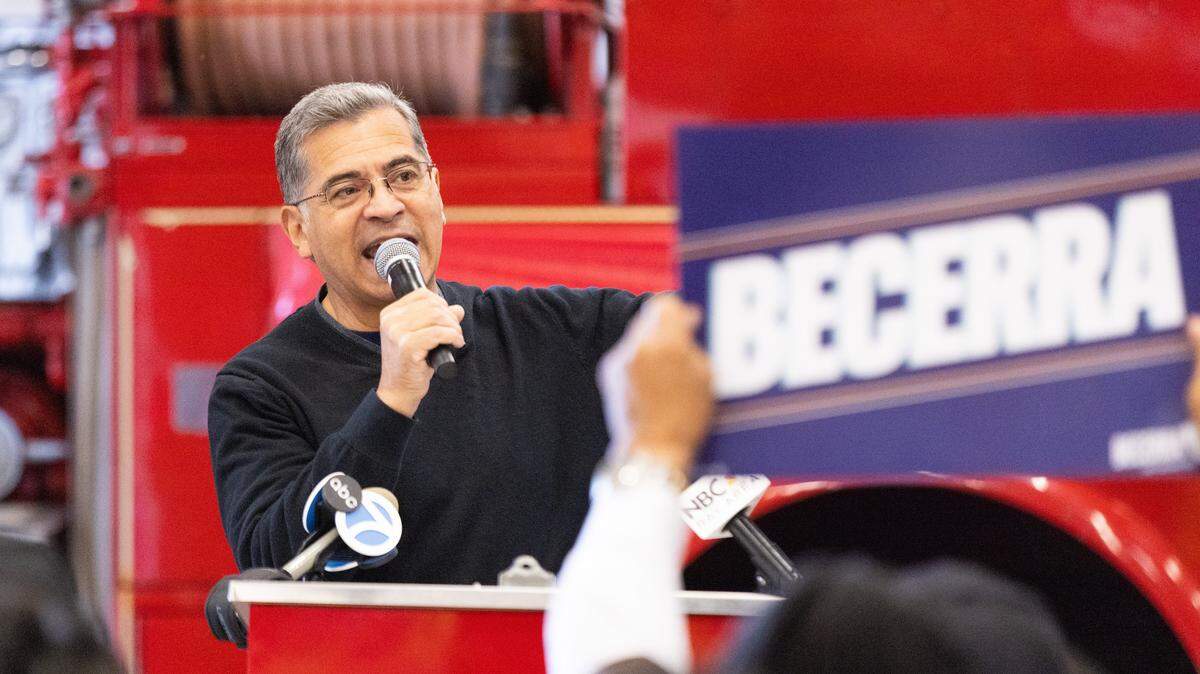
Though the primary is over, the race for the top two spots in the general election for California’s governor is still on.
It was not yet clear as of late Tuesday night which of the three front-runners will come out on top. Initial results suggest the final matchup will be Democrat Xavier Becerra versus Republican Steve Hilton, who respectively have 26% and 28% of the total votes as of late Tuesday evening. But as the state slowly counts more votes over the coming days, the general election could also result in a faceoff between Becerra and his progressive opponent Tom Steyer.
The two ballot options have different outcomes for California’s state workers.
In the event it’s Hilton against Becerra, the Republican faces an uphill battle against the former U.S. Health and Human Services secretary in deep-blue California.
If the two Democrats lock out the GOP candidate, Steyer and Becerra will have to fight it out until November to convince California voters who might be a better choice to lead the state for four years.
Here’s a breakdown of the three candidates and how they might serve as state workers’ next boss after Gov. Gavin Newsom leaves office.
Xavier Becerra
Becerra appears to have an even-headed, deliberate management style, according to his former associates who spoke with Politico for a recent profile of the former California attorney general.
“Once he’s reached a conclusion, it’s hard to dislodge him from that conclusion,” Rep. Zoe Lofgren, D-San Jose, told the news organization. “But I will say this: He does not just jump to a conclusion.”
Former HHS employees who worked with Becerra told the news organization that his “even-temperdness” and “deliberative habits” proved helpful during public health crises.
In a statement, Becerra previously said that he would honor all provisions in state workers’ collective bargaining agreements.
On the topic of telework for state employees, he said the practice was an important element of the 21st century workplace, but he stopped short of explicitly endorsing a specific remote work policy.
“What should drive state policy on return to office is the goal of ensuring the highest performance, productivity and resilience of our state workers,” the candidate said. “And we must strive to retain the talent and experience of the people who make our state government work, rather than allow them to be poached by other employers after they have acquired valuable skills, training and experience through public service.”
Steve Hilton
Hilton, a former Fox News commentator, has previously said he would make sweeping changes to the state’s workforce.
“We need a drastic reduction in the state government workforce,” Hilton said in an interview with The Sacramento Bee earlier this year.
The leading Republican said that if elected he would establish a duplicate of the Trump administration’s Department of Government Efficiency that sought to reduce the size of the federal government’s workforce. Hilton’s Cal DOGE would cut back on areas of state government that he sees as bloated, he said.
“CAL DOGE’s mission goes beyond uncovering fraud, waste and abuse. A key focus will be government reform, including identifying every opportunity to reduce or eliminate the size and scope of state agencies, end duplication across state, regional, county and local governments, and roll back bureaucratic and regulatory structures that drive up costs for families and businesses,” Hilton announced in a January news release about the effort.
The GOP contender didn’t have a clear stance on whether he would support telework for state employers, in part, because his priority was to shrink the size of state government. “That’s far higher a priority than fiddling around about where people work,” he said.
Hilton said he would need to hear the arguments in favor and against telework before making a decision on the topic.
Hilton has some experience working in government, though not in the United States. Hilton served as British Prime Minister David Cameron’s director of strategy from 2010 to 2012. He later worked as a conservative commentator for Fox News for several years after moving to California.
Tom Steyer
Steyer’s public record as a manager is thin given that he has never held public office.
For much of his career Steyer led a successful San Francisco hedge fund. He subsequently used his billions in personal wealth to fight climate change and to fund political campaigns. Steyer has already spent over $200 million on his bid for governor.
Steyer has the backing of major labor groups in California, including the California Federation of Labor Unions and the Service Employees International Union. The latter represents a significant number of state workers.
Steyer is also endorsed by the California Attorneys Administrative Law Judges and Hearing Officers in State Employment, which represents roughly 5,000 state employees.
“Our next governor must stand with us as we fight for wage parity, protect our members’ ability to telework, and deliver a strong contract in 2028,” the state attorneys union said in a statement. “Tom Steyer is that governor, and we look forward to working with him to build a California that works for all its people — including the public servants who make it run.”
The billionaire philanthropist’s campaign team did not respond to questions about where Steyer stands on telework for state employees.
This story was originally published June 3, 2026 at 5:00 AM.