What do state workers have to say about the impending return-to-office order?
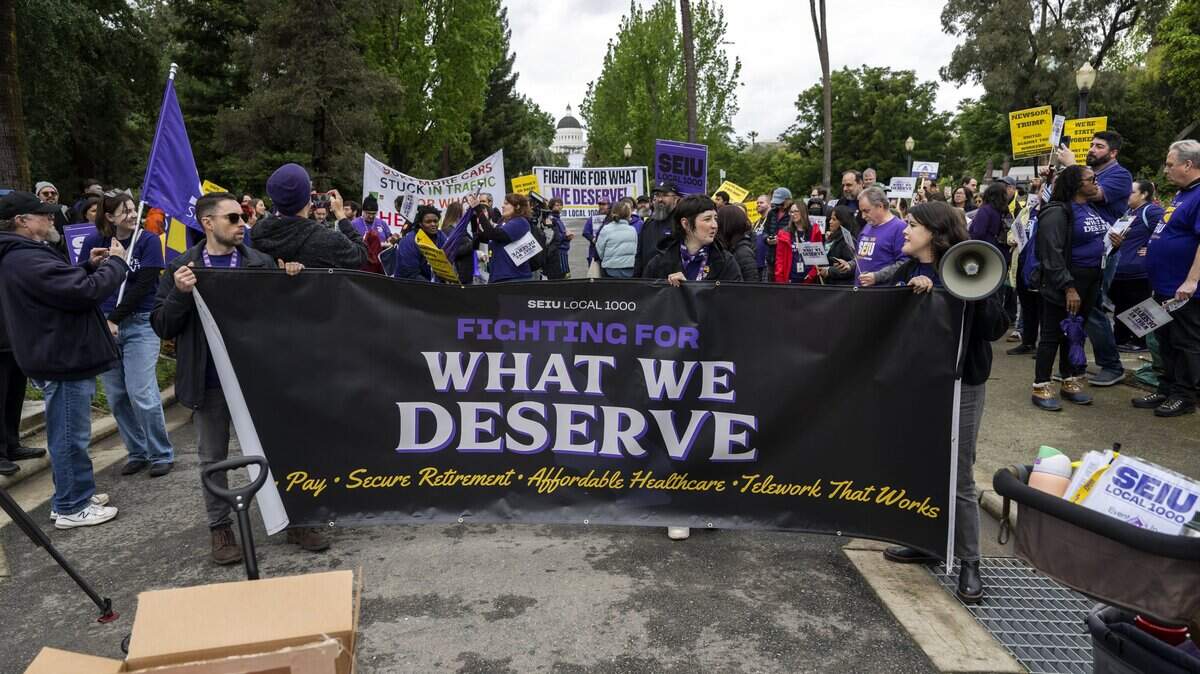
On the contentious topic of Gov. Gavin Newsom’s return-to-office order, there are some who say state workers should stop complaining about being asked to come back to offices. They should have to deal with the headaches of working in person like so many others are required to do.
“While most Americans returned to the office years ago, government workers are fighting to maintain their special treatment,” the Washington Post editorial board wrote earlier this month in an editorial about California state workers’ telework fight.
But according to state employees, these attitudes flatten the debate around telework and how it has improved working conditions for civil service workers while their wage growth has lagged amid rising costs of living in California.
To voice their support for telework, state workers have regularly held rallies in opposition to Newsom’s return-to-office order and erected billboards along freeways to support their cause.
To get a more nuanced perspective of state workers’ views on telework, The Sacramento Bee conducted a survey asking for readers’ return-to-office concerns and about how the policy change will impact them. Over 150 readers responded, and a handful agreed to share their perspectives publicly.
Readers from at least 30 different state departments responded to the survey. They spoke on behalf of themselves, not their departments.
The top concern, cited by roughly three out of four respondents, was the financial burden associated with the transition back to offices now that gas prices in California have reached nearly $6 per gallon and childcare costs remain persistently high. The next most cited concern was about how the return-to-office push would disrupt a work-life balance many state workers have come to value.
The Bee’s survey was conducted between May 27 and June 10 using a web-based questionnaire, which 157 respondents completed. People who receive the Bee’s State Worker newsletter were invited to participate.
Here’s what else state workers shared.
Why should state workers buoy downtown businesses?
Colleen Davis, an analyst with the state’s Civil Rights Department, asked whether the return-to-office order is designed to keep downtown businesses in Sacramento profitable. Newsom has previously acknowledged that when he issued his executive order he was thinking about the “mom and pop” businesses, like sandwich shops, that are struggling to make ends meet.
“While I am not unfeeling towards their struggles, why am I responsible for remedying the economy of downtown Sac when I don’t even live in Sacramento?” Davis asked.
Davis wondered why the economic health of Sacramento was more important than her local communities, Orangevale and Folsom, where she works remotely.
“Why are we not focused on larger, more permanent solutions to make downtown a desirable destination for more consumers?” she asked.
Cost pressures squeeze employees
In recent years, annual inflation rates have regularly outpaced the 3% general salary increases many state workers were granted as part of their recent labor contracts with the state.
During last year’s budget negotiations, public sector unions signed new agreements with the state that resulted in moderate pay increases in exchange for suspending retirement contributions and instituting a leave program for state employees. The deals helped address the state’s deficit, but resulted in marginal wage gains for state workers.
“Our wages have barely increased the last few years, while inflation has skyrocketed,” said Adam Whitcomb, a California Department of Transportation analyst. “The return-to-office mandate strips us of even more money.”
The increased cost for commuting and working in person will hit lower paid state workers more, Whitcomb noted. He said commuting will add five hours of commuting time each week to perform the same job he has done from home over the past six years, despite the fact that his position doesn’t require any in-person work.
“Working for the state is not a good deal anymore,” he added.
A California Department of Public Health employee who requested anonymity to share his concerns said that unions have spent an unhealthy amount of time focusing on the fight for telework, instead of negotiating better salary increases
“Defending our teleworking privileges are important but not at the cost of defending our real wages,” the CDPH employee said. “Telework provides relief, but what we really need is enough pay to go to work in the first place.”
What’s the reason?
Newsom has maintained that the reason for this executive order is to increase state workers’ opportunities to collaborate, mentor younger employees and improve the public’s trust in government.
But many state workers are skeptical of that reasoning.
“If there was a drop in productivity or quality of the work, I would understand the mandate,” said Sabrina Barrera, a California Department of Consumer Affairs employee. “However, every staff meeting I’ve attended at DCA, the executive officer of the board I’m employed with has given staff a glowing review.”
Chelsea Carney, a health program specialist at the public health department, echoed the claim that telework has made state workers more productive. A survey conducted by the California State Auditor’s Office found that 31% of agency officials reported the department’s productivity was improved by telework.
“I’m concerned about the lack of transparency from the governor around RTO when the data clearly shows that state workers are more productive working from home and that telework is a huge cost savings for the state during a time when we all feel the economic pressures,” Carney said referring to another finding from the auditor’s report, which is that California could save up to $225 million annually if the state maintained its current telework schedule and reduced office space costs.
Remote work offers flexibility to parents, caregivers
For many state employees, the flexibility of remote work has made it easier to navigate childcare and support their families.
“Telework has allowed me to be more involved with my children’s school,” Carney, a CDPH worker, said. “There’s no way I could do that if I had to travel to the office every day.”
Leif Jones, an employee with the California Department of Housing and Community Development, said that teleworking enables him to maintain an effective work-life balance by offering the flexibility to care for family members when needed. Jones said two of his family members are seniors and without the ability to work remotely he will not be able to provide them support.
“I think many state workers are grieving something bigger than just a commute,” said Margaret Silver, who also is an HCD employee. “For a lot of us, remote work represents progress. It allowed parents to stay in the workforce. It allowed talented people outside Sacramento to contribute. It gave opportunities to people who may not have otherwise been able to pursue state careers because of geography, caregiving responsibilities, disabilities, or financial barriers.”
Silver said state workers are asking for flexibility in a state where affordability and quality of life are becoming harder every year.
“And many of us are quietly asking whether there is still room in public service for people trying to balance both meaningful careers and meaningful lives,” she said.