Enough rain? Sufficient snow? Here’s how wet California, and Sacramento, got in 2019
It’s a new year, and a time to take stock in California’s most precious commodity: water.
While October marks the start of the new water year, state hydrology leaders opened the new year with the first measure of snowpack in the Sierra Nevada, east of Sacramento. Coupled with the rainfall totals for the calendar year, thanks to a series of storms in late November, Thursday’s measurement brought a hopeful start for the state’s biggest source of water.
Numbers from the National Weather Service and California Department of Water Resources tell the story of 2019 for the Sacramento region, Northern California and the Sierra Nevada mountains: a very wet start, followed by a long dry spell from late spring into mid-November, and finally a few winter storms to end the year strong.
Those storms brought an end to California’s 2019 wildfire season, which had roared to life in the autumn months with Sonoma County’s Kincade Fire and other significant blazes in Northern and Southern California after a relatively quiet summer.
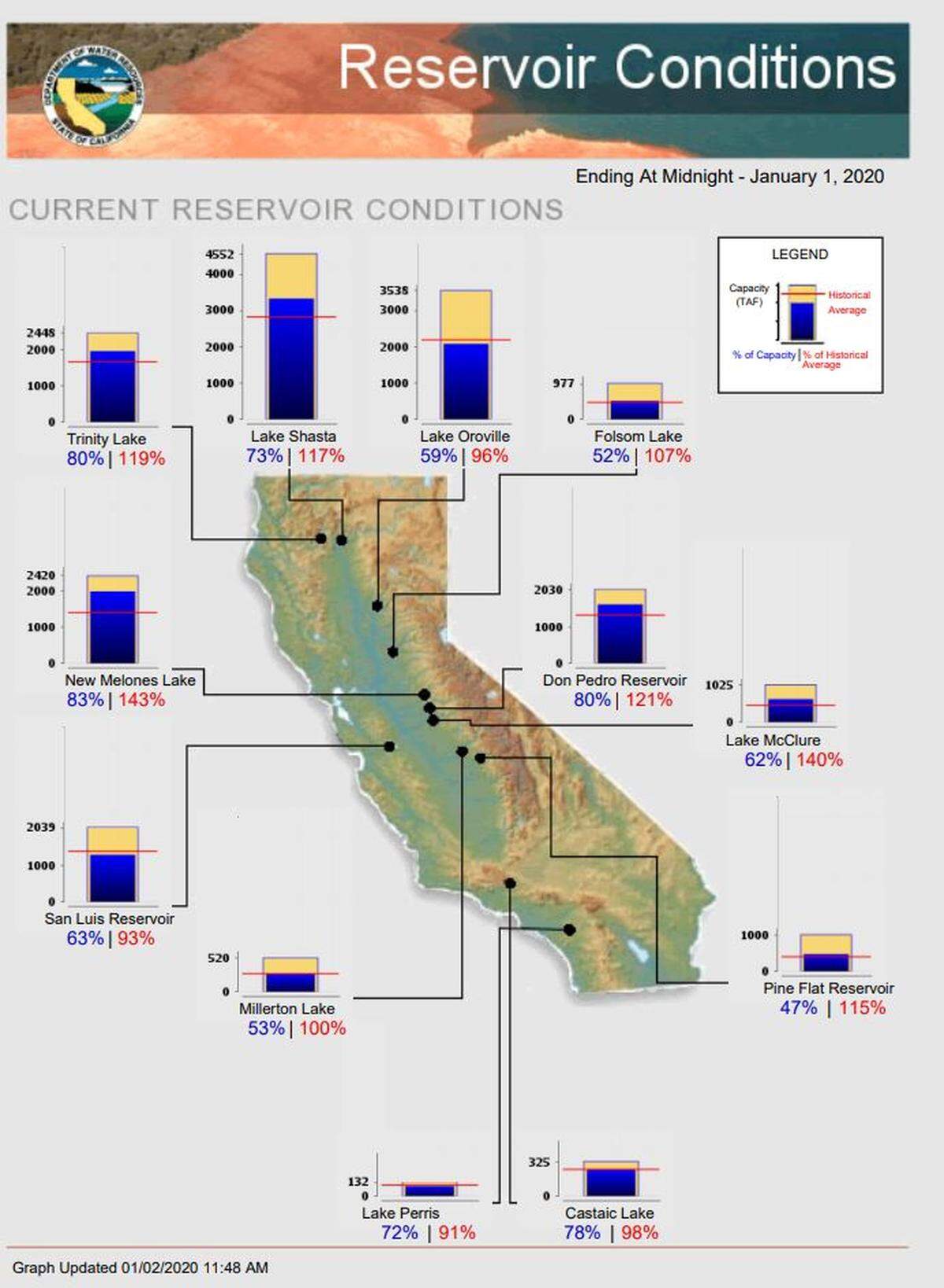
Heavy rain and snow bookending 2019 also mean reservoirs are in good shape to start 2020.
As of Wednesday, eight of DWR’s 12 reservoirs were at or above historical average levels, and none were below 91 percent of normal.
The Folsom Lake Reservoir was at 107 percent of its normal level this time of year, and at 52 percent of its full capacity. Lake Oroville in Butte County is at 96 percent of normal and 59 percent of its capacity; New Melones Lake is at 143 percent of normal, 83 percent full; and the Deon Pedro Reservoir is at 121 percent of average, 80 percent full.
How much did it rain in Sacramento?
Sacramento’s yearly average rainfall is about 17.8 inches, according to the NWS. Through Monday, the station at Sacramento Executive Airport had received 24.9 inches for the year.
That makes 2019 Sacramento’s second-wettest calendar year in two decades, edged by only by the 26 inches of precipitation that fell in 2017, the year that then-Gov. Jerry Brown declared an official end to California’s drought.
Prior to that, the wettest year came in 1998, when just under 28 inches of rain fell at the city’s main weather station. Last year’s mark of 24.9 inches also represented Sacramento’s sixth-wettest calendar year on record, dating back to 1948.
Nearly 20 inches fell from January to May 2019, boosted by 7.84 inches that fell in February thanks to strong atmospheric river systems that pounded Northern California with powerful storms.
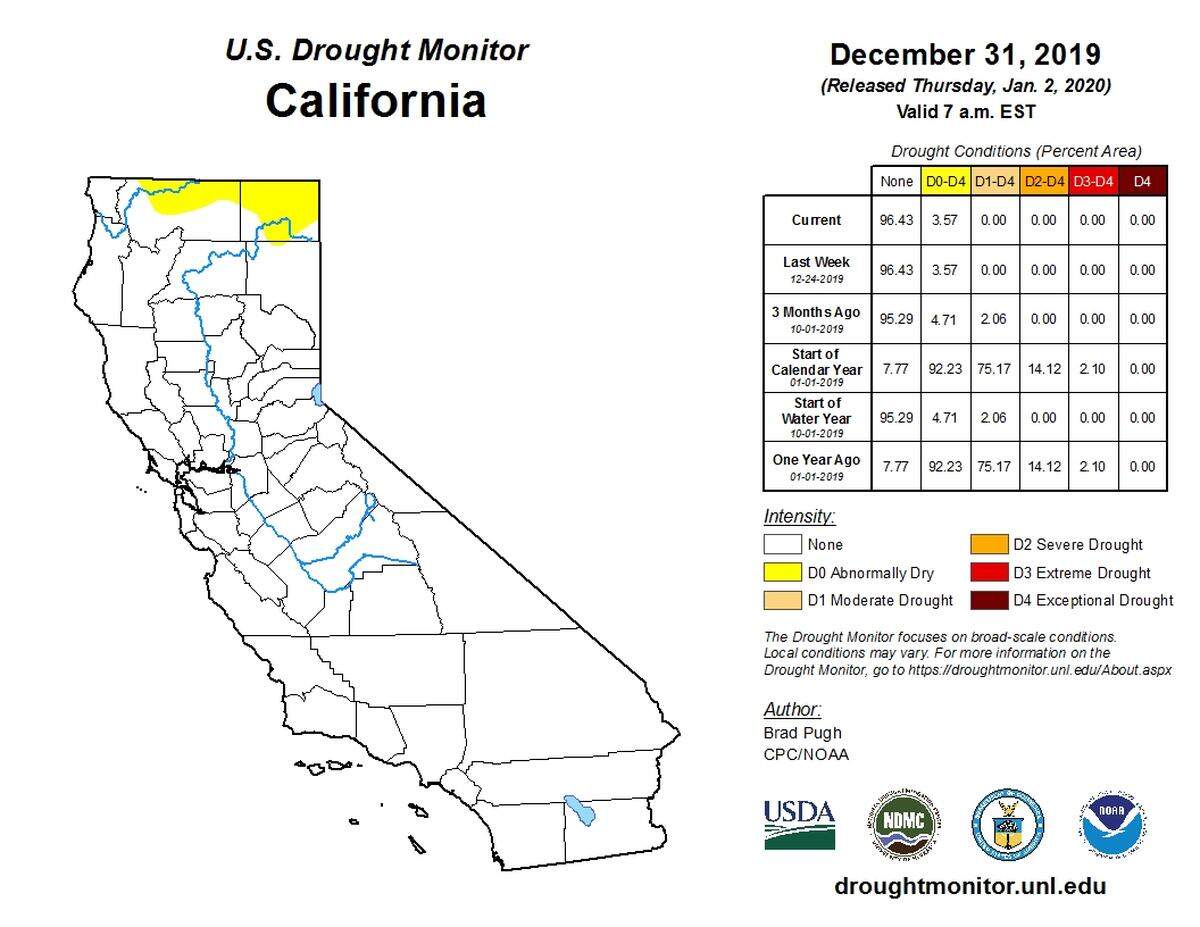
The wet trend was a welcome sign, and it led the U.S. Drought Monitor to show the entire state becoming drought-free for the first time in about eight years.
But in Sacramento and across most of the rest of Northern California, the rain halted. From late May through late November, just over one-tenth of an inch of measurable precipitation was recorded in the capital city.
But then December ended the water year on a high note, with more than an inch-and-a-half falling the first two days of the month to jump-start Sacramento to total of 4.35 inches by the end of the month, 1.3 inches more than average.
A precipitation map by the NWS confirms it was a wetter-than-normal December throughout most of the state.
How about Sierra snowpack?
The statewide average snow-water equivalent, across the Sierra Nevada range, stood at 9 inches as of the last day of 2019, according to the DWR. That represents 94 percent of normal for California, and is the best year-end figure since 2015, when it reached 106 percent.
DWR officials conducted the first manual snow survey of 2020 Thursday at Phillips Station near Echo Summit, recording a snow depth of 33.5 inches for a snow-water equivalent of 11 inches.
Sean DeGuzman, chief of snow surveys and water supply forecasting at the DWR, said those numbers are about 97 percent of average for the start of January, and 44 percent of the average snowpack for April, which is when snowpack typically peaks.
“It’s still too early to predict what the remainder of the year will bring in terms of snowpack,” he said.
DeGuzman stood atop heavy powder and wearing a beanie and thick blue jacket as he announced the results, streamed live via Facebook.
“While the series of cold weather storms in November and December has provided a good start to the 2020 snowpack, precipitation in Northern California is still below average for this time of year,” DWR Director Karla Nemeth said in a prepared statement. “We must remember how variable California’s climate is and what a profound impact climate change has on our snowpack.”
Surveys at Phillips Station over the first few months of 2019 brought good news for the state’s water health. A reading of 51 inches of snow-water equivalent at the start of April made it the fourth-best start to that month ever recorded thanks to Northern California’s torrential storms early last year.
What does this mean for state’s drought status?
Though a “drought” technically refers to a statewide emergency being declared, as Gov. Brown did in January 2014, California is in excellent shape, according to the U.S. Drought Monitor.
According to a map released Thursday with data through the last day of 2019, more than 96 percent of the state’s land area has no measurable level of drought or “abnormal dryness.” The only dry patch is seen in the state’s northeast corner.
On Jan. 1, 2019, more than 92 percent of California had some level of drought or dryness, according to the monitor.
This story was originally published January 2, 2020 at 1:04 PM.