Sacramento’s driest-ever start, Sierra snowpack at historic low as California drought persists
Powerful storms in October and December couldn’t carry California through the wet season, nor could moderate bouts of rain and snow in late March rescue the state from a dismal first half of the 2021-22 water year.
Statewide snowpack through Friday, at an average of 10.6 inches of snow-water equivalent, marked just 38% of the historic normal for the date, according to the California Department of Water Resources.
The northern Sierra Nevada range was at just 28% of normal, the central Sierra at 42% and the southern Sierra at 43%.
State water officials performing the final snowpack measurement of the water year Friday at Phillips Station reported even more dramatic figures at the site near Sierra-at-Tahoe: a snow depth of 2½ inches, and snow-water equivalent of just a single inch.
The latter amount represents a measly 4% of the historic average for the April 1 survey, Department of Water Resources snow survey manager Sean de Guzman said of the survey results in a Facebook livestream.
De Guzman read those results as he stood on near-barren ground with a dry, blue measuring instrument in his hand. One month earlier, he stood in the same spot in a thick winter jacket, standing atop a mound of powder that that same instrument measured at 35 inches in depth.
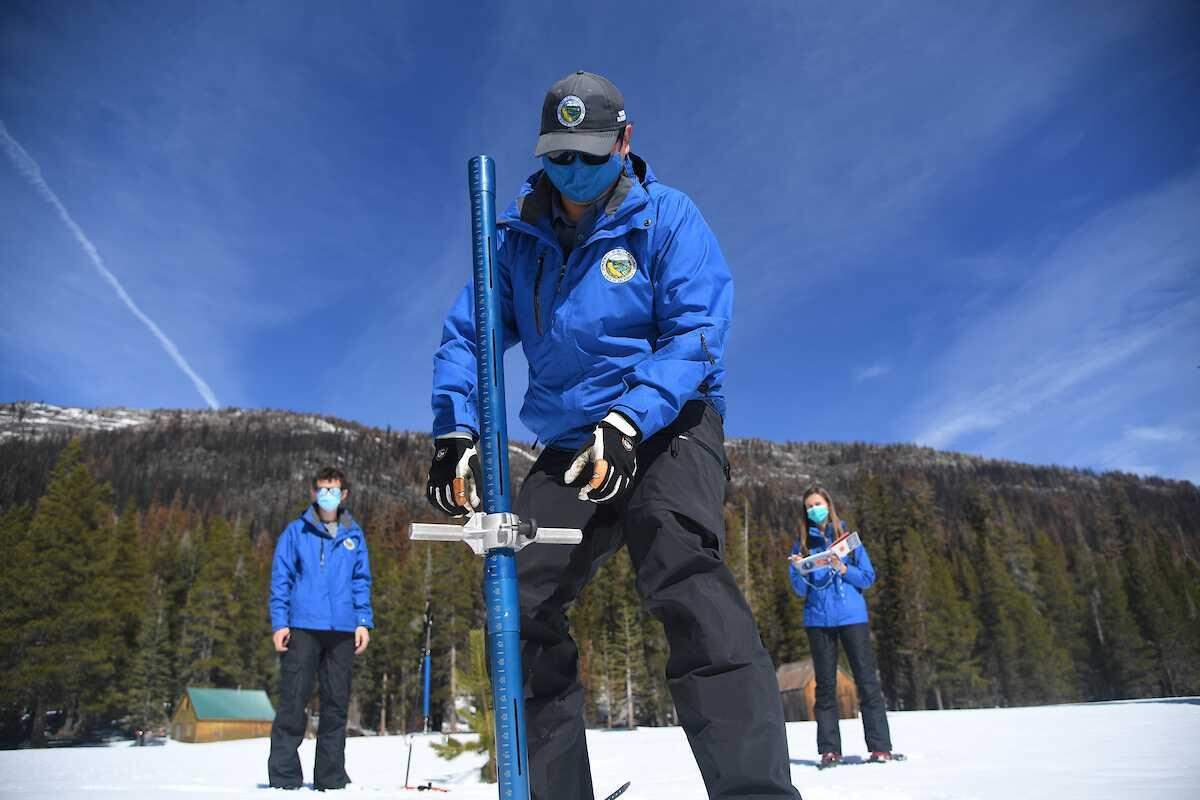
But his message was the same both days: Poor rain and snow totals for the winter months mean another year of drought is incoming.
“This past January, February and March have been actually the driest period on record in the Sierra Nevada, in over 100 years,” he said.
“During that period, California has only received about half the amount of rainfall recorded in comparison to 2013, which ended up turning into the driest calendar year on record.”
Statewide snow levels are a profound disappointment after snowstorms smashed records in December.
California’s snowpack had been at 154% of normal by Jan. 1. Then it withered, to 93% by Feb. 1 and to 64% by March 1 before Friday’s 38%.
“The small amounts of snowfall that have happened since (December) haven’t been enough to outpace the amount of snow melt,” de Guzman continued.
There was one glimmer of good news: “Our watersheds look to be in better condition this year for that snow to actually melt and run off, and hopefully not soak up into those dry soils as much as they did last year.”
De Guzman said his team is working now to forecast how much of the remaining snowpack is expected to melt and run off into California’s reservoirs, to get a better idea of the anticipated water supply this spring and summer.
All 17 of the state’s reservoirs were below their historic average for March 31, according to state water officials, and 10 of them are below 70% of average.
California’s largest, Lake Shasta, is at 48% of its historic average and 38% of its total capacity. The second-largest, Lake Oroville, is at 67% of average and 47% of capacity.
Folsom Lake is among the state’s fullest, at 95% of average and 60% of capacity by the end of March, according to Department of Water Resources data.
Driest start to year in Sacramento history, by far
Downtown Sacramento went an unprecedented 66 days without recorded rainfall, book-ended by just 0.05 inches on Jan. 7 and 0.34 inches on March 15.
Historically, the capital city averages just over 10 inches of rain through the first three months of the calendar year.
This year, just under an inch has fallen downtown — 0.98 inches, about a half-inch of which fell Monday, according to National Weather Service records.
That’s by far the driest January-to-March stretch in Sacramento history, according to weather service records that go back to 1858.
The next-closest marks were 2.36 inches, in 1864, and 2.45 inches, in 2015.
In fact, prior to 2022, there had never been a year on record in which at least one of January, February or March did not exceed an inch, let alone all three combining for below an inch. And 2022 marked just the second year, after 2020, in which Sacramento recorded no measurable rainfall in February.
Remarkably, the weather service said Sacramento remained at 94% of normal to date for this water year — a testament to just how wet it was in October and December.
A bomb cyclone-atmospheric river combination drenched the city with 5.44 inches of rain on Oct. 24, the single wettest day in Sacramento’s recorded history. Close to 7 inches fell in October, followed by 7 more inches in December spread across a few different storms.
Bleak drought picture as first half of water year ends
California’s water year runs from Oct. 1 to Sept. 30 of the following calendar year. A vast majority of the year’s precipitation comes in the first half, from October through March.
California is effectively guaranteed to enter its third year of drought, barring an extremely rare spate of wet weather from mid-April through early May.
The U.S. Drought Monitor in a Thursday update reported 40% of the state in “extreme” drought conditions, including wide swaths of the Central Valley and the north coast region. Another 54% is only a step better in “severe” drought, and the entire state is in at least “moderate” drought conditions, per the monitor.
Gov. Gavin Newsom earlier this week ordered cities and water agencies to tighten conservation use and cut back on water use.
State water personnel later Friday morning will report the results of a snow survey at Phillips Station west of Lake Tahoe, the last manual survey of the water year as California enters its dry season.
Water officials shared a bleak outlook during last month’s survey.
“This winter has demonstrated that as the world continues to warm, we’re seeing average conditions become more rare,” Jeremy Hill, a hydrology and flood operations manager with the Department of Water Resources, said March 1. “Precipitation is moving toward extremes.”
This story was originally published April 1, 2022 at 8:42 AM.