A cop turned Sacramento County supervisor defies expectations in areas suspicious of both
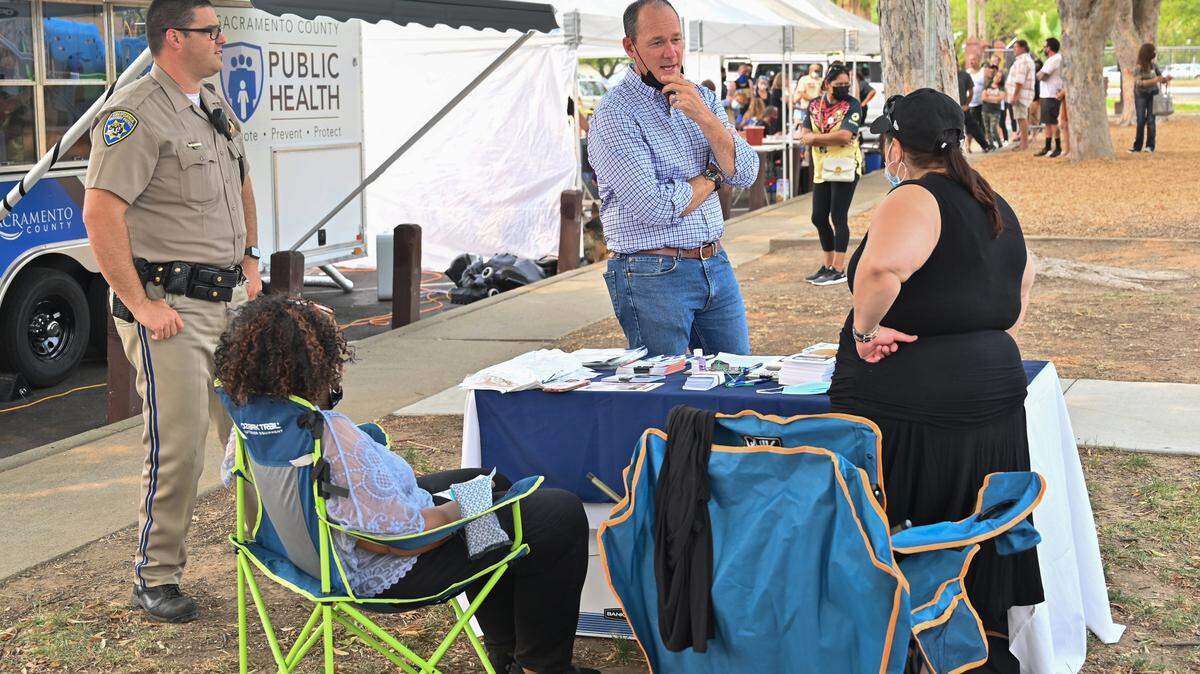
By the time I was in high school, gang violence had become regular in North Highlands. My neighborhood had deteriorated noticeably, and our issues were obviously less and less of a priority to our elected officials. Students smuggled guns into basketball games; every few weeks, there was another photo of a slain student surrounded by candles and stuffed animals sitting in silent memoriam on a street corner; and we were warned never to walk alone after dark.
It’s easy to pinpoint the closure of McClellan Air Force Base in 2001 as a turning point for the once-burgeoning communities of Sacramento County’s District 3, which generally encompasses North Highlands, Foothill Farms, Carmichael, Arden Arcade, and Fair Oaks. The loss of 14,000 jobs from the area more than two decades ago sent a shock wave through the surrounding suburbs from which they are still recovering. The district is approximately 95% unincorporated county, a disparate set of neighborhoods vastly unlike any of the other four supervisorial districts partly because it must rely on the county for governance and support.
Despite the disadvantages, my neighbors, former classmates and I remain fiercely loyal to our community. District 3 is ripe for reinvestment and longs for beautification of our streets, schools, and suburbs. But loyalty alone can’t overcome a legacy of neglect and a lack of advocacy at the most local level of government: the county.
That legacy could change with Rich Desmond, the district’s freshman supervisor.
As a former denizen of North Highlands and current resident of Carmichael, I was curious to find out how the supervisor sees the future of the communities within his purview. About a year ago, Desmond won the District 3 election by slightly more than 1% of the vote.
It wasn’t exactly “a huge mandate to go out and strike a position,” as he pointed out.
Instead, he seems to have spent his tenure so far listening to his constituents and working to resolve some of the long-standing “unique needs” of his district, including reducing homelessness, improving employment and transportation, and increasing investments in local schools.
If he can help with just one of those, the district will be in a far better place than it was during the 16-year tenure of his predecessor, Sue Peters.
Peters seemed like a reliable vote for whatever would cause the most harm to her constituents. She voted against night meetings that would have allowed more public scrutiny. She opposed a temporary ban on no-fault evictions in 2019, even after a packed chamber pleaded with her and District 4 Supervisor Sue Frost for more than an hour. At the beginning of the pandemic, she voted no on a temporary eviction ban to protect people who lost their jobs because of COVID-19.
Considered the conservative in his 2020 contest with Gregg Fishman, Desmond was expected by many to neatly fill the shoes of Peters, who backed him in the race. A longtime California Highway Patrol officer who received more than $80,000 in campaign support from the Deputy Sheriffs’ Association, he’s a cop supported by cops in a district that has long had an uneasy relationship with law enforcement.
But Desmond maintained that he never felt like Peters’ successor in any way other than the most literal. And the first-time politician has shown as much, emerging as a true centrist capable of working with both liberal and conservative supervisors. He seems far more interested in addressing the rampant homelessness in his district in innovative ways rather than cracking down on petty crime or doing favors for the deputies’ union.
“Every conversation I have either begins and/or ends with homelessness,” said Desmond, who cites the issue as one of the reasons he ran for the seat in the first place. “(I was) frustrated by the inability of the city and the county to work better together.”
The board and the city of Sacramento have a historically fraught relationship, but that’s also improved over his tenure. Desmond said he chalks a lot of that up to his place on the city-county 2x2 committee, serving alongside District 1 Supervisor Phil Serna, City Councilman Jay Schenirer, and Mayor Darrell Steinberg.
Desmond, Serna, and Steinberg, along with Assemblyman Kevin McCarty and Sacramento City Councilman Jeff Harris, recently championed legislation to authorize Cal Expo to enter into a five-year agreement with the city and county to use one of the event venue’s overflow parking lots for homeless services. Desmond and the group have been working on the idea for months.
“The site is inherently limited because of where it’s located, but I’m proud of the progress we’ve made there so far,” he said.
The day after our conversation, Desmond was headed to San Antonio with city and county staff for a tour of that city’s Haven for Hope campus, which offers tailored, all-encompassing programs for unhoused families and individuals, in an effort to bring something like it to Sacramento.
“It’s such a complex subject with so many complex causes for why someone ends up being (unhoused),” Desmond said. “I think it’s really important to look at what other municipalities are doing and how they’re dealing with this crisis in a compassionate and effective way to change people’s lives.”
Thirty years ago, the unincorporated Sacramento suburbs of North Highlands, Foothill Farms, Rio Linda, and Carmichael were thriving. Today, in North Highlands, less than 11% of residents have a college degree, nearly half (including me) are renters and a quarter live at or below the poverty line, according to a recent county report.
Decades ago, these communities “had good jobs,” Desmond said. Their residents “worked at McClellan, worked for the federal government or in support of the military.” Now, most work in blue-collar jobs like construction, and “you have a very, very high percentage of renters, very low homeownership rates, and crime has increased in those communities,” he said. “That change from McClellan has really manifested itself in so many ways, and the neighborhood has just deteriorated.”
Desmond said he would like to allocate federal stimulus funds to local organizations that focus on youth safety, schools, and perhaps beautification. He recently took a colleague on a driving tour of his district, specifically around Foothill Farms, showing him the neglected and blighted areas, pointing out the “brownfields that are just filled with trash and center medians with no landscaping.”
The vast majority of his constituents rely on Desmond for the sort of services that other areas of Sacramento County can lean on their city councils for, from trash pickup to crime prevention.
“If these areas were in a city, they would have at least five city council members just for that area to be advocating for them and calling attention to the challenges they face,” he said.
Decades of neglect have left confidence in local government low in the district even if community pride is high. Desmond calls for a “paradigm shift” toward more attention and investment in these communities, which need more time and care from the county than places like Elk Grove and Rancho Cordova. Less than a year into his term, the supervisor is off to a hopeful start toward making the long-overdue changes they need.
This story was updated to reflect the fact that Natomas is part of the city of Sacramento.
This story was originally published November 2, 2021 at 5:00 AM.