
California still has daylight saving time despite voting to end it. No wonder we’re tired
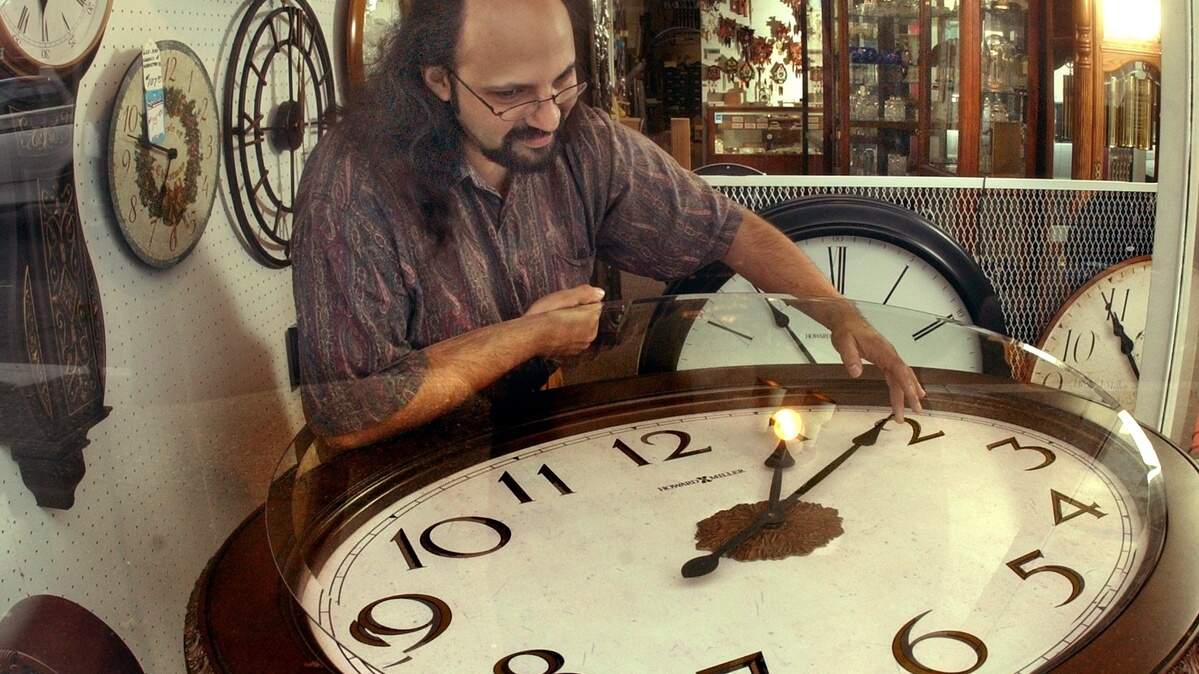
A dwindling number of rituals still unite this divided country, among them Sunday’s changing of the clocks for reasons almost everyone has forgotten. Perhaps our memories would be better if we weren’t in the habit of abruptly disrupting our sleep cycle every few months.
The semiannual oscillation between standard and daylight time comes with an extra bit of confusion for Californians. That’s because many of us are under the impression that, in the best iconoclastic spirit of our state, we did away with the obsolete exercise years ago.
In fact, we only voted to do so.
Lending it the imprimatur of the founders, daylight saving is often said to have been invented by no less a figure than Benjamin Franklin. But as with much of what Franklin came up with, he seems to have been joking.
It took a historical villain, Kaiser Wilhelm II, to get serious about this miserable idea. The German Empire advanced the clocks in an effort to save energy and seize an advantage in the First World War. Its enemies soon followed suit, including the United States, where the practice was so unpopular that Congress overrode Woodrow Wilson to do away with it. The Nazis set off another round of competitive clock-changing during World War II, when it was known in America, with more appropriately foreboding implications, as “War Time.”
Since Congress instituted annual daylight saving in 1966 and 48 states opted in, it’s been repeatedly expanded based on the German notion that it saves energy by making better use of the summer sun.
But a 2008 National Bureau of Economic Research study noted “surprisingly little evidence that (daylight saving time) actually saves energy.” Because modern cooling and heating tend to consume more energy than lighting, the researchers concluded, daylight saving actually increases energy consumption.
Worse, because the shift to daylight time leads to lost sleep, the spring change has also been linked to small but statistically significant increases in such ills as heart attacks and car crashes.
Californians had an opportunity to do something about this historic error in 2018, or at least we thought we did. Proposition 7 was a rare example of a state ballot initiative that seemed to live up to the promise of direct democracy, allowing voters to weigh in on this well-understood matter of public interest with none of the usual organized interference from people with money to make. Better yet, we came to the right conclusion, voting resoundingly to stop messing with our clocks and circadian rhythms.
California had instituted uniform standard and daylight saving time by voter initiative in 1949, so lawmakers had to get voters’ permission to do anything about it. The trouble is that once voters gave them the go-ahead, they didn’t do anything about it.
The Legislature’s lonely onetime champion of temporal integrity, then-Assemblyman Kansen Chu of San Jose, initially struggled to get the question through his chamber and in front voters because of lingering idiosyncratic attachments to daylight saving. His answer was to change his favored solution from permanent standard to permanent daylight time.
It worked until a bill to achieve that started moving in 2019, whereupon a key legislator found a reason to object. A few years after year-round standard time was effectively blocked by the Assembly, year-round daylight time was killed in the Senate.
Remarkably, it would have failed even if it succeeded. That’s because the federal law that established uniform time allows states to opt out of daylight saving, as Arizona and Hawaii have, but not out of standard time. So if the Legislature had gone ahead with the perpetual daylight proposal, as 18 other states have, it still couldn’t take effect without congressional legislation that has also languished.
So the voters’ clearly expressed will was frustrated and the timelessness of political dysfunction proven. Three years and half a dozen time changes after we voted to stop changing the clocks, the Legislature appears to have been wasting our time.