‘A 100-year flood and we’re sandbagging’: California preserves eviction loophole again
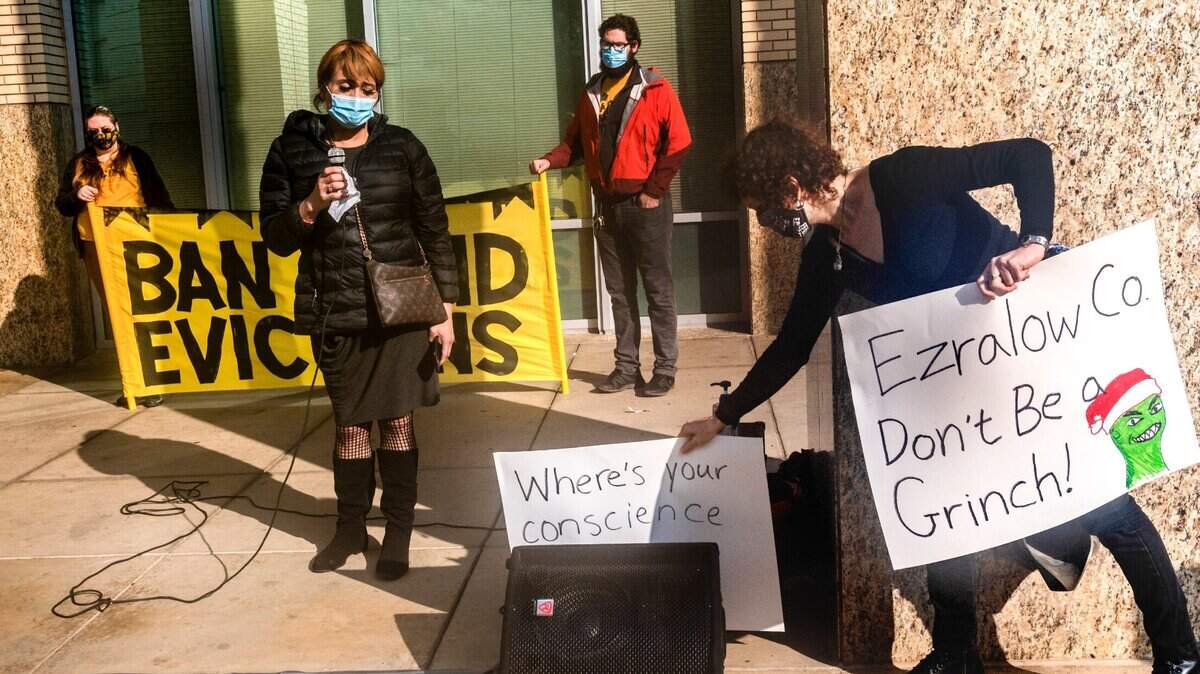
California politicians ensured last week that property owners and speculators will be able to continue evicting entire buildings of people for profit thanks to antiquated state laws favoring owners over renters.
On Feb. 1, a progressive bill to close a problematic legal loophole that has exacerbated California’s housing and homelessness crisis for more than 35 years died on the Assembly floor. Consequently, serial evictors retained their legal pretext to force out tenants in rent-controlled areas simply by claiming a property is going to be sold. For decades, it’s been misused to force out less resilient low-income renters.
AB 854, introduced by Assemblymember Alex Lee, a Silicon Valley Democrat, marked the first time in four tries over three decades that a bill seeking to amend the Ellis Act, has even reached the Assembly floor.
Passed in 1984, the Ellis Act was intended to protect mom and pop landlords by allowing them to evict tenants in rent-controlled units if they were planning to “go out of business” — i.e. retiring or putting the property up for sale. But instead the Ellis Act has allowed California landlords make a quick buck by selling to speculators who evict tenants, and then flip the property or raze it and replace it with a market-rate project.
According to Lee, more than 78% of the Ellis Act evictions in California occur within the first five years of the evicting landlord’s ownership. That’s not mom and pop businesses transitioning into retirement.
“It’s like a 100-year flood and we’re sandbagging,” said Elliot Stevenson, a member of the Sacramento Tenants Union. “It really demonstrates the need for further investment in public housing.”
Stevenson said the Ellis Act has been “horrific” for cities like San Francisco and Los Angeles, two high-priced California cities with longstanding rent control. While Sacramento lacks similar rent control policies, property speculators have flooded the area’s booming housing market during the pandemic. Last year, investment buyers purchased more than 56% of Sacramento homes compared to 2020, according to real estate brokerage Redfin.
“Ellising” a building decreases a city’s available housing stock by removing rent-controlled properties — which typically house vulnerable seniors, low-income families or communities of color — from the rental market. More than 20,000 rent-stabilized apartments housing more than 60,000 residents have been lost to Ellis Act evictions in Los Angeles just since 2001. In San Francisco, 3,600 renters were “Ellised” between 1997 and 2013.
“That doesn’t help our worsening affordable housing crisis,” Lee said. AB 854 would have prohibited property owners who have owned rental units for less than five years from using the Ellis Act to evict someone.
Lee’s bill enjoyed broad support in California, even from opposing groups. It was endorsed by the California Democratic Party, supported by Democratic central committees and clubs, YIMBY and NIMBY groups, and was formally backed by the cities of Berkeley, Culver City, Oakland, San Francisco, Santa Monica and West Hollywood.
“Until there’s an expansion in the production of public and social housing, as long as they’re flipping properties and people’s lives are caught in the middle, we’re going to be stuck like this,” Stevenson said.
California landlords like to suggest that they are too small a lobby to force change, but they hold more power than they care to admit. There is nothing to stop a coalition of small landlords like the California Apartment Association from singling out serial evictors and property speculators or from supporting legislation to ease California’s housing shortage,
Instead, the CAA gathered its forces to defeat AB 854. Members sent thousands of letters urging legislators to vote no. Their actions speak volumes, and show that they actually do have the power to follow their economic interests by selling out what little rental property remains in the state to unscrupulous speculators. That hurts everyone involved — landlords, tenants and at-risk communities alike.