
How California voters got two elections but no contest for the same U.S. Senate seat
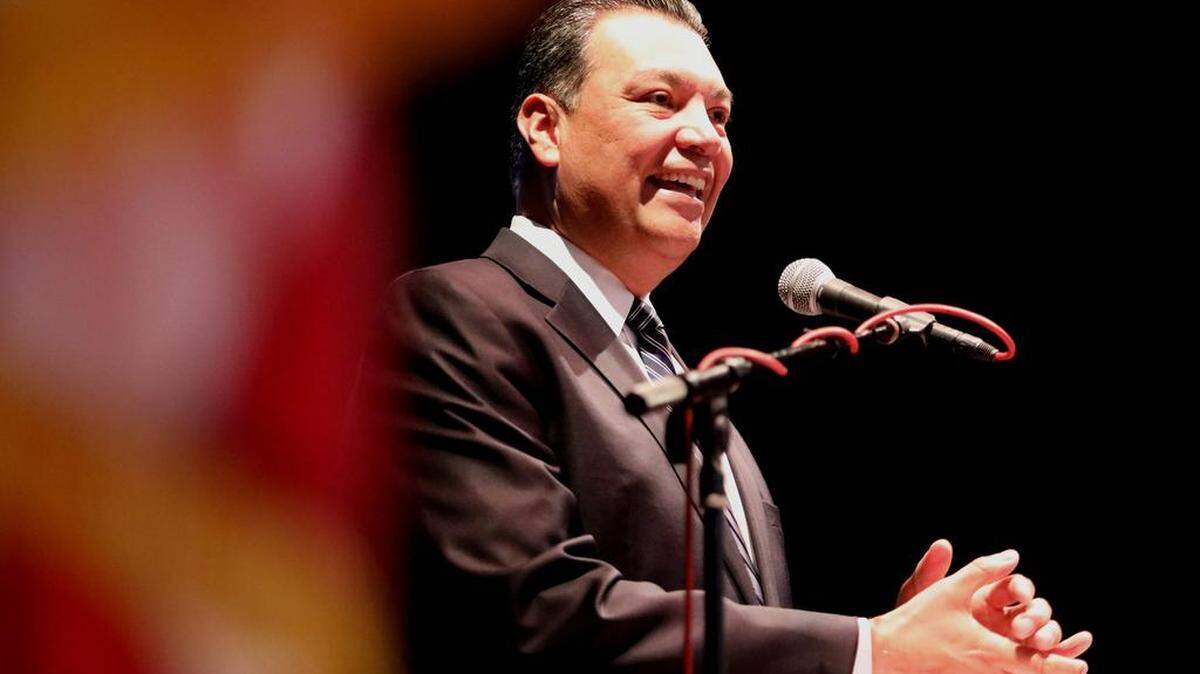
Crowded with obscure offices, also-ran candidates and misbegotten gestures toward direct democracy, the typical California ballot could wear out even the most civically energetic voter. Some might look at the latest entry and conclude they have gone bleary-eyed: The ballots mailed out last week ask us to vote for the same U.S. senator — or one of his long-shot opponents — twice.
But California voters aren’t seeing double. What we are seeing is another example of the duplicity of a political establishment that endorses democracy in form while avoiding it in substance.
Both of the twin elections concern the all-but-foreordained fate of U.S. Sen. Alex Padilla, the former California secretary of state Gov. Gavin Newsom appointed to the remainder of Vice President Kamala Harris’ Senate term. That put Padilla on track to represent California in a constitutionally elective federal office for nearly two years, the equivalent of a full term in the U.S. House or state Assembly, without facing an election.
As if to make up for lost time, Padilla now faces a pair of them. One is, straightforwardly enough, for a six-year term starting in January. The other is for the 56 days between the Nov. 8 general election and the beginning of that term on Jan. 3. And because this is just the primary, the top two finishers will also be featured in a double election on the November ballot.
It doesn’t take a political scientist to discern the practical pointlessness of this: Anyone who wants Padilla (or someone else) to serve the next six years in the Senate will probably not hold a radically different opinion about the right choice for the not quite two months beforehand.
So what is the point of this awkward contrivance? It turns out that according to recent federal court rulings, the governor’s attempt to hand Padilla a Senate seat for two years may run afoul of the U.S. Constitution, specifically the 17th Amendment. The Legislature conjured up the extra election as a legal stopgap to protect Padilla from being bounced out of office on those grounds.
The amendment, which instituted the popular election of senators over a century ago, also requires governors to call special elections to fill any vacancy in the office. But it allows legislatures to empower governors to “make temporary appointments until the people fill the vacancies by election.” That’s the consequential loophole that Newsom and other governors have exploited to anoint unelected senators to lengthy terms. It’s the same provision that tempted disgraced Illinois Gov. Rod Blagojevich to auction off Barack Obama’s former Senate seat.
Newsom’s conflict with the law is less dramatic but also revealing of the way politicians come to view these offices as theirs rather than ours. Because his appointment of Padilla continues into January, when Harris’ term ends, it goes nearly two months past this year’s regularly scheduled general election. That’s allowed by state law, but a pair of federal appellate decisions — one stemming from the Blagojevich fiasco and another in Arizona — raise questions about such arrangements.
Despite the sorely abused provision for temporary gubernatorial appointments, the Constitution ultimately requires an election to fill an unexpired term. That suggests the November election could put Padilla (or someone else) in office only for the eight more weeks in the current term that Harris would have served.
The nutty fix devised by California Democrats was a bill to bring about simultaneous elections to both the weeks remaining in the current term and the following full six-year term. Authored by Assemblyman Marc Berman, a Bay Area Democrat, it was passed along party lines and signed into law by Newsom last year.
The powers that be want us to regard this as a harmless bit of legal i-dotting and t-crossing. Secretary of State Shirley Weber — who as it happens was appointed by Newsom to Padilla’s unexpired term — appended an unenlightening “Attention Voters” note to the state’s official guide explaining that we “may vote for both contests.” And Padilla cheerfully informed his Twitter followers that he “will be on the ballot two times, which means you have given me twice the reasons to earn your vote and continue delivering results for the people of California.”
But California Democrats could have avoided the confusion, followed the spirit of the Constitution and, most importantly, demonstrated a modicum of respect for voters by calling a prompt special election for the seat. Figures as divergent as Kevin Kiley, the Republican assemblyman from Rocklin, and Christine Pelosi, a Democratic Party official and daughter of the House speaker, have argued as much.
Vacancies in the House, the state Legislature and other offices are already filled exclusively by special elections. Oregon and three other states require the same of Senate seats, and 11 others impose a variety of restrictions on gubernatorial appointments.
But wouldn’t that require an expensive extra election? Well, last year’s attempted gubernatorial recall cost $200 million, which is a lot to spend for nothing. But in the context of a state budget whose surplus alone could reach $97.5 billion, it would have been a worthwhile expense to let the people have a meaningful say on one of the nation’s most important offices.
But then Newsom, who once claimed to want no part of choosing a senator, wouldn’t have been able to put a political ally in office long enough to acquire the formidable advantages of incumbency. Not coincidentally, as The Bee recently reported, Padilla’s opponents in the twin primaries include two chiropractors, one podiatrist and a billionaire concerned about self-driving cars, but they don’t include anyone who is likely to beat the senator. Instead of one real contest to succeed the vice president, we’re getting two nominal ones.
Worse, given recent agitating to dislodge California’s senior senator, Dianne Feinstein — who, as it happens, won the seat by defeating a Republican appointed by Gov. Pete Wilson — it’s not difficult to imagine this scenario repeating itself soon. Newsom has even mused about the desired demographic specifications of the next senator he anoints.
That the current beneficiary of this end run around the electorate previously served as the state’s top elections official is rich indeed. The result for voters epitomizes the trouble with too many California elections: plenty of voting but precious little democracy.