R Street’s renaissance was a joy to experience. And then they let the cars come back
When Derar Zawaydeh opened midtown’s Crepeville for outdoor dining on an adjacent sidewalk in 2005, he said it was hard to get the relevant permits from the city. But Zawaydeh, who also owns Burgers & Brew on R Street, said everything changed after the pandemic upended our daily lives in March of 2020.
“Now I’m seeing a shift where (cities) are actually encouraging the outdoor scene,” he said. “People want to be outside because they’re indoors all day. They want to sit outside and have a decent meal in a safe environment.”
The city of Sacramento approved an Al Fresco Dining Program in May 2020 after the pandemic decimated indoor dining. City officials allowed restaurateurs to set up tables on sidewalks outside of their businesses to promote social distancing, and it quickly became a popular option for diners and a way to keep owners such as Zawaydeh from closing permanently.
Two years on, the City Council recently voted to make Sacramento’s Al Fresco Dining Program permanent in June, but that meant restaurant owners who were previously utilizing cordoned-off street space were required to take down their temporary tents by the end of July.
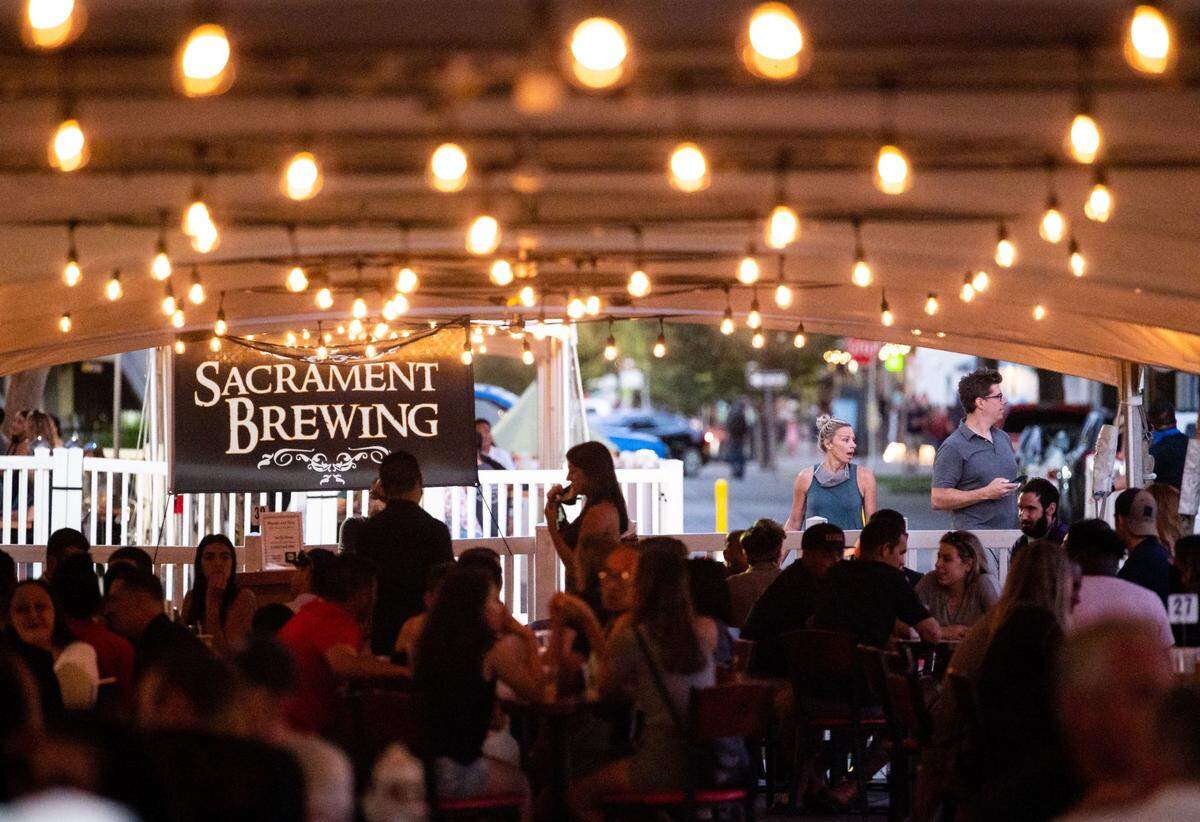
Once a pedestrian safe haven, full of white event tents with plastic windows and mingling neighbors, R Street and other formerly cordoned-off streets will open once more to car traffic. Restaurant owners can apply and pay for city-approved permits to create permanent “parklets” on the sidewalk or in parking spaces directly in front of their businesses, but not in the street, as some restaurants had opted to do when the streets were closed. Zawaydeh shared his tent patio with nearby bar-restaurants Bawk and Shady Lady, which gave each of them about 50 extra seats beyond their indoor capacity.
“We’re trying to move toward permitting everything properly and make sure it’s ADA-accessible,” said city media communications specialist Gabby Miller. “(We have to) ensure that there are safe and durable patios in the public right of way.”
Wesley Fagundes with R Street Sacramento Partnership, which manages the R Street Property and Business Improvement District, said removing the program’s temporary status was a joint decision between business owners on R Street and the city.
“All of the businesses would be happy to keep it, but we don’t have the infrastructure in place,” she said. The tents “weren’t made to be out there for two years” through all kinds of weather, and many are in disrepair, she added. Additionally, several of the bright yellow bollards protecting pedestrians from nearby traffic have been severely damaged in accidents.
But the biggest headache for the city and owners has been the issue of parking, Fagundes said. Previously, the city was footing the bill for the street closure, but paying for parking alone runs about $25,000 per year, she said. To keep the street closed to car traffic, a sponsor would be needed, said City Council member Katie Valenzuela, whose district includes the R Street corridor.
There are some parking options available, but there never seem to be enough for visitors: On the east side of the R Street corridor, there’s an underutilized parking garage, but on the west side, there’s only limited street parking.
Ultimately, Fagundes said, “customers want it to be convenient for them, and parking is limited in the central city. At the end of the day, a lot of customers are still car-centric.”
According to an annual poll by the National Association of Realtors, “People with places to walk remain more satisfied with their quality of life. A majority in the most walkable areas are very satisfied; however, the overall number (of people living) in very walkable communities is down.”
Studies have shown that living in a pedestrian-friendly city improves your mental and physical health, as well as reduces urban sprawl and carbon emissions. Walkability gives residents, visitors and businesspeople the opportunity to mingle and interact, leading to greater economic success. The value of nearby homes also increases, according to some studies, by as much as 23%.
According to walkscore.com, Sacramento is the 21st most walkable large city in the U.S. ( No. 1 is San Francisco), but we’re viewed first and foremost as a car-dependent city. The site also lists the most walkable neighborhoods as midtown, downtown and Hollywood Park; the R Street corridor straddles the blurry line between midtown and downtown, making it a perfect location for a pedestrian-friendly outdoor mall.
Zawaydeh said the pedestrian-friendly street closure was nice to have, but running his business takes precedent over what he’d like to have. One of those things they’d like to have is a larger patio, but now that indoor dining is becoming more common, it’s less of a priority.
Still, he’s interested in seeing what the city will offer restaurateurs in the permanent al fresco program.
“I still really haven’t seen the plans exactly,” he said, “but I don’t know what the costs would be. There are economics involved.”
And that’s unfortunate, because having a swath of R Street — and also a bit of street in the Handle District in midtown, near Capitol and 19th streets — was refreshing to experience.
In a world increasingly full of things we have to be worried about avoiding — viruses, wildfire smoke, mass shootings — it was nice to have a place to feel like a normal consumer. You could walk with friends under shady trees, feel the breeze without inhaling the exhaust fumes of a passing car, grab some food on an open patio and watch people walk by, catch a show or a concert nearby, and then wander back out — often right into another shop.
Some of Sacramento’s best-loved attractions are closed off to traffic, including K Street, DOCO and parts of Old Sacramento. But those are all geared mainly toward family-friendly activities. Having R Street — with its popular bars, venues and restaurants — cordoned off felt like something that was specifically meant for 20- and 30-somethings; a generation that’s spent some of our best years cooped up inside.
It would be a shame to lose the new pedestrian spirit of R Street, which was found by accident but blossomed in a space ready to receive it, and which was so lovingly nurtured by a neighborhood that stood its ground to development once before. Leave the cars out, and let the people — and their wallets — wander freely.