
If moving one homeless Sacramento man is this hard, how can we help 9,300 unhoused people?
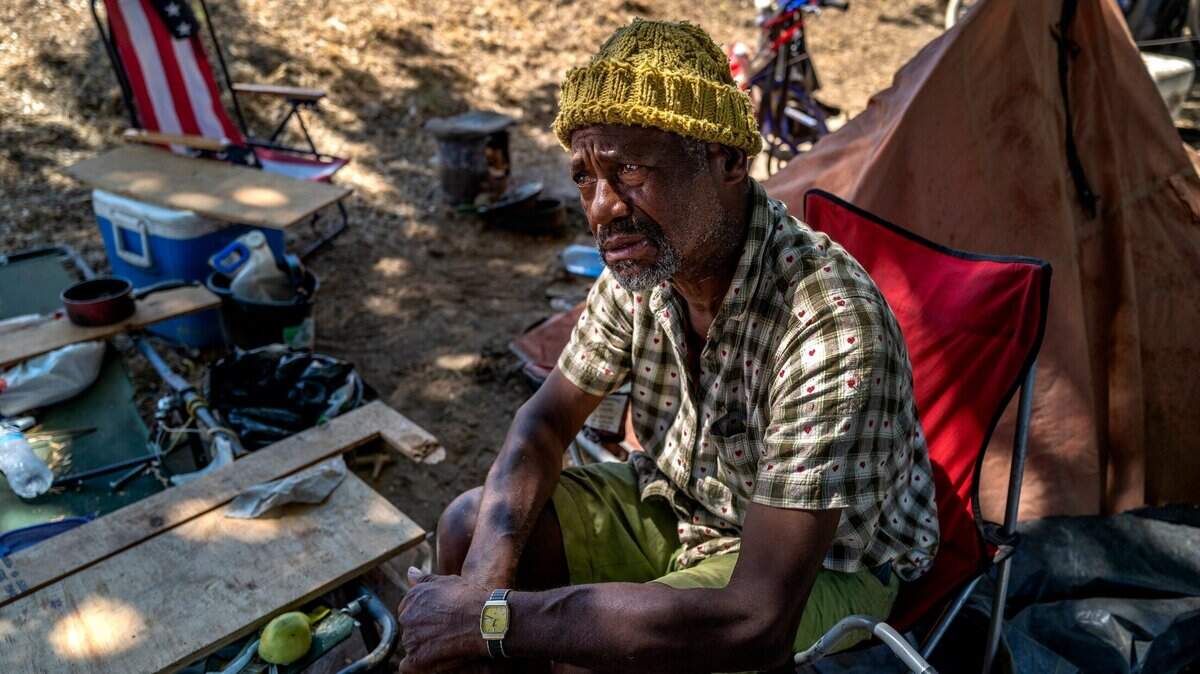
Former home builder and bass player Eugene Williams sees a lot from the tent where he lives on Sacramento’s Commerce Circle.
He sees that his jumpy neighbor in the long black leather coat on a 90-degree day is not going to be following up on the city’s offer of medical help. He sees that the young man who keeps setting the Porta Potties around here on fire needs to be hospitalized — “We’re leaving him behind is what we’re doing” — and that the lady down the block needs to dump her “dead weight boyfriend” asap: “Look at her dragging him down the road in a wagon,” says 63-year-old Williams, shaking his head. “She does that every day, and he’s not worth two dead flies.”
He also sees how hard one screaming, shirtless homeless man in the RV community that Williams is also part of must be on those trying to make a living on this street. “That place over there is a business,” he says, jerking his chin in the direction of the DaVita Kidney Care dialysis center across the way. “And how can you go to work with somebody out here acting like that?”
What Williams does not see right this minute, though, is how to say yes to at least a small step forward for himself.
“Let me get you out of here and away from all this nonsense,” says Nate Cox, who works for Sacramento’s Department of Community Response. A place had come open that morning at the Miller Park “safe ground,” and moving there would help Williams in a bunch of ways, Cox tells him: There’s security there and bathrooms with showers, plus three meals a day and rides to medical appointments. Put all of that together, and it’s bound to move Williams toward his goal of getting his life back, right?
“How big are the tents?” Williams asks. Big enough for you to stand up in. Maybe, then, Williams says, but first he has to go eat because Thursday lunches are always extra good at Loaves & Fishes, Sacramento’s largest service provider for the unhoused.
For most of the last couple of years since Williams lost his health, and with it his ability to make a living framing houses, he has been living on this block in north Sacramento. At first, he was in an RV, like most others in the encampment, which was completely cleared by the city last December but is back now.
While he was hospitalized, the city “cut the rope and took” his camper, so now he’s living in a tent at the end of a long row of broken-down RVs. “I try not to think about it,” he says, in a tone that says that not thinking about all he’s lost is a full-time job.
Williams, who grew up in Jackson, Mississippi, ought to be easier than some others are to help. He has kidney disease but is not mentally ill or addicted. He knows his Bible, he knows the blues, and really, he just needs to get out of here and get to feeling better.
But when your world has been reduced to a tarp and a routine — he rides his bike to Loaves & Fishes every noon, feeds the stray cats every evening and listens to his neighbors’ problems a lot of the rest of the time — then that tarp and that routine are hard to forfeit. “I don’t want to go backwards,” he says, afraid of trading the fraught but familiar for something even worse.
Cox, a big, bearded guy with a large tattoo and a lot of patience, is one of only eight city neighborhood resource coordinators in a county where just under 9,300 people were homeless at last count. He stresses how important it is for Williams to take this spot in Miller Park now because he doesn’t know when one will come up again. So can they go right now, Cox asks? Or OK, can he come back after lunch, help him pack and take him to this new place then?
“I just woke up, remember,” Williams answers.
It’s sad that there even is that one spot at Miller Park, Cox tells me later, since it’s only come open because they had to turn away a young mentally ill woman who has been trafficked. Now he’s trying to get her into City of Refuge instead, and sees her as someone who at some point could even work there.
So much has to align to get even one person into a slightly better situation that anyone who claims “all we have to do is ____” to get folks off the street is either deluded or dishonest. But for that one person, and then the next, Cox and his colleagues can do a lot.
The next day, I’m not surprised to find that Eugene Williams hasn’t gone anywhere, but is still sitting by his tent quoting Matthew 6 and Eric Clapton.
A friend has told him some bad things about Miller Park: “He said people were killing turkeys and throwing them in the river.” Who would do that, and does he really want to live around them? Also, “I don’t want to be around people smoking and all that.”
He’s still going to check it out, he says, and maybe he will.
Williams “dodged us earlier today,” Cox says, and with so much need, he can’t hold that spot open much longer.
He will be back to see Williams again, though: “I will literally hound him,” because not infrequently, “I’ll talk to somebody 30 times and then that one time,” for whatever reason, that person on that day is ready. And Williams is ready, Cox thinks. Or almost, anyway.
This story was originally published August 16, 2022 at 5:00 AM.