
California is ready to try almost any tactic on homelessness. Just not the one that works
Three years ago, the Bay Area produced a harbinger of the increasingly desperate extent of California homelessness — and a missed opportunity to respond convincingly.
Officials in the notoriously housing-hostile region revealed that the number of people sleeping on its streets had exploded, in parts of the East Bay by over 40% in just two years.
California’s new governor reacted by reaching for an old means of political procrastination: a task force.
What Gavin Newsom may not have bargained for is that his Homeless and Supportive Housing Advisory Task Force, co-chaired by Sacramento Mayor Darrell Steinberg, would come back with a proposal equal to the humanitarian crisis: a legally enforceable right to shelter.
The governor’s response could be charitably described as tepid: “I want this debate,” he offered wanly.
Undeterred, Steinberg proposed a similar policy for his city two years later as homelessness surged past the Bay Area to reach new levels in the capital and beyond. The mayor still maintains that a right to a roof is “ultimately the only way out of this mess.”
If he is, as overwhelming evidence and experience suggests, correct, Californians should get used to this mess.
Coming crackdown
The state and its capital are on the verge of a concerted reaction to homelessness that promises disruption and threatens worse.
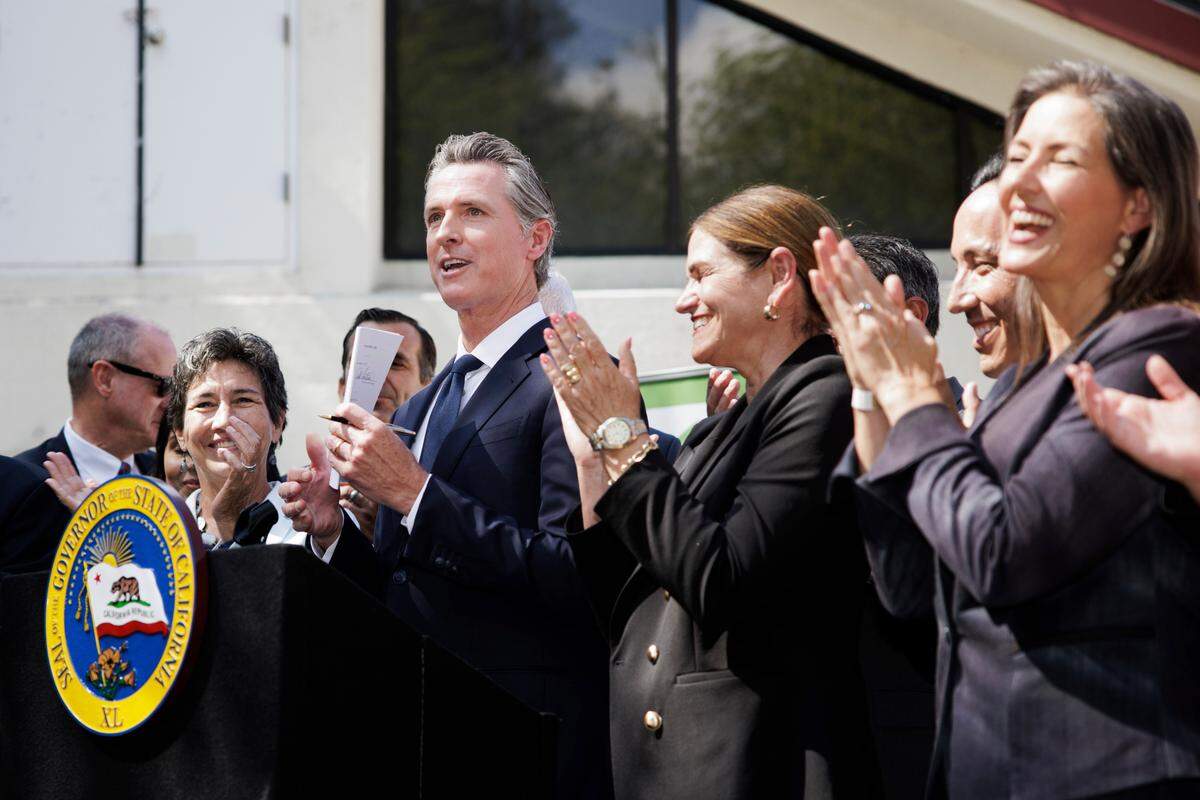
Newsom signed legislation Wednesday creating a court focused on compelling treatment of the severely mentally ill and often homeless. Sacramento voters will be asked to ratify a crackdown on unauthorized camping in November.
Neither is likely to provide much more of what California’s legion unsheltered homeless people lack by definition — homes and shelter — much less require anything of the kind.
Newsom’s CARE (Community Assistance, Recovery and Empowerment) Court and Sacramento’s Measure O are different but parallel examples of the inexorable march of California’s homelessness discourse. It starts with an inordinate share of the population being deprived of housing or shelter; it ends with a determination to eliminate the evidence rather than the cause of the deprivation.
Wave of displacement
California homelessness is more widely observed than understood.
Despite its prodigious wealth and population, the state has fewer homes per person than all but two very different states, Hawaii and Utah. Newsom recognized as much as a candidate, vowing to preside over the construction of 3.5 million homes by 2025.
So far, his administration is on pace to preside over less than a quarter of that. California’s housing production per person still ranked in the bottom fourth nationwide last year despite the chronic housing shortage and its increasingly disturbing results. Utah, the only state on the mainland with a comparably short supply, ranked first in residential permits last year.
The inflated cost of housing has therefore bled from the metropolises inland, causing housing prices in Sacramento County, for example, to come close to doubling over the past decade. Homelessness has inevitably followed, growing 67% over the past three years in the capital region, according to the latest official census, a pace comparable to the Bay Area’s wave of displacement a few years earlier.
Contrary to much of the public conversation about homelessness, research has repeatedly shown that homelessness rates are closely correlated with the overall availability and cost of housing.
“We end homelessness all the time in Sacramento and up and down the state,” said Bob Erlenbusch, executive director of the Sacramento Regional Coalition to End Homelessness. The trouble is that housing scarcity and prices perpetually drive more people out of their homes than the substantial numbers local governments and nonprofits manage to rehouse.
The homeless state
Anti-development laws, zoning and sentiment have depressed housing construction in California’s cities and suburbs to an unparalleled degree for decades. The same forces have blocked the supportive housing and emergency shelter that might otherwise serve as a safety net.
The ranks of the state’s unsheltered homeless people — those sleeping in tents, vehicles and other unsanctioned places and thereby driving the latest political paroxysms — have swelled even faster than California’s broader homeless population. Much of the increase proceeded as national homelessness declined.
The latest federal counts show that California is home to more than a quarter of the nation’s homeless people, over 160,000, which is more than double the state’s share of the overall U.S. population. Moreover, a majority of the country’s unsheltered homeless people are Californians — more than quadruple what the state’s relative population would predict.
An astounding 70% of California’s homeless people are unsheltered. That’s more than in any other state — small or large, Eastern or Western, Republican or Democratic.
In New York, one of only two states (along with Hawaii) with more homelessness per capita than California, less than 5% of homeless people sleep outside. Sacramento alone has more unsheltered people than the entire Empire State. In every subset of New York’s homeless population, the vast majority live in transitional housing or emergency shelter.
In California, the opposite is true: Across almost every segment of the homeless population — the severely mentally ill, military veterans, domestic violence survivors and even unaccompanied children – a majority sleep in tents, cars and doorways.
East vs. West
The difference, as the governor’s task force recognized, is New York City’s legal right to shelter, rooted in a 1981 court settlement of a lawsuit on behalf of unsheltered homeless people.
Although New York’s huge shelter system comes in for plenty of criticism, the California solution — or, rather, lack thereof — can’t be seriously regarded as superior.
“All the alternatives are preferable to being outside,” Erlenbusch said.
And yet Newsom’s task force gained no traction with a right to shelter or, in an attempt to answer critiques of the New York system, a right to housing.
The Legislature did approve a shadow of the idea in 2020, passing a bill to declare it the “established policy of the state that every individual in California has the right to safe, decent and affordable housing.” Newsom vetoed it, calling it a “well-intentioned bill” that would be “duplicative of existing efforts” while somehow simultaneously costing “over $10 billion annually.”
In fact, a legislative analysis put the likely cost of the bill in the “low hundreds of millions of dollars” a year at most.
But even if the state actually were to require shelter for every unsheltered Californian, based on the analysts’ estimate of New York’s costs per person, the yearly expense would be $3.3 billion. That’s about 6% of California’s most recent discretionary budget surplus, let alone overall state and local government spending.
The current state budget will spend nearly three times that much on direct “inflation relief”: cash payments to households making up to half a million dollars a year.
Shelter in name only
For all its feasibility and logic, Steinberg’s proposal of a similar right to shelter in his own city didn’t satisfy the escalating calls for sterner measures.
As with the task force recommendation, the mayor proposed that the local right to shelter be accompanied by an obligation to accept it on the part of homeless individuals. That was supposed to draw broader support than a right to shelter alone, appealing to those more likely to blame homeless people than the lack of homes.
But New York’s example, as the mayor acknowledges, debunks the myth that any significant share of the population wants to live on the sidewalks. The right alone has eliminated widespread unsheltered homelessness in New York without any legal obligation to accept shelter.
In any case, Steinberg’s approach drew no groundswell of support until a rival proposal turned it on its head, putting the emphasis on the enforcement rather than the shelter.
The mayor’s efforts ultimately gave way to frustrated local business interests pushing the initiative that came to be known as Measure O: The Emergency Shelter and Enforcement Act of 2022. Steinberg and most of the rest of the City Council ultimately climbed aboard the bandwagon lest it run over them in less manageable form.
As it stands, the measure would limit Sacramento’s obligation to provide emergency shelter to just 12% of the city’s unsheltered population, or about 600 of the nearly 7,000 people counted sleeping outdoors across Sacramento County.
Its definition of shelter, moreover, is a redefinition if not an outright contradiction of the term. It can be as little as a 100-square-foot campsite or a 150-square-foot parking space.
Nakedly draconian
The “enforcement” end of the act, by contrast, is expansive.
Once 600 or so patches of ground are designated, Measure O would empower the city to enforce anti-camping laws against anyone who is less than eager to take its less than generous offer.
And apart from even that threadbare shelter mandate, it would authorize the clearing of “unlawful encampments,” broadly construed as any group of “four or more unrelated persons camping together or within 50 feet of each other.”
As if to drive home the point, the city and county recently adopted a flurry of anti-camping laws without so much as awaiting the voters’ answer — or, in the county’s case, asking them a question.
Soon after, Newsom’s office separately took credit for having cleared more than 1,200 homeless encampments in a year, 40 of them in Sacramento County, providing the latest photos of the governor personally taking part in “removing 1,213 tons of trash — enough to fill 22 Olympic-size swimming pools.”
The county’s newly adopted measures, passed unanimously by the Board of Supervisors, are the most nakedly draconian, threatening to clear thousands camping along the American River and beyond without offering housing or shelter.
Whether the federal courts would even allow that is an unsettled question at best. The Ninth Circuit U.S. Court of Appeals ruled that officials in Boise, Idaho, could not constitutionally punish homeless people for sleeping in public spaces if they can’t obtain shelter.
The homelessness coalition’s Erlenbusch said the enforcement measures are tantamount to “admissions that the city and county have failed” to effectively address homelessness and decided to “blame the victim” instead.
Moving units
Erlenbusch and Sacramento Metropolitan Chamber of Commerce President Amanda Blackwood represent warring camps with respect to the measure, but they agreed on one point verbatim: “Everyone’s frustrated.”
They’re even frustrated with some of the same intractable conditions: the human suffering to the point of scores of deaths a year; the inability of the city and county to muster a coordinated response; the sour turn of public sentiment.
Measure O is undoubtedly an expression of that frustration. But it’s not a particularly humane or productive one.
From Blackwood’s perspective, the initiative is a cure for a political paralysis that has served no one — not the businesses she represents and certainly not the people on the other end of the economic spectrum.
“They didn’t meet for a year because people were up in their feelings,” she said of City Council and Board of Supervisors members, whose talks on homelessness broke off for months at one point amid mutual recriminations. “The status quo wasn’t working, and a disruption occurred.”
The details of the disruption — the quantity and quality of shelter, the means of achieving it, the respective jurisdictional responsibilities — strike her as far less important than the occurrence itself.
But those details are all-important to Joseph Smith, advocacy director for the Sacramento homeless services organization Loaves & Fishes.
“When I think about the business community, their concern is moving units, whatever the units are,” Smith said. “These aren’t units; they’re people.”
Smith shared Blackwood’s assessment of the city-county impasse that helped bring the region to this point, noting that the two governments’ respective headquarters are “two blocks apart from each other on I Street, and they can’t meet in the park in the middle to figure this out.”
But he said the measure’s careless approach to defining and distributing shelter inspires little confidence.
“We need to invest in high-quality solutions,” he said. “They need to last. They need to be helpful. I don’t see any of that here.”
Rents in Fresno
“We’re going to be back out here eventually,” said Jerry Graf, who lives near the American River not far from its confluence with the Sacramento. “We’re not clearing out if there’s nowhere for us to go.”
Graf, 39, is animated and amiable. He was pacing under the canopy of trees that made a sweltering recent afternoon just bearable and talking about the rents in Fresno.
Not that he has ever lived there or has any intention of doing so; it’s just that like a lot of Californians, he can’t quite believe how much it costs to live in Fresno.
Graf shares a general vicinity, a penchant for keeping a tidy camp and spoiled pets, and a friendship with Mark Underwood, 60. Both consider themselves more together than many of their fellow campers along the American River Parkway, where the number of people taking refuge and regularly losing control of their campfires has become such a flashpoint that the Sacramento Sierra Club offered some off-key support for a crackdown.
Underwood blames those who make messes and start brush fires, saying the chaos “brings heat on those of us who don’t.”
Graf agreed, saying of homelessness, “Out of sight, out of mind is what it used to be.”
Out of mind
State Assemblyman Ash Kalra used the same phrase to describe his misgivings about CARE Court, fearing it could enable officials to enforce an “out-of-sight, out-of-mind mentality” about homelessness.
The San Jose Democrat was the first of just two lawmakers in the entire 120-member Legislature to vote against the bill, which “wasn’t easy,” he said. “This is the governor’s priority. No one wants to push back against the governor’s priority, myself included.”
Kalra, a former public defender, said he hesitates to criticize any effort to help more homeless and mentally ill Californians. But he is concerned about granting local officials expansive authority to compel treatment without guaranteeing housing, the lack of which is a prescription for failure, he said.
“My worry is that this net that’s being thrown out is going to be too broad,” Kalra said.
He also doubted the wisdom of conjuring a court system to treat the sick. Smith, of Loaves & Fishes, concurred.
“If I ever suffer a mental health problem,” he said, “please don’t take me to court.”
Housing is the answer
Like the business interests behind Sacramento’s Measure O, CARE Court’s proponents are less likely to dwell on the quantity or quality of housing or shelter than to refer to the indefensible status quo they are determined to alter. The disruption, once again, is the point.
“The way California addresses mental illness and substance abuse isn’t working,” said Newsom adviser Jason Elliott. “The question is not, ‘Is the status quo acceptable?’ We all agree that the answer is ‘no.’ The question is, ‘How do we very rapidly do better?’”

Even if the change is rapid, it won’t be, by the government’s own reckoning, broad. The administration estimates that CARE Court will affect at most 12,000 people with behavioral health problems who may or may not be homeless. Even if all of them were unhoused, they would make up less than 8% of the state’s homeless population.
Elliott said CARE Court is a response to mental illness and substance abuse, which are “intertwined” with homelessness. But he said the program should not be mistaken for the administration’s chief response to homelessness.
“The solution to homelessness,” he said, “is housing.”
Conceptual cousins
Also like Measure O, the CARE Court debate exposed a wide rift between the state’s cities and counties. Counties, which bear the legal burden to provide social services, were generally skeptical; cities, which are home to most of the people who aren’t getting those services, were supportive.
While about three-quarters of Sacramento County’s homeless residents live in Sacramento, Steinberg noted, three of the five county supervisors are elected entirely by voters who live outside the city.
Steinberg therefore sees the prospect of an enforceable agreement between city and county, which the City Council required at the eleventh hour as a condition of enforcing Measure O, as a potential breakthrough in forcing local governments to accept responsibility for homelessness.
CARE Court could make similar progress by requiring local officials to treat severely mentally ill and drug-addicted people, Steinberg said.
For those reasons, despite their distance from his own proposals, the mayor counts himself a supporter of both the measure and the court, which he called “cousins of my original concept.”
After a beat, he added, “I didn’t say brothers or sisters.”
Desperate for results
The mayor, a former legislative leader well versed in political compromise, said he is willing to support policies that fall short of requiring shelter if they appear to be headed in that direction.
“I’m desperate for a better result,” he said.
So are the people facing further disruption of their already difficult lives.
“I would love to move indoors,” said Graf, the parkway camper. “I’m ready.” His friend, Underwood, was more categorical: “I can’t do another winter here.”
Yet the latest uprising against homelessness isn’t likely to help a substantial share of the state’s unsheltered thousands over a threshold and out of the elements. In California and its capital, the desperation to do something about our dispossessed legions is cruelly devoid of any commitment to bring them home.
This story was originally published September 18, 2022 at 7:15 AM.