How California’s chief justice changed the state — and why you might not have noticed
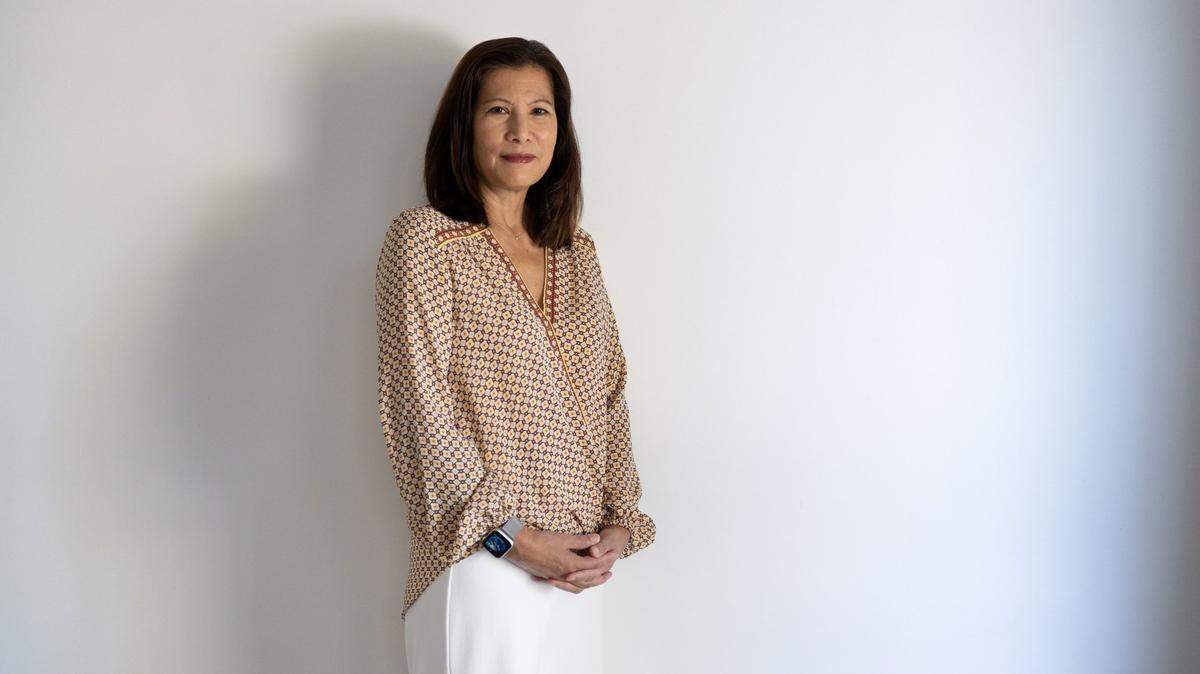
Tani Cantil-Sakauye has been one of the most consequential California figures of the last 12 years. But you might not know it because the outgoing chief justice is unlike most consequential California figures of the last 12 years.
Communicating chiefly through legal opinions, Cantil-Sakauye never sought to be well-known for anything other than her work.
But the California Supreme Court that Cantil-Sakauye leaves Friday is more unified in its decisions, and more supportive of women and people of color in the judiciary, than ever before.
A Filipina American, Cantil-Sakauye was the first person of color to lead the state’s highest court, succeeding a line of white chief justices dating to 1850, when Serranus Clinton Hastings became California’s first chief justice. She’s also the first mom to lead the court, and she may be the last Republican. Nominated by Gov. Arnold Schwarzenegger in 2010, she quietly left the GOP in 2018, when she changed her voter registration to no party preference.
Her seat on the high court put Sacramento-born Cantil-Sakauye, 63, in the middle of California’s most contentious issues. From reforming the state prisons to defining the difference between an independent contractor and an employee protected by California labor laws, she worked to build consensus and collegiality on a court that she saw as critical to protecting the public against political overreach — even when the overreach is in the name of the public through direct democracy.
“It may not be clear, but it is true that the California Supreme Court is the only restraint on the initiative process,” she said. “And when an initiative is passed, it has to be interpreted, and the final word is the California Supreme Court.”
Capitol B.S.
Despite her leading role in pronouncing the final word on so many key issues, Cantil-Sakauye didn’t get as much attention as she might have because she is not an activist, ideologue or political performer. Nor is she a Democrat from the Bay Area or Los Angeles, which means that she didn’t benefit from the machines that power and promote most of the anointed leaders of our one-party state.
A graduate of McClatchy High School and UC Davis, the future chief justice of California once worked as a waitress and a blackjack dealer to make ends meet. She married a Sacramento cop, now a retired lieutenant, and had two daughters.
Cantil-Sakauye was nurtured by a right-of-center power structure that no longer exists in Sacramento. After starting out as a young prosecutor in the capital, she worked for Gov. George Deukmejian, who eventually appointed her to the Municipal Court in Sacramento in 1990, when she was just 30. In 1997, then-Gov. Pete Wilson nominated her to the Superior Court in Sacramento, where she started the region’s first court dedicated to domestic violence.
Schwarzenegger named her to a state appellate court in 2005 and, five years later, to lead the high court, calling her “the embodiment of the American dream.”
The legal and political culture Cantil-Sakauye entered at the start of her career was overtly dismissive of women. She remembered calling agencies on the governor’s behalf as a deputy to then-Legal Affairs Secretary Vance Raye, whom she described as “the only Black man in the Deukmejian administration.” She said the men answering the phones would invariably tell her that they didn’t want to talk to a girl; they wanted to talk to Raye.
“So (Raye) said to me, ‘You tell them that I’m going to refuse all their calls unless they talk to you,’ ” she said. “He was really a bulwark against a lot of that early B.S. at the Capitol.
“There were a couple of female judges in those years, and I liked how they ran a courtroom. I liked how they laughed at insults and kept going despite the insult.”
‘Mad Dog’
She also remembered an old boss telling her that to be an effective prosecutor, she would have to emulate a lawyer whose nickname was “Mad Dog.”
“There is no way I could be a Mad Dog,” she said. “There were no minority female prosecutors to copy. ... So the people that shaped me are the people I decided not to be.”
Cantil-Sakauye said she was moved toward a career in justice by an unjust incident that affected her family here in Sacramento. The city declared their block at 3rd and O streets a blighted area, forcing them and their neighbors to relocate.
“We were living in an alley, but it was a nice alley,” she recalled in a 2010 interview. “We had a lot of family parties and relatives, and all of a sudden we had to move. It was hard. It was emotional.”
They moved to Land Park, where they were one of few families of color on their street.
“I would go to the house of my good friend and they had a white carpet, nice furniture, a painting of herself and her brother,” she said. “And then I would go home and look at our furniture, and it just made me think that we live differently, but we were so much alike.”
When Cantil-Sakauye has spoken out as chief justice, it’s been to protect access to the court and to justice. She expanded access to court facilities and worked to improve accommodations for people with limited English skills. She criticized cash bail as unfair to the poor. She urged Donald Trump’s administration to stop sending immigration agents to California courtrooms.
“She’s a natural leader,” said David De Alba, a former presiding judge of the Sacramento Superior Court. “She’s brilliant and a great communicator.”
Fact-based
One of Cantil-Sakauye’s guiding passions is the elevation of vetted factual information as an antidote to partisan politics. Starting in the new year, she will attempt to further that mission as president and chief executive of the Public Policy Institute of California, a nonpartisan think tank.
“The PPIC is fact-based,” she said. “They don’t light things on fire. I love that they give you information to form your own opinion. I don’t want to watch a TV news show and have them tell me how I should think about something.
“At PPIC, I hope to bring the same passion. Let’s get on the same page on the facts and then produce a report on it. Then smart people can strategize on how to use those facts.”
Cantil-Sakauye’s new post is an extension of a career in which she has been a pioneer as a woman and a person of color. At each stop, she rose to the top by making her name based on her work, and by working within systems she strove to make more accessible to more people.