
Former California Governor Jerry Brown terrified me. And that was before the ATV ride | Opinion
I have never been more frightened about meeting anyone in my life than while preparing to interview former California Gov. Jerry Brown.
Researching for this assignment felt like I was about to appear on the most competitive game show ever.
“Try Not To Sound Like A Complete Dope… With Jerry Brown!”
After all, Brown was a four-term governor and a presidential candidate who was a central figure at the outset of my journalism career as much as he was more recently as I move toward the end of my career.
Brown was also a 1970s icon who is still relevant nearly a half-century after California voters first elected him governor in 1974. But more than anything else, it’s the power of Brown’s stern intellect that completes the intimidating picture of him in my mind. He is as smart as he is tough and Brown would lap any current politico in any and all competitions of knowledge, insight and ruthlessness.
The thought of hanging out with current Gov. Gavin Newsom inspires one word: Fun! The thought of hanging out with Brown inspires one word: Gulp!
And then there he was, standing in the doorway of his Colusa County ranch, the man of my late-career nightmares.
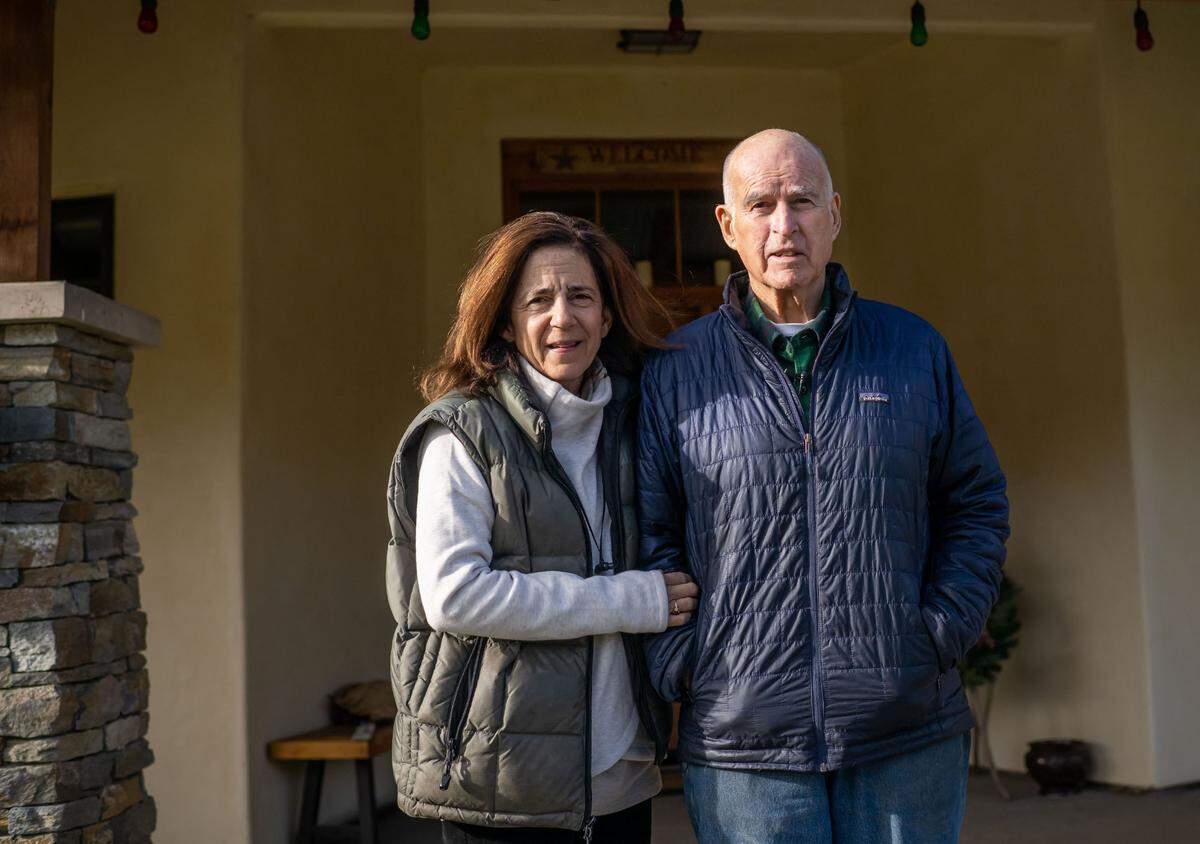
Fit-looking in jeans and a plaid wool shirt at 84, Brown bounded out of his front door, chipper and smiling.
Yes, Jerry Brown was smiling. Friendly. Warm, even. For the moment, I almost got over the feeling that I was going to pass out.
Brown doesn’t want to get COVID-19, so he eschewed a handshake and a proffered elbow bump. I tested prior to the meeting at his request.
Anne Gust Brown, the former First Lady, was returning from a walk with their dogs, Cali, a bordoodle, and Colusa, a corgi. Cali jumped up on me, and Anne apologized.
“He’s not well-trained, but Jerry likes it when he jumps up.”
When asked how many guests he has at the ranch, Brown replied, “More than Anne likes.”
‘I’m the guy who draws your dog’
She and I exchanged pleasantries about both being former Michigan residents. Her father, State Sen. Rocky Gust, was a GOP candidate for Lt. Governor of Michigan in 1962. I said it was rather likely my parents had voted for him, given their liberal Republican (remember that phrase?) George Romney sensibilities.
We all sat on his sunny front porch, at his ranch roughly 70 miles north of Sacramento. The property itself is in a ravine; a dry creek bed is nearby. It is scenic in its own way at 2,500 acres.
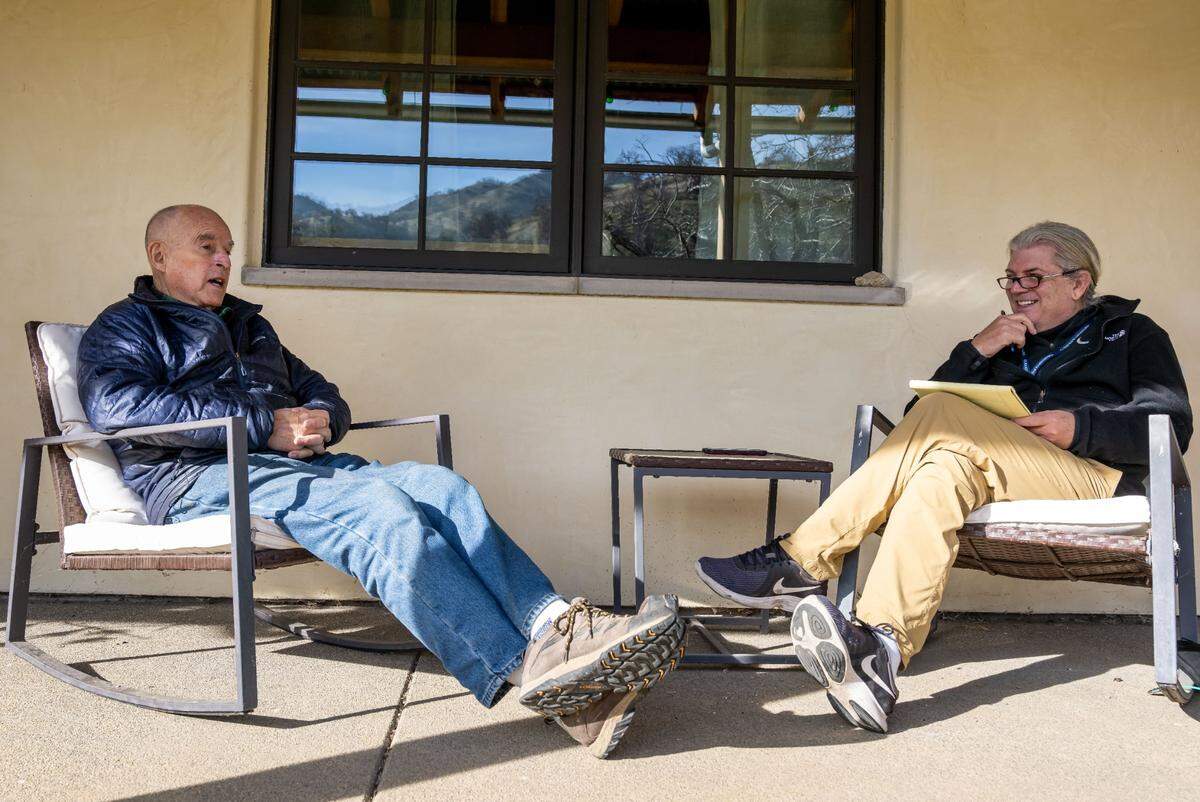
His house is not modest, but also not overwhelming, maybe 3,500 square feet. It has a cathedral window facing east, with spectacularly high ceilings. An older guest house sits to the left of the main house, surrounded by blue oaks and brush. The houses have what I would call a territorial view, and neighbors are close by.
A battered ATV sits by the porch, ready to whisk unsuspecting guests off on an off-road adventure tour he clearly revels in giving. A postal worker drops off mail, unfazed by the former governor in the driveway.
We sat in low rocking chairs and Gov. Brown seemed almost playful and avuncular, not adjectives I would previously apply to him.
I had met Brown once nearly a decade ago and found him somewhat detached. I couldn’t get through to him, unlike Gov. Newsom, who has the easy manner of a network talk show host. When I met Brown in 2014, he seemed unmoved by my efforts to joke around with him.
“I’m the guy who draws your dog,” I noted then, without comment from the governor.
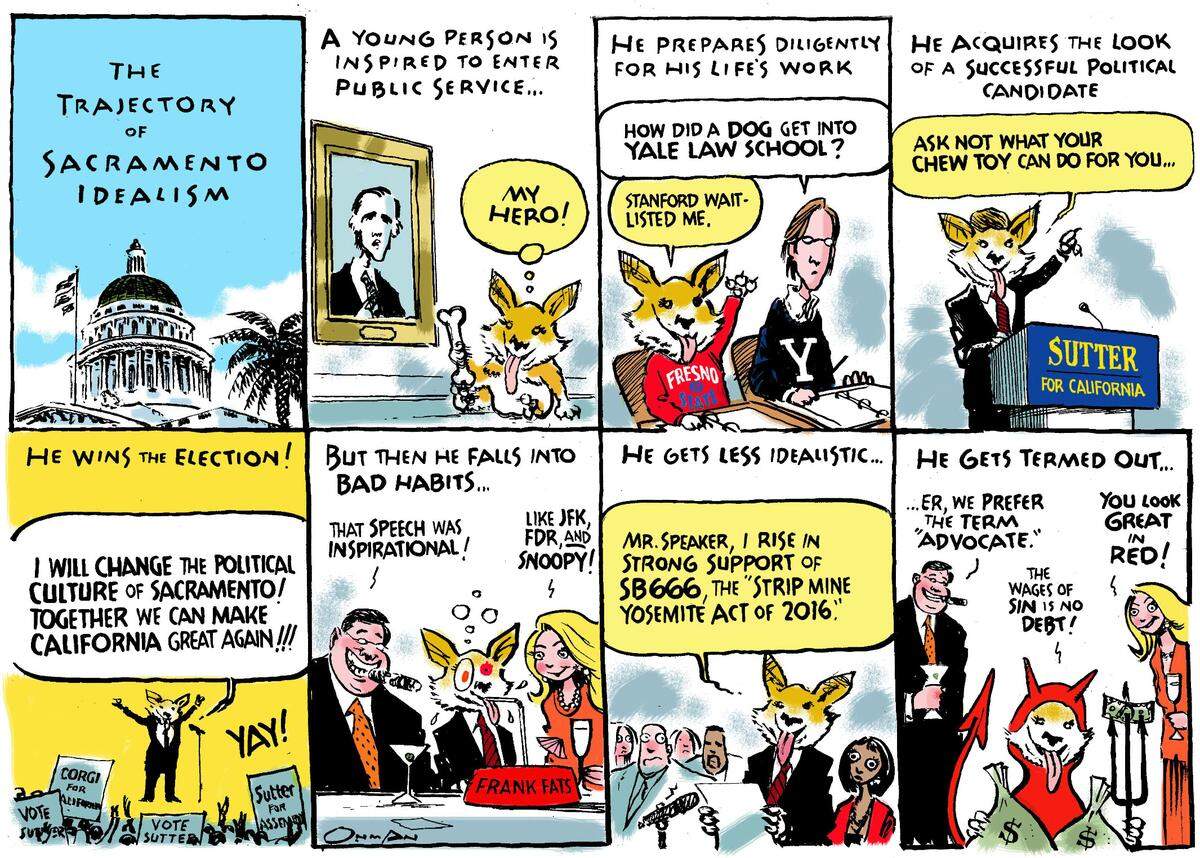
I had drawn Sutter in dozens of cartoons over the course of Brown’s administration, and the corgi became something of a political talisman (talisdog?) in California. I had also written about Sutter as his notoriety grew.
Brown didn’t have a dog as a kid. His mother was asthmatic. I asked him if had any cats. “No. You know, we had a cat that was here for a month. Left.”
They do that.
What was Sutter’s personality like? “He was this showboat. He enjoys attention, likes getting his picture taken.”
Brown reported that Sutter bit him once when he was trying to get him off a bed.
I asked, “At what point did you realize Sutter was a potential political asset?”
“I don’t know that I ever did….I just walked into the office…people want to get around him and play with him. And so there’s just a demand.”
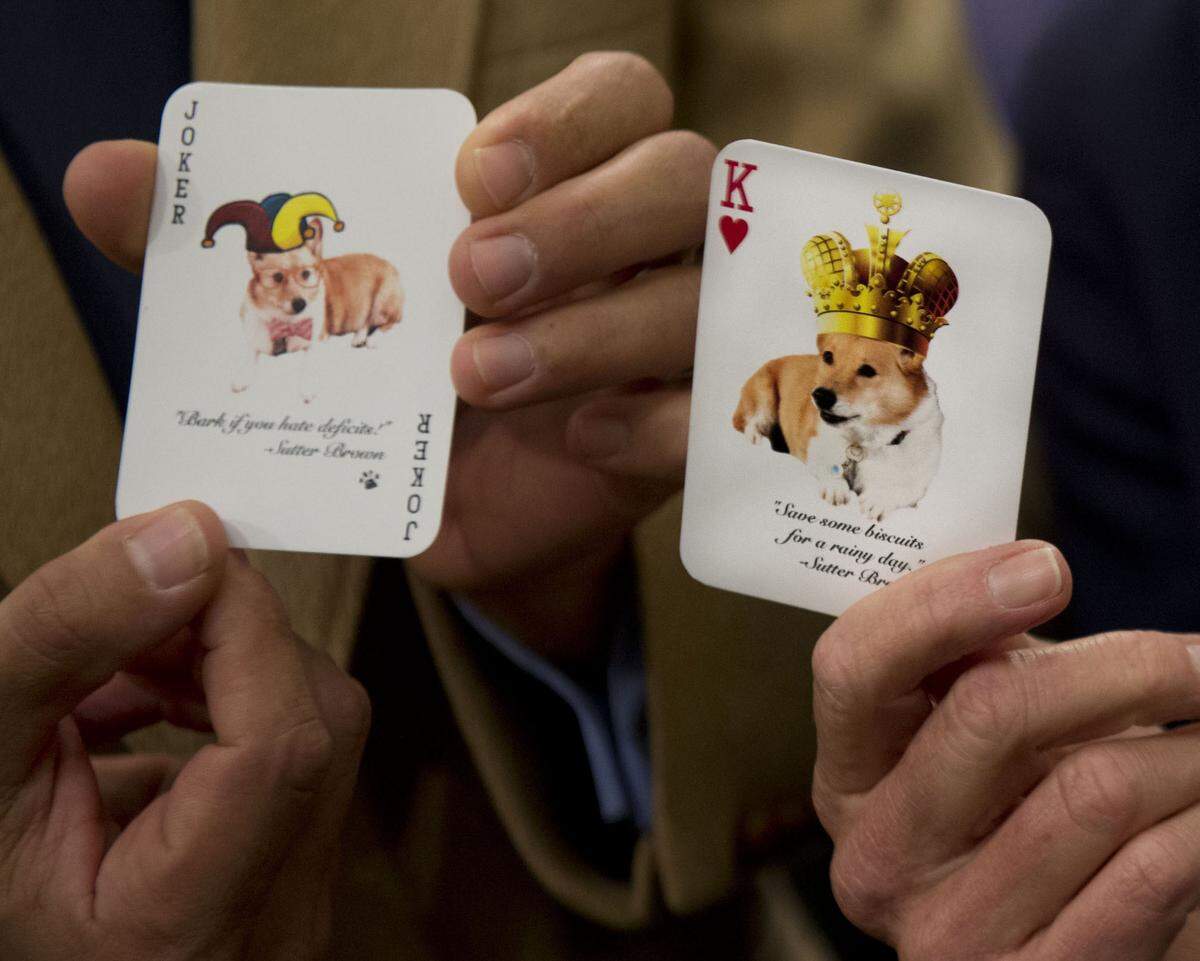
At one point the governor’s staff had even put out a set of playing cards featuring the dog in 2014. Was Sutter pivotal in the passage of Proposition 30, an education tax measure, and what effect had he had on that campaign?
“Yeah, he helped in the campaign. Yes. Campaigns are always striving for some kind of notice…he was an attention-getter.”
Sutter made news when he died in 2017.
Runs for president
Our conversation shifted to his presidential ambitions. After only a year and half of serving as the youngest governor at 38 , Brown entered the 1976 presidential campaign late, well after former Georgia Gov. Jimmy Carter had established himself as the front-runner.
I mentioned that 38 was terribly young to be getting into a presidential campaign. “Do you recall what was going through your mind,”? I asked.
Characteristically, Brown said, “I don’t have a lot of this going-through-my-mind stuff.” This was the first of many observations like this.
“(I) probably thought that President Carter might not be as strong, so I thought, what the heck? Maybe I can take them on. No harm, no foul…I think because he was governor of Georgia, why can’t we have a governor of California? Sure. So I was younger than him (Carter was 51). But I had a more prestigious position. Absolutely. But on the other hand, he prepared for it, and so he was around, and so he had some unique characteristics, which I didn’t fully appreciate.”
I asked Brown what he thought his lane was in 1976.
“You know, I can’t remember. I honestly thought I could win. And I did win a few states, five states by one reckoning…it may be (my) perception of the people running –(the late Idaho Sen.) Frank Church, (former Arizona U.S. Rep. Morris) Udall, Jimmy Carter. I think (the late Washington Sen. ) Scoop Jackson is easy…a free-for-all…I thought, sure, of course a lot of these people had fallen by the wayside…but that’s how I jumped in.”
Presidential candidates usually look at the field and think, geez, I’m better than these guys, why not?
Did Brown ask his father what he thought about running for president at age 38?
“I don’t know…this was 46 years ago.”
Brown seemed slightly annoyed and said, “There are a lot of these questions. What did you think? How do you feel? Well, I tell you how I felt this morning, waking up first, (but) you know, 46 years ago?”
I didn’t mind the pushback. This is how Brown is wired. Commenting on his own upbringing, he said: “Parents and children had more separate lives…there was no helicopter (parenting)…I was never driven to a soccer league game or even…a swim meet, or debate meet.”
As Brown was the only son in a family of four children, well, no one has time to helicopter parent when you have five kids, and particularly not his father, the California attorney general and then later a two-term governor, from 1959 to 1967.
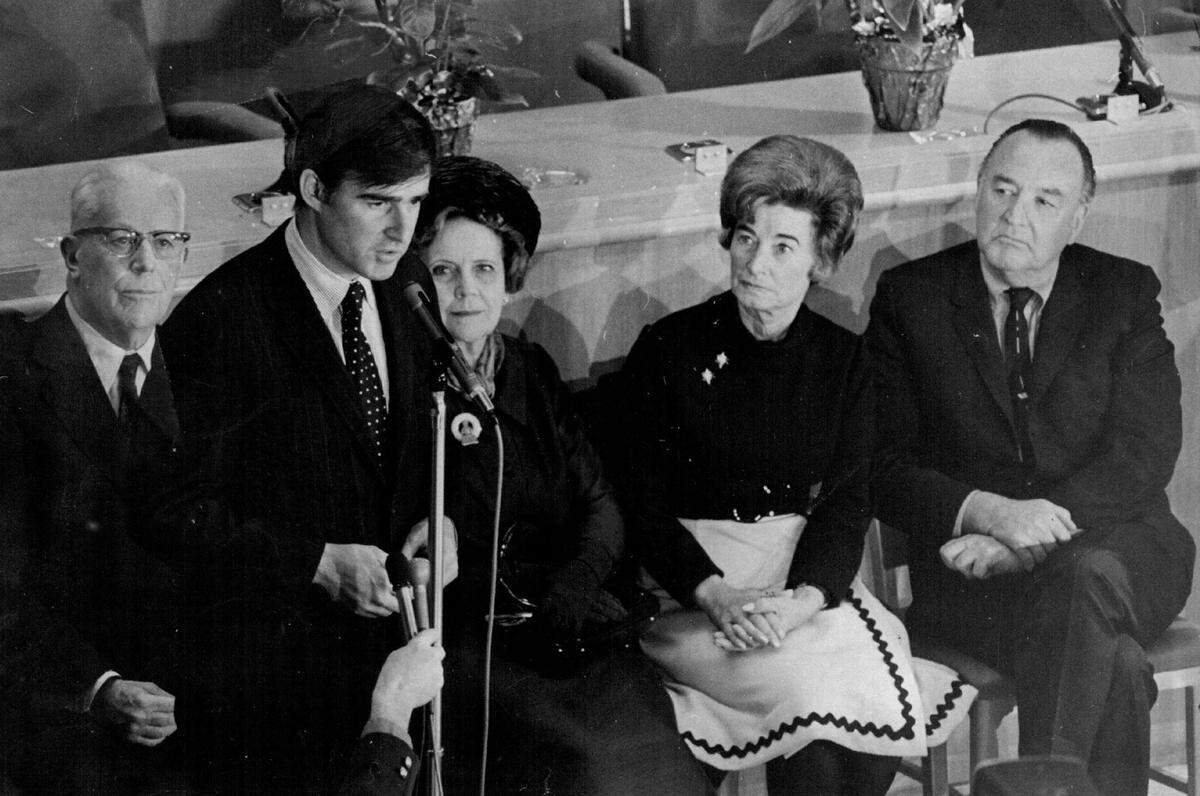
The first time I saw Jerry Brown in person was at the January 1978 funeral of former Vice President Hubert Humphrey. He was with his father, Pat Brown. I asked Brown if he had ever met Humphrey.
“I didn’t know any politicians particularly well…he was very impressive to listen to.”
I said, “the public perception is that you guys know each other and talk to each other.” Not Brown. But he did have a strong affinity for the late Minnesota Sen. Eugene McCarthy, who in 1968mounted an insurgent presidential campaign over the Vietnam War against then-President Lyndon Johnson. McCarthy was also Catholic and a novice in a Benedictine monastery, similar to Jerry’s Brown’s early days.
Brown said he was one of the California co-chairs of the McCarthy campaign. On June 4, 1968, the night of the California primary, Brown was at the Beverly Hills Hilton at the McCarthy headquarters.
McCarthy was slightly behind Kennedy all night. At the Ambassador Hotel, Kennedy finally claimed victory around midnight on live national television.
Then Sirhan Sirhan shot Kennedy. The political world froze.
“Kennedy was very dynamic…(McCarthy) was more laid back, maybe a little more abstract…I thought more restrained, more elegant. McCarthy had a depth and an authenticity that I found impressive and convincing…Robert was more hyperkinetic, more powerful in some ways, but they’re very contrasting characters.”
Kennedy died early on the morning of June 6.
I asked Brown if he patterned himself from McCarthy.
“Well, I liked the way he put a sentence together, and I liked the fact that he (had) a very dry sense of humor.”
The first major politician that Brown saw in person as a teenager was the 1952 Democratic presidential candidate, Gov. Adlai Stevenson of Illinois. McCarthy was also a Stevenson acolyte, and was very much in the same mold as Stevenson; wry, cerebral, and sometimes too hip for the house, which could describe Brown’s decades-long political persona.
Turning to Jan. 6, I asked Brown for his impressions of the coup attempt carried out in the name of former President Donald Trump by his supporters.
“There is a fringe element of the Republican Party. But with Trump, he brings the fringe into the mainstream. So that’s been his contribution.”
Conjugations and aspirations
As a change of pace, I asked Brown what role faith plays in his life now.
“That’s hard…that’s not a word I use. (In) Buddhism, they don’t talk about faith. They talk about practice…Faith is a very Christian idea. Jewish people talk about the law, the Torah…you can talk about the…Apostles Creed, the Nicene Creed, so there’s these very particularized expressions of religious groups. So I have had a lot of experience in religious groups.”
“In fact, I participate every Sunday at 8 in Compliance, which is (what they call in the monastery) “The Hours,” and the monks gather…this is complex, it’s in Latin…(they) chant…done by Zoom for a group at Stanford.”
“So I participate…I like to keep my finger in Latin…when I do my floor exercises, core exercises…I have been playing consistently a…Gregorian mass, mass for the dead. It’s called the Requiem Mass, and it’s in Latin, and it’s chanted by…push-ups and leg lifts and planks.”
“My wife thinks I’m extremely Catholic. I think of myself not in a box and…not tied down to these propositional descriptions of the big matters in life.”
Brown didn’t know it, but he opened the door to my next question (and nerdy desire) to speak Latin with Jerry Brown.
“I’m going to try this out on you,” I said. “So I studied Latin in high school. I got to the point where I could play Scrabble in Latin. So I thought I would start off with a Latin conjugation and you come back and see if you can fill that.”
Me: “Sum es est.”
Brown: “Sumus estis sunt.”
Yup.
Me: “I isti it.”
Brown responded, “It’s the “it” I don’t remember, that’s not present. Yeah. What tense is that?”
It was at this point that Brown exposed me for the obvious Latin fraud that I was. Brown had majored in classics at Berkeley.
Brown: “What’s the verb? What’s the infinitive? I have a Latin dictionary, by the way.”
Me: “Oh, I’m sure you do.”
Also me: “OK, you win. Congratulations.”
Brown wouldn’t stop. I was trapped.
“There are five declensions. There are five cases. Nominative. The genitive. Dative…there is also ablative. Vocative, more rare. So then you have the plural. Right?”
Limp and metaphorically bleeding, I shifted topics, in the way that all obvious Latin fakers do. Carpe corgi.
“Let’s talk about the ’92 (presidential) campaign for a minute…I’m curious about what your perception of (former President Bill) Clinton was at the time…you seemed to have a read on him rather early in the process.”
“Well, whenever you run against somebody, you always think you should win. Not the other guy. So you don’t spend a lot of time thinking about the other man’s virtues. More than you’re focused on the weaknesses, but it’s just that I think I underestimated Clinton…I definitely underestimated him.”
I brought up President Biden, who, at 80, is four years younger than Brown.
“I can’t run for governor. But I could run for president…right? Because he’s only 80.”
“Sure, he’s a child,” I said. “ So what’s your take on him? Do you like President Biden?”
“I think he’s a good guy. I voted for him…he’s got staying power, and he’s been around stuff.”
“How do you think Vice President (Kamala) Harris is doing?”
“Well…she’d probably like to be doing better. Vice President. I don’t know what she’s doing, so that’s what funny. Falling into a trap like this. Remember John…”
“John Nance Gardner,” I said.
Brown: (Garner said)“The Vice President isn’t worth a bucket of warm spit.”
Garner actually used an, um, earthier word than spit.
“Yeah, the vice presidency…you’re in the shadow there,” Brown said.
I asked Brown about his U.S. Senate aspirations.
Brown had lost in 1982 to then-San Diego Mayor Pete Wilson, and was looking at making another Senate bid in 1992, but decided against it when he saw former Sen. Barbara Boxer was ahead of him in polling. He opted for another White House run in 1992 after a failed 1980 bid against President Carter and the late Sen. Edward Kennedy.
Brown’s rides and Sutter’s site
Brown was as unsuccessful in national politics as he was successful in California. When I asked about his favorite moment in elective politics I expected him to say being elected governor of California, or his almost surreal comeback from the mayor of Oakland, or regaining the governor’s office in 2010.
Nope.
“My favorite moment was winning the primary in 1969, when I was elected to the (Los Angeles) junior college board, out of ... (more than a hundred) candidates, I came out number one.”
“What about in governance?”
“I’d have to think about that…like getting the farm labor bill negotiated.”
“The nature of politics is very ephemeral,” Brown said, noting that his father got an aqueduct built, and created the UC Irvine campus.
At the end of the recorded interview, Brown seemed to struggle as he rose out of his low rocker. I was looking down at the top of the governor’s head as he rose up.
His hair was still rather dark around the crown, which surprised me. I had spent decades looking at Brown’s face, and suddenly it was right there.
When you have as familiar caricature subject to me as Brown was, I couldn’t help but stare at his face, his nose, his eyebrows, his neck, all of it; it all seemed as familiar to me as my own, but we had never really been together.
I was about to offer to help him up, but he popped up before I could say anything.
Brown then invited me on a tour of his property. The muddy red ATV was at the ready, and we trundled in, Brown at the wheel.
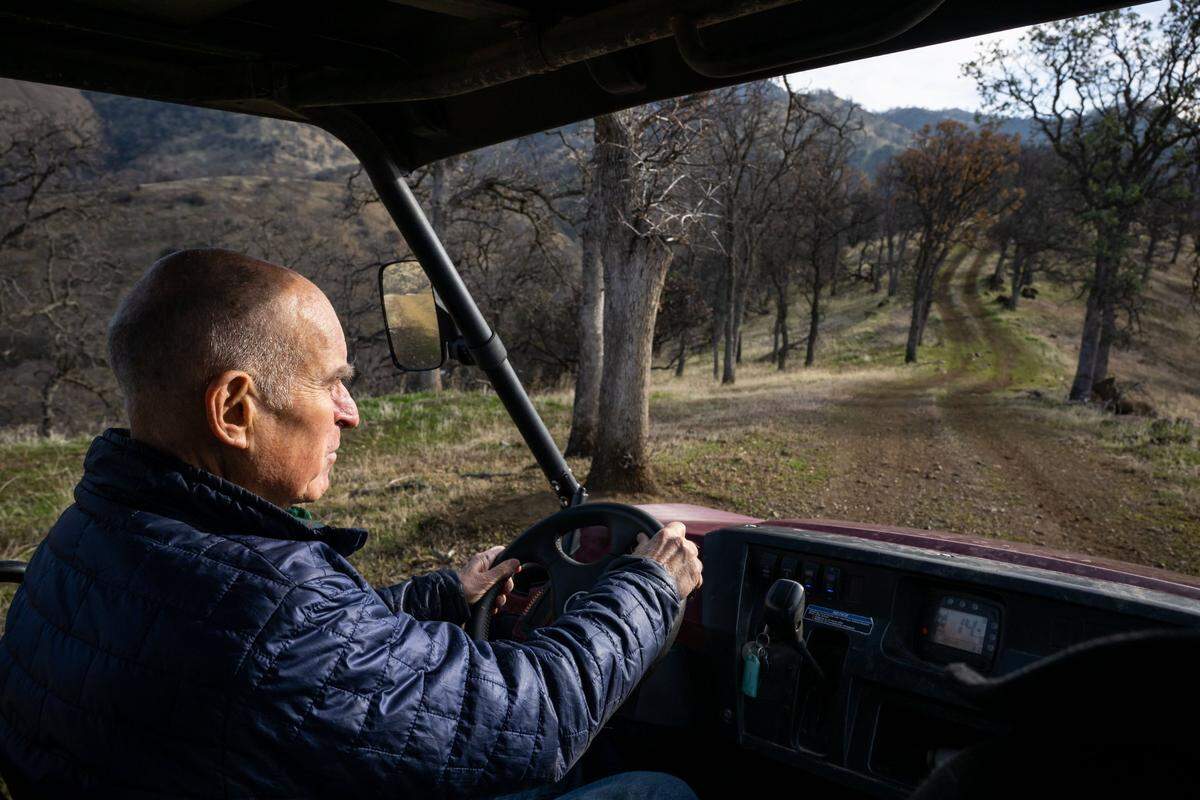
“This ain’t no golf cart,” he said, as I hung, barely, off a handle on the roof while bouncing and swaying on the rough ground, hoping not to sever my tongue.
At this point, Brown seemed almost giddy in his enthusiasm, gleefully ripping around muddy corners on the narrow path, like a teenager who got the keys to the car but maybe hadn’t quite passed Driver’s Ed.
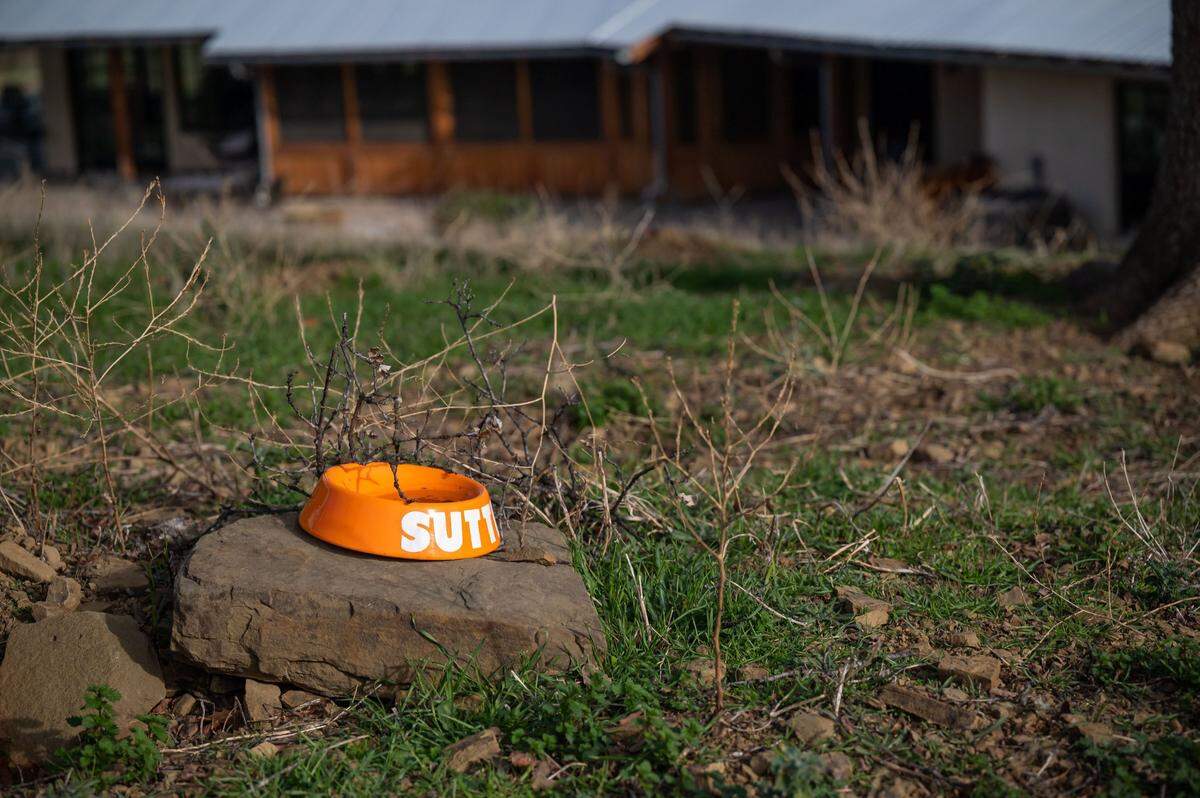
Brown drove me to Sutter’s grave site behind the new house that is marked by his red dog dish, inscribed “SUTTER,” which I found extremely poignant.
In some ways, I felt like Sutter was one of my own pets. I had met the corgi twice; a mutual friend brought Sutter to my 53rd birthday party, and he was absolutely the star.
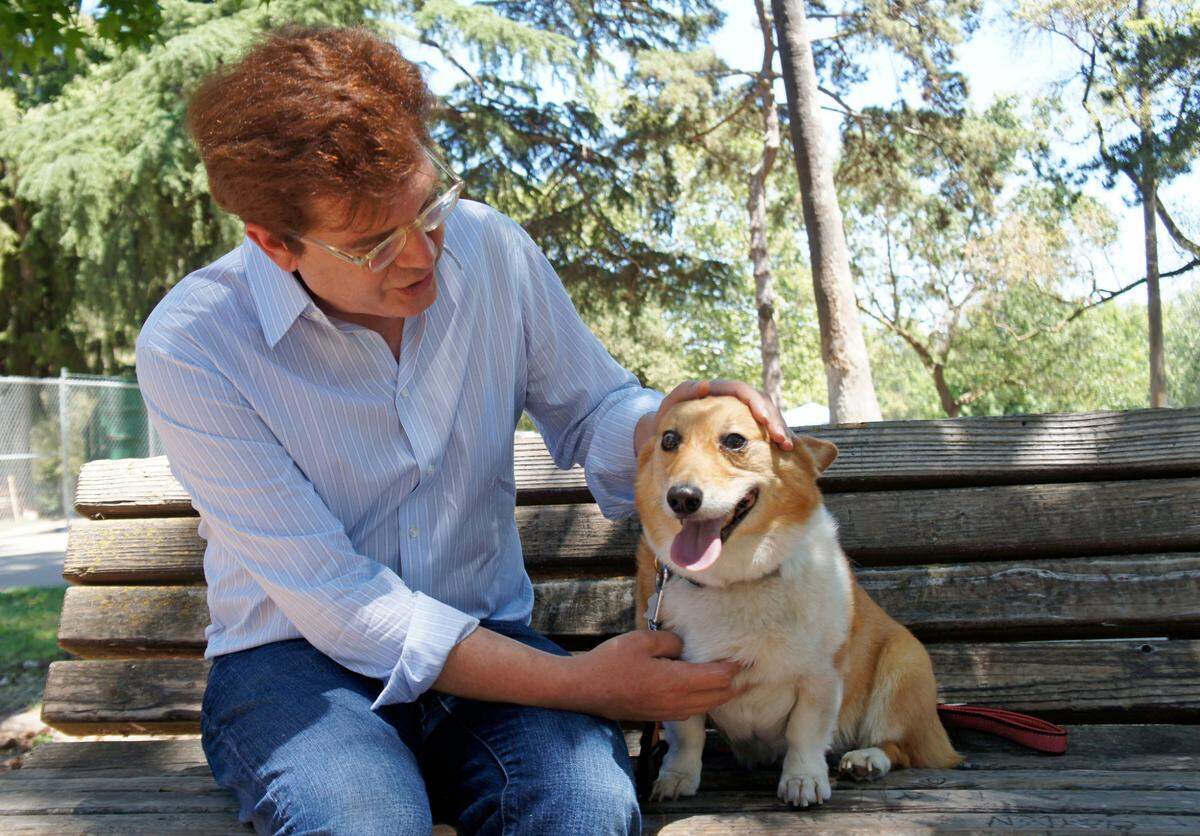
When Sutter was ill, the Browns invited me to say goodbye to him, and I was unable to attend. When I heard that Sutter had died, I became very emotional. I had spent many convivial hours with Sutter at my drawing board. I never asked if they had a little blue suit for the dog, as I portrayed him.
Brown then drove us to the top of the ridge of his property, which provided some truly spectacular views. He noted that his neighbors ran cattle on his property, and dozens of what appeared to be Black Anguses milled about on the valley floor.
Brown’s ATV driving was, shall we say, exhilarating. He dropped us off at the front porch. I gave the Browns a few Sutter cartoons, and they closely examined each one.
As we parted, Jerry Brown, the ascetic, the guy who slept on a mattress on the floor of the studio apartment in Sacramento, the sometimes terse Jesuitical lecturer, said something surprising.
“This was fun.”
I mean, what’s not fun about reckless ATV driving and Latin conjugation?
This story was originally published January 29, 2023 at 5:00 AM.
CORRECTION: This story was changed Jan. 29, 2023 to correct the number of former California Edmund G. “Pat” Brown’s children. It was also changed to correct the number of candidates Jerry Brown faced in his 1969 primary election for the Los Angeles junior college board.