That weird-looking debit card with the bear on it? It’s a legit ‘gift’ from California | Opinion
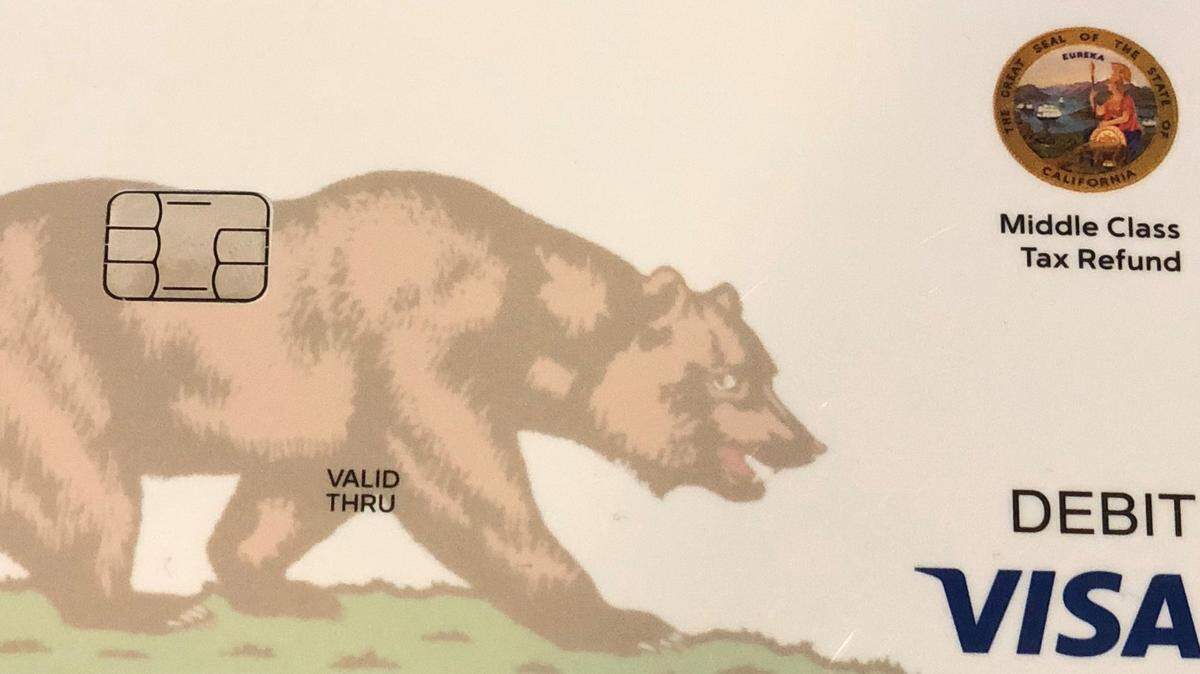
By now, millions of lucky Californians should have received one-time “tax relief” in the form of a direct deposit or a debit card, courtesy of, well, taxpayers.
That should be welcome news, right?
Except in this case, payment distribution has been handled so haphazardly that some recipients are worried the whole thing is a big fat scam.
Especially when it comes to the physical cards.
Maybe it’s the cheesy envelope, with its red lettering promising this is “not a bill or an advertisement” and its return address — a post office box in Omaha, Nebraska.
Or the vaguely ominous-looking, pale brown bear that dominates the debit card.
Or are we just jaded after getting so many unsolicited credit card offers?
Whatever the reason, the $9.5 billion tax-relief program — which should have been ratings gold for Gov. Gavin Newsom — has been generating lots of complaints.
“Just received a shiny new Visa debit card from a bank supposedly funded by our 2022 ‘California Middle Class Tax Refund,’” San Luis Obispo resident Carol Nelson-Selby wrote in a letter to the editor. “It had a picture of a bear and the California seal. Like many, it looked like a scam to me, I almost threw it away. ...”
Some people did exactly that.
ABC7 News out of San Francisco heard from several people who trashed their cards, not realizing they were tossing away plastic worth anywhere from $250 to $1,050, depending on household income and the number of dependents.
“I thought it was a scam and chopped it in little pieces. Now what?” one viewer asked.
Where’s my card?
Then there are the folks who have been looking forward to getting a debit card in the mail, and have yet to receive one.
A special kind of telephonic hell awaits them — one that San Luis Obispo Tribune Editor Joe Tarica is caught up in right now.
His quest to track down his payment has included various internet searches, attempts at online chats and calls to three separate phone numbers, most of which were entirely frustrating automated lines and only one of which yielded any specific information about his refund.
After many attempts and much waiting on hold, he did reach a human being once.
“I finally broke through and got a person who only succeeded in giving me more numbers,” he said.
One of those numbers was 800-240-0223 — which is, incidentally the number to dial if you’ve thrown away your card and need a replacement. (Press 3 when you hear the prompts if you’re reporting a lost or destroyed card.)
It connects you to Money Network’s My Banking Direct, a service of New York Community Bank — the banking network California chose to make the disbursements.
Tarica, who says he absolutely qualified for payment, learned that My Banking Direct had no record for him, which means no card had been sent.
“So then they gave me a second number to track down just what the hell is happening. ... When I tried to reach an agent, it hung up on me saying the line was too busy.”
If you, too, are still waiting for your windfall, don’t give up just yet.
Some debit cards have yet to be mailed, though time is running out. The “vast majority” will be issued by the end of January, according to Andrew LePage of the Franchise Tax Board (FTB), which is administering the program.
A small number of cards for recipients with a recent address change will be issued as late as Feb. 14, LePage added.
Wouldn’t checks have been easier?
This mini-fiasco cannot be what Newsom had in mind last spring, when he proposed providing financial relief to Californians struggling with inflation, particularly high gas prices.
He originally suggested $400 payments for all vehicle owners — up to two per person — regardless of their income level. After some opposition from lawmakers, the plan was revised to base eligibility on income — not car ownership — and approved in June.
Money went straight into recipients’ bank accounts if they had received a 2020 state tax return by direct deposit.
The rest of us were issued those weird debit cards — a process that has taken so many months that memories of the tax-relief program have grown hazy.
That’s only added to the confusion.
So now is a good time to ask, why not just send good, old-fashioned checks, like the IRS does?
It’s not like the debit cards are super secure; there have been reports of scammers draining the accounts.
The Franchise Tax Board says that’s rare, though it does recommend withdrawing or transferring the money as soon as possible to avoid being scammed.
“For security reasons we are not discussing the exact level of fraud claims or the number of cases being investigated,” LePage wrote in an email. “However, we have pointed out that under the terms of FTB’s contract with Money Network, the debit card program is expected to run with less than a 1% fraud rate, and currently Money Network reports that the rate is well below that level.”
Well, that’s reassuring, unless you happen to be one of those unlucky 1 percenters.
In that event, call Money Network immediately — 800-240-0223 — unless it happens to be on the weekend.
In that case, you’ll have to wait until Monday.
And if they offer to send you another card, remember to keep an eye out for a cheesy looking envelope from Nebraska.
This story was originally published January 20, 2023 at 5:30 AM with the headline "That weird-looking debit card with the bear on it? It’s a legit ‘gift’ from California | Opinion."