Rains and flooding are not enough to solve California’s persistent drought problems | Opinion
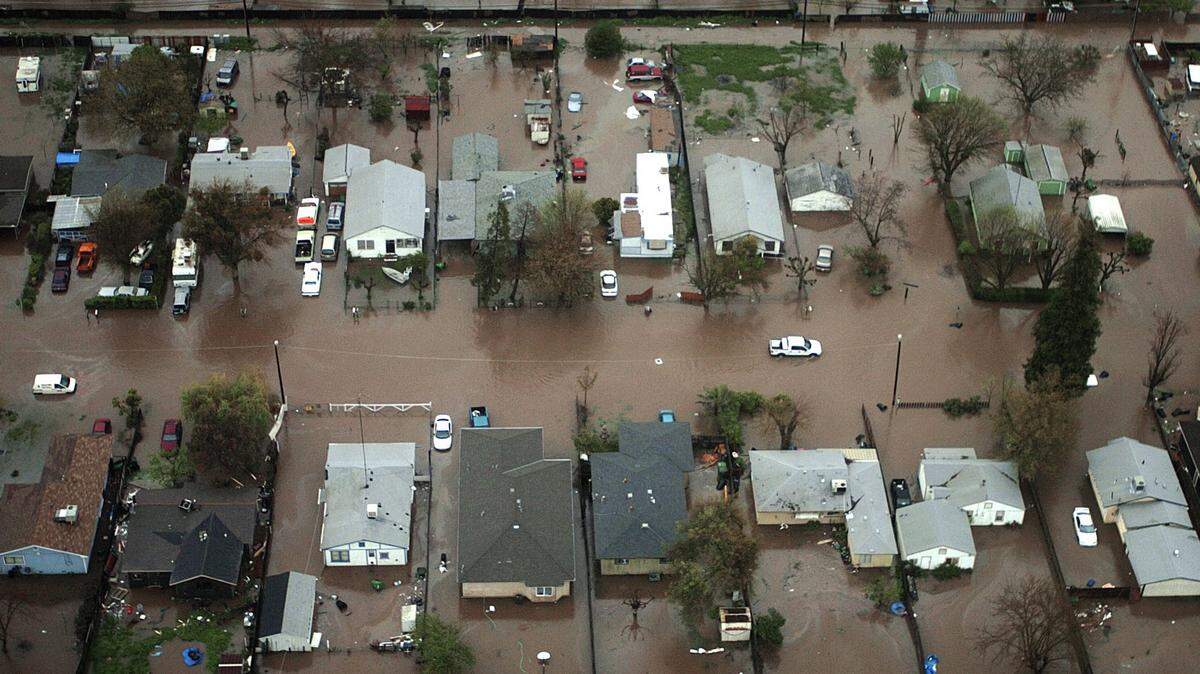
California’s reservoirs may be as full as they’ve been in years thanks to recent rainfall, but it’s still not enough water to meet the state’s demands — and it will never be if the state doesn’t invest in new ways to capture all that precious water.
Not enough of the state’s heavy rainfall is draining into California’s underground reservoirs to keep us sated, even through the next summer.
January saw torrential downpours. February has been dry. This week, California will see a blanket of snow across much of the state, and some forecasters predict it will even reach coastal communities such as Eureka.
This is, of course, the havoc of climate change at its most obvious: The wets are getting wetter and the drys are getting drier. We, the people, get soaked and scorched every time the pendulum swings.
But the drought is ever-present. This is perhaps why it is so disappointing to see Californians act like a bit of rain has magically solved the state’s water problems.
“California water is always fraught with very different opinions and perceptions,” said Peter Gleick, president-emeritus and co-founder of the Pacific Institute, which provides research and analysis of American water issues.
“It’s absolutely too soon to say the drought is over. Even if it were really wet, it would be too soon to say our water problems are over. It would take an abnormally wet year just to refill the reservoirs and the soil moisture.”
Yes, a “drought” by simple definition is a lack of rain, and California certainly did not have a lack of rain in January. February, however, has been drier than average, and a few good drenchings at the beginning of the year does not herald the end of a years-long depletion.
There’s simply never enough water in the West, even after the state sees torrential downpours and catastrophic flooding, like the atmospheric river that slammed into California last month. Our state is simply not equipped to capture and store that much rain.
We have gotten better at conserving water, but we’re not good enough yet. We couldn’t even manage to reduce our state’s water consumption by 15% in 2021. So if it seems like California officials are hesitant to declare an end to the drought, then that’s because there’s no evidence so far that we can achieve that.
Part of the problem is that California “almost never” gets an average rainfall anymore, Gleick said. Our above-ground reservoirs can nearly overflow in the rainy season and still rapidly deplete in just one hot summer. We need the rain to soak into our deep, cool groundwater reservoirs where it is safe from evaporation.
California dam operators and water scientists have to gauge how much water they can send downstream to soak into ground water reservoirs, which can hold many times more water than the state’s above-ground dams and lakes. They also have to play a game of prophecy, and if they get it wrong — which is an abiding risk — disastrous consequences await downstream.
“What we’re seeing now is exactly what was projected 30 years ago,” Gleick said. “These rules were designed for yesterday’s climate, not today’s, and the operation rules (for reservoirs) don’t yet adequately reflect that for climate change.”
Never has climate change and the fight for water been more evident than in the San Joaquin Valley, which was historically home to a large-but-shallow, seasonal lake. The Tulare Lake Basin (which disappeared in the early 20th century thanks to interventions such as nearby dams) naturally replenished the underground aquifers and created the rich, nutrient-laden farm land that California has relied upon for nearly a century.
But we’ve since interfered with that natural process, and are now paying the consequences of our hubris.
Last summer, more than 1,400 households in the state experienced dry wells. These dry wells rarely refill, so water must either be shipped and stored in tanks or brought in in bottles to the location.
In January 2023 alone, 41 households in California have already reported a dry well and have lost their only source of running water, reported the Community Water Center, a nonprofit organization dedicated to issues of water conservation.
An estimated one million people in California are served by water systems that are vulnerable to groundwater thresholds, reported the Pacific Institute. Declining groundwater levels will affect nearly 70% of the state’s water systems.
“The simplest way to think about drought is when there’s not enough water to do the things we want to do,” Gleick said, “and by that definition, California has been in a drought forever.”
This story was originally published February 23, 2023 at 5:00 AM.