
I’ll never forget Jimmy Carter’s red editing pen or his true concern for his staff | Opinion
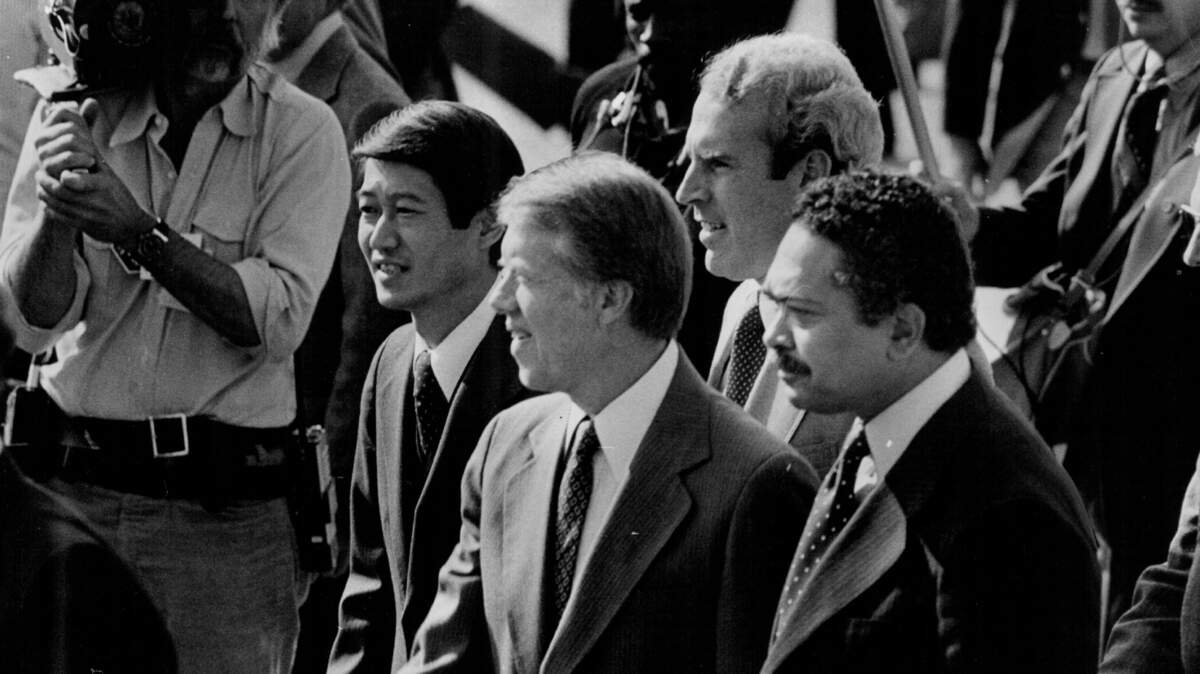
Earlier this month, on February 13, I celebrated my 80th birthday, and one greeting stood out from all the others. It was a personal letter from the 39th President of the United States, my old boss Jimmy Carter. A mutual friend told me that the letter was among the last that President Carter signed.
We met a lifetime ago, in July of 1975, when I attended a $25 campaign fundraiser at a hotel near what’s now Reagan National Airport outside Washington D.C. I don’t remember a lot of what he said that night, but I do remember being won over by the former Georgia governor’s humility and genuineness.
My early support eventually led to service as his “whip” of the California delegation at the 1976 nominating convention, field director of the Carter/Mondale California campaign that fall, and to my utter surprise, a position on the White House staff in early 1977.
A couple of months into my job in congressional relations, I wrote my first memo to the president under my own name. The next day, it was returned to me with an embarrassing notation, in red ink, at the top. I had misspelled ‘liaison,’ using one ‘i’ instead of two. It was circled, accompanied by a checkmark and the initial J.’ Some mistakes you never forget, and never make again.
Today, people laud Jimmy Carter’s service-oriented post-presidency, as they should, but they too often ignore what he accomplished while he was president. In fact, his legislative scorecard was almost equal to Lyndon Johnson’s, and superior to that of every president since.
Also insufficiently understood is Carter’s role as a transitional figure in the history of the Democratic Party and in the presidency itself. Although a progressive by any rational standard, he was nevertheless to the right of most Congressional Democrats, which is likely to be true of any successful Democratic presidential candidate — a fact still little understood by both politicians and those who comment on politics.
He was elected at a time when Congress was consciously and actively reasserting itself as a co-equal branch of government. Carter ran against the Washington establishment, against the status quo, and against business as usual before that was usual. His was a true political insurgency.
With his favorability in decline in the run-up to the 1978 midterm elections, many of us on the president’s staff concluded that the best way to reassert himself would be through the strategic use of the veto.
By late summer and early fall, both the public works and the defense authorization bills were headed toward Congressional passage, despite unambiguous warnings from the administration.
Carter vetoed both bills, and it was “game on” to sustain those vetoes. At one point, my boss, Assistant to the President Frank Moore, asked me to join him in his daily early morning meeting with the president to provide an update on what we were doing to secure the necessary votes to win. As I went through our various approaches to individual members — the deals sought and the deals cut — the President put up his hand and said, “I don’t want to hear any more!” And he meant it.
I never knew whether Carter cut me off that day because he wanted plausible deniability, or because he was simply disgusted by some of the oldest — and most effective—political tools we possessed. My guess is that it was a combination of the two.
In the late spring of 1979, Carter decided that he needed to refocus his presidency, and that he should make changes on the White House staff and cabinet. One of those changes was to elevate Hamilton Jordan to chief of staff, and to make me one of two deputies to Hamilton.
As all of this was going on, so was the contentious dissolution of my first marriage, a fact which I had shared with only a small handful of fellow staffers. I never even considered telling the president. But one day, after a couple of colleagues and I had briefed him in the Oval Office, the president approached me, poked his finger in my chest, and asked “How are you doing?” At first, I took it as a simple inquiry, and responded “I am fine, Mr. President,” to which he replied, “No, how are you really doing?” Then he asked about our children, and made clear that he cared about whether we really were all OK.
Between the early summer of 1979 and mid-autumn, I undertook a variety of tasks for Hamilton, mostly having to do with getting the White House staff geared up for what we expected would be a very tough reelection campaign. Ultimately, he and campaign manager Tim Kraft asked me to move to the campaign full-time.
Of course, the next year was horrendous. First, Ted Kennedy announced his candidacy to run for President. Then Iranian revolutionaries captured our Embassy in Tehran, taking 52 of our diplomats hostage.
The fight with Kennedy turned bitter, even as we racked up one primary victory after another. In early May, I moved again, this time to become executive director of the Democratic National Committee, and to begin planning for the fall campaign.
That summer’s convention was brutal, and nothing like the celebratory event four years earlier. Democrats left Madison Square Garden divided and dispirited.
Then in early September, Tim Kraft was hit with a bogus drug charge and had to leave the campaign manager’s job. Hamilton told me that I was to return to the campaign and fill in.
The night of Carter’s defeat to Ronald Reagan was one of the few times in my adult life I truly cried, and I only did so after the President shook my hand and thanked me for all my work on his behalf.
Since then, I have been with Jimmy Carter many times, at reunions, book signings, and Carter Center ‘retreats.’ In the last two of those that I attended before COVID, I was able to spend time with the president and just chat. It was no longer staff and boss talking, but something different, more personal.
Between the former president and most of us who worked for him, there was profound mutual respect, trust, and loyalty.
Most of all, loyalty. Jimmy Carter reliably inspired loyalty, though not the fawning sort. It was something more, and it grew out of the man’s essential character, which is what had drawn me and so many others to him in the first place.