
Supervisor Phil Serna has disrespected Sacramento’s role in growth. Why? | Opinion
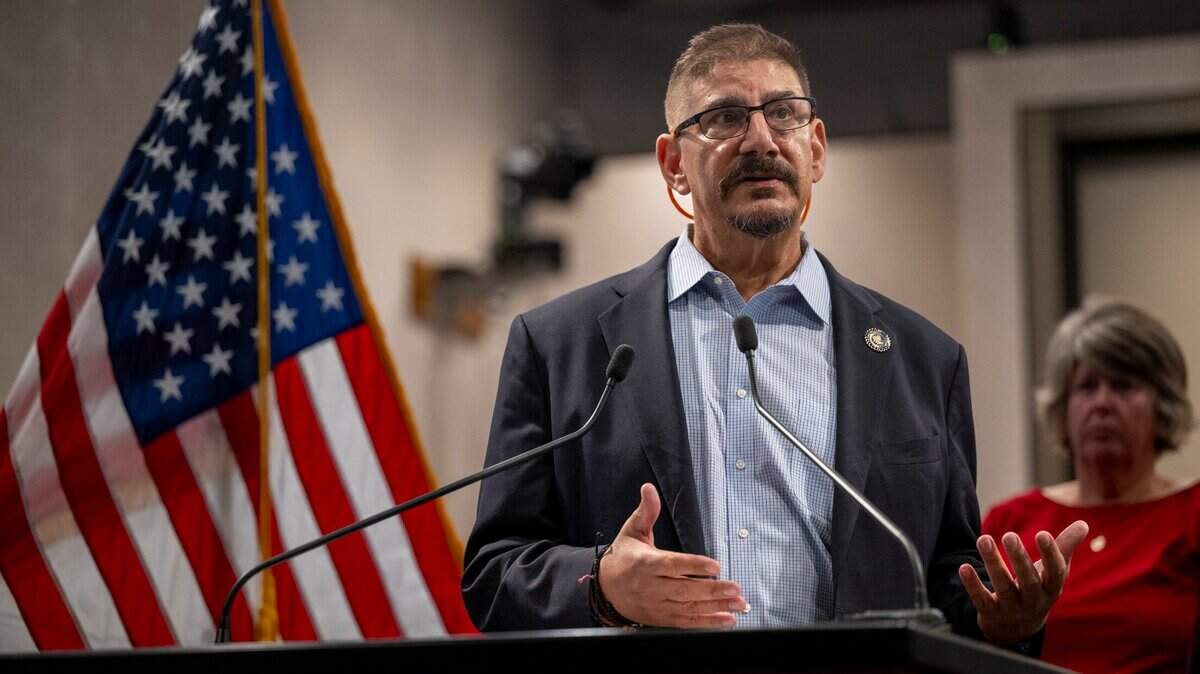
Phil Serna grew up in Curtis Park, in the city of Sacramento. His late father, Joe Serna Jr., was a beloved mayor of Sacramento. As a Sacramento County supervisor, a big swath of the city falls within Serna’s supervisory district, including Curtis Park, where his family lived, and Oak Park, where he attended Christian Brothers High School.
For all these reasons and more, Serna should be in a position to be a key voice on behalf of the city, but instead, he is using his position to disrespect the city in every way. Serna is attempting to wrest land use control away from the city. He is ignoring decades of land use planning to do this and is essentially putting himself in charge of it instead.
Back in 2002, County supervisors agreed to let the city decide whether and where to grow on its northern flank, the basin surrounding the Sacramento International Airport known as Natomas. It was a remarkable step in collaborative planning known as the Joint Vision.
Then Serna got elected to the board eight years later. And things began to change.
Now Serna and his fellow Sacramento County Board of Supervisors are close to deciding whether to build 10,000 new homes on land that is surrounded on three sides by the city and the nearby Sacramento River to its west.
Supervisors should leave this land alone.
Building an unincorporated community surrounded by the capital city makes no sense. Yet this is Serna’s brainchild. It speaks to how little Serna seems to care about Sacramento, and to honor a collaborative planning agreement that precedes him. Instead, Serna’s on a path to urbanizing thousands of acres in Natomas that have long been envisioned as undeveloped for at least half a century.
“We’re looking at major developments that fly in the face of every plan that’s been approved in the county of Sacramento for the last 25 years,” said former Sacramento mayor Heather Fargo, a Natomas resident and now an activist against Serna’s emerging growth agenda. “Phil has taken the lead on this and encouraged this kind of development.”
Serna did not respond to questions from the Bee. “I don’t subscribe to, nor do I read, The Sacramento Bee,” Serna told fellow supervisors in July. “I haven’t in years.” That he allegedly won’t read this exemplifies a petulance that is not his most flattering attribute. It is this same animus that he is now taking out on his own city.
How Serna stiffed Sacramento
When Serna was elected in 2010, the city was in the driver’s seat in Natomas. It had a path to grow while preserving land for the basin’s 22 protected animal species.
In 2003, Sacramento and Sutter County (home of the northern third of the basin) agreed with state and federal wildlife agencies to urbanize roughly a quarter of the 60,000-acre basin. They agreed to preserve all land within a mile of the river while purchasing more than 8,000 additional acres as habitat.
While Sacramento County was not part of this deal, participants took the county at its word in how its general plan sought to maintain its third of the basin as farmland. With county supervisors a year earlier officially deferring to Sacramento to decide on any additional growth, the city seemed in charge of its own destiny.
Stability in the basin turned out to be short-lived. Serna is an urban planner who worked for local developers before he was elected.. In only his second year as supervisor, Serna in 2012 launched a new “master plan” for Natomas, with the county as the lead. In terms of environmental preservation, Serna vowed to outdo the city “qualitatively, even quantitatively in terms of acreage” with a “superior plan.”
The move flew largely under the radar. “I was still under the impression that the (Joint Vision) was being followed,” Fargo said.
But it was not.
Seven years later in 2019, those planning efforts led Serna to propose that the county take the lead on growth in Natomas, starting with studying a new 25,000-person community just east of the Garden Highway known as the Upper Westside specific plan. The project area is also bordered by Interstate 80 to the south, and it bisects El Centro Road.
‘Good planning’
Serna at the time said he supported the planning for Upper Westside because the alternative, saying no, “would run cross grain to my training, to my fundamental understanding of good planning.”
Yet once Sacramento County starts to look at a big development project, it nearly always gains momentum. “The reality is, once you start that path…this is the path towards development,” Fargo said. “This is not the path towards preserving farmland.”
Now some six years later, the county has completed its environmental review of Upper Westside, the final step before approving or rejecting the project. It doesn’t live up to Serna’s promise of anything approaching superior.
More than two-thirds of this project is within a mile of the river, defying that 2003 agreement between the city and Sutter County to preserve lands like this. There is no new broader habitat plan like the one Sacramento and Sutter came up with. And instead of being lauded as that “superior” approach to environmental planning Serna promised 13 years ago, Upper Westside has drawn concerns from the city, Sutter County, wildlife agencies and environmental activists like Fargo.
Watching Sacramento County led by Serna today, it is as if Sacramento and Sutter County’s plan to carefully balance growth and preservation in Natomas does not exist. And this plan is now at risk of collapsing, which is now openly feared by the conservancy that is supposed to protect the basin’s habitat.
“”It’s not only a slap in the face of the city, but it’s really to all of the community members that engaged in all these extensive….planning efforts,” Fargo said.
Sacramento supervisors so far have deferred to Serna on this project because they traditionally defer district matters to colleagues. Yet doing so has led them all toward a fateful decision in the coming weeks. They should resist the pressure to start urbanizing in this part of the county. Supervisors were right 23 years ago to leave Natomas alone and to let Sacramento decide its planning future.
It’s hard to imagine a worse supervisor at representing the interests of the city of Sacramento than Phil Serna. His contempt for the city and its rightful role in planning for Natomas’ future is only exceeded by his apparent desire to sprawl in precisely the wrong places.
Alma Muñoz, Serna’s chief of staff, says a board hearing on Upper Westside is scheduled for August 20 at 2:15 p.m. “This will be an opportunity for the public to hear Chairman Serna’s comments on the matter,” Muñoz said. More to come.
This story was originally published August 4, 2025 at 5:00 AM.