
As Trump sends California water to farmers, native salmon face extinction | Opinion
AI-generated summary reviewed by our newsroom.
- Federal operators shifted reservoir releases to maximize farm deliveries.
- Shasta draws reduced cold storage, jeopardizing salmon spawning below dam.
- Administration cut science staff and skirted formal rulemaking on water.
Editor’s note: This is another in an ongoing series by Sacramento Bee opinion writer Tom Philp examining the precipitous decline of California’s wild salmon and what can be done to head off extinction of the iconic fish.
California’s wild salmon have faced just about every obstacle imaginable over the decades as they now cling to survival. Dams have blocked where they are supposed to spawn. Levees deny young fish the floodplain for feasting. Pumps send them in deadly wrong directions.
But all the previous man-made threats to the salmon have nothing on President Donald Trump.
The president’s water managers have been quietly and aggressively operating a vast federal system in California, attempting to squeeze out of reservoirs every last drop for water supplies. This has alarmed some Northern California water agencies, who fear there will be fewer water supplies in the coming years.
For salmon, how Trump operates his California water system may prove to be the crucial difference between survival and a path toward extinction.
“We’re on the very edge of total failure,” said Carson Jeffres of the University of California, Davis, one of the state’s top salmon researchers.
Watching Trump’s moves in California, I’m most worried now about what his administration is not doing. There is a very public and transparent way how any administration can change the rules, apply new science and modify how dams and pumping facilities throughout Northern California are operated. So far, Trump doesn’t seem interested in playing by these rules.
It is possible that this administration has neutered itself when it comes to California water, decimating the ranks of operators and scientists by an estimated 25%. Those left behind are strained to run the system.
But if Trump holds true to his word to provide more water supplies, as he has in so many other instances, he would shatter the norms, unilaterally changing how the federal system is operated and sending into chaos state water management. Such a conflict would start to happen whenever the rains return and there is enough new water in California to fight over.
What is Trump’s team up to?
Above Sacramento in the Sierra foothills, Folsom Lake nearly filled to the rim last April after a healthy winter snowpack, nearly 50% higher than typical for early spring. Folsom is part of the federal Central Valley Project that is operated by the Bureau of Reclamation, as is Shasta Dam on the Sacramento River, New Melones on the Stanislaus and Millerton Lake behind Friant Dam on the San Joaquin.
Now Folsom’s lake level is barely average. Something is afoot.
“What the CVP appears to be doing is maximizing that discretion for one value versus another,” said Jeffrey Mount, a former geology professor at the University of California, Davis who continues to follow water as a fellow at the California Public Policy Institute.
“Very subtle changes in day-to-day operations add up to big numbers over the course of the summer,” Mount said. Increasing releases from a reservoir by a single cubic foot per second, for example, adds up to more than 650,000 gallons over the course of a day.
How the CVP operates from one year to the next is a challenge for outsiders to compare, given how every California weather year is different. The prevailing politics, however, are more clear. Trump is trying to deliver as much CVP water as possible to farms in the San Joaquin Valley. And that means testing the limits of the system.
Water districts in the Sacramento Valley became alarmed in July as the CVP projected that Shasta levels would be 25% lower than previously forecast this fall in order to deliver as much water as possible to those farmers south of the Delta. These districts, known as the Sacramento River Settlement Contractors, “understand Reclamation’s efforts to maximize water deliveries this year,” they wrote in a July 28 letter to the administration. “However, it is likewise imperative that Reclamation recognize the risks to water storage and balance the need to protect water supplies for next year.”
Salmon are caught in the crossfire
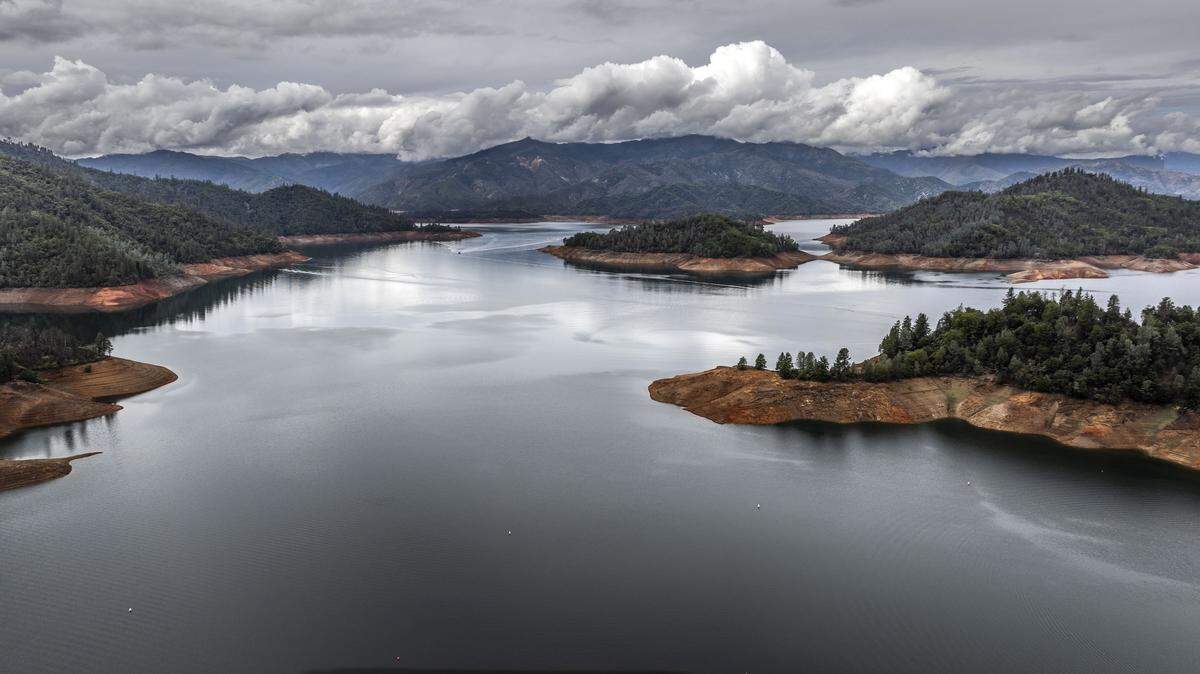
Dams like Shasta prevent salmon from climbing Sierra rivers thousands of feet to reach the colder water upstream to spawn. That cold water, critical to the species’ survival, is held behind the big dam. The more the Trump administration releases Shasta water, the less cold storage is left. Shasta is ground zero in the fight to save salmon that return from the Pacific in the winter because this is one of the last places in California where these salmon still exist.
“We have all our eggs in one basket below Shasta,” said Jeffres of UC Davis, one of the state’s leading salmon researchers.
The bureau’s decision in the spring of 2021 to release water from Shasta to Central Valley farmers proved fatal to salmon by summer, when they died and could not successfully reproduce in warm water below Shasta since the cold water was no longer behind the dam.
“We’re at the moment, right now, of the greatest risk for California salmon in human history,” said Barry Nelson, a longtime environmental activist. How the Trump administration is operating the California water system is “pushing the envelope. What’s not clear yet is whether that plan … will violate the law.”
Are Trump and Newsom on a collision course over water?
This system is supposed to comply with the federal Endangered Species Act and its complex regulatory system that guides reservoir operations and pumping limits in the Sacramento-San Joaquin Delta.
Changing these rules is akin to slowly turning an aircraft carrier, starting with an administrative call for “reconsultation” that triggers a rigorous new scientific review of impacted fish species and their status, a new “biological opinion” and new ways to operate the system.
It took nearly the full term of President Joe Biden for his administration to rewrite the operating rules crafted during Trump’s first term. Trump’s second administration has shown no tolerance for lengthy government processes. That’s what makes his unfolding California water strategy a public mystery.
The CVP and the companion state system on the Feather River, the State Water Project, are required together to release enough water to maintain flows through the Delta. These two projects have a decades-long tradition of cooperating with one another and complying with this shared obligation.
But what if one simply said no? What if the federal pumping facilities in the Delta started taking more for farmers than their share?
The cold water behind the Sierra dams is the lifeblood California salmon need to survive. We either reserve enough of this cold water behind the reservoirs for salmon to survive, or we don’t.
For Jeffress, who has dedicated his career to saving this species, “there is no other option.” But, in fact, there is.
If salmon happen to be a casualty here in California during Trump’s second term, it will not all be the president’s fault. There is another political party that occasionally talks about the environment and salmon, but isn’t delivering.