As California debates a billionaire tax, class lines begin to harden | Opinion
Mark these words: A new American class war is brewing.
A union representing health care workers has proposed California put a one-time income tax on the state’s billionaires to garner revenue for the state’s health care system, as federal funds are increasingly threatened by the Trump administration.
The Billionaire’s Tax is proposed by Service Employees International Union-United (SEIU) Healthcare Workers West, a union that has more than 120,000 members. SEIU wants to put an initiative on the 2026 state ballot to force the California’s richest residents — around 200 billionaires total — into paying a one-time tax of 5%, with five years to send the proceeds to Sacramento. Projections estimate the tax would raise around $100 billion for health care, education and food assistance.
The debate is now on the front lines of the growing class war between average Californians and the wealthiest 1%. It also puts Gov. Gavin Newsom in a tight spot between billionaires and the working class labor union that proposed the tax at a time when he will likely seek to tout the state’s robust economy as a selling point in his presumable, though unconfirmed, 2028 presidential campaign.
Yet for all of Newsom’s public back-patting and posturing to the contrary, the state currently has a projected budget deficit of around $18 billion. (You know what would help with that?)
“The new federal budget passed by Congress slashes $100 billion from California’s health care funding over the next five years, pushing our state towards a healthcare collapse,” states SEIU’s website. “We can’t let this happen.”
Bye bye billionaires?
The proposal is causing California billionaires to panic, and some are even making threats to leave the state and take their money with them.
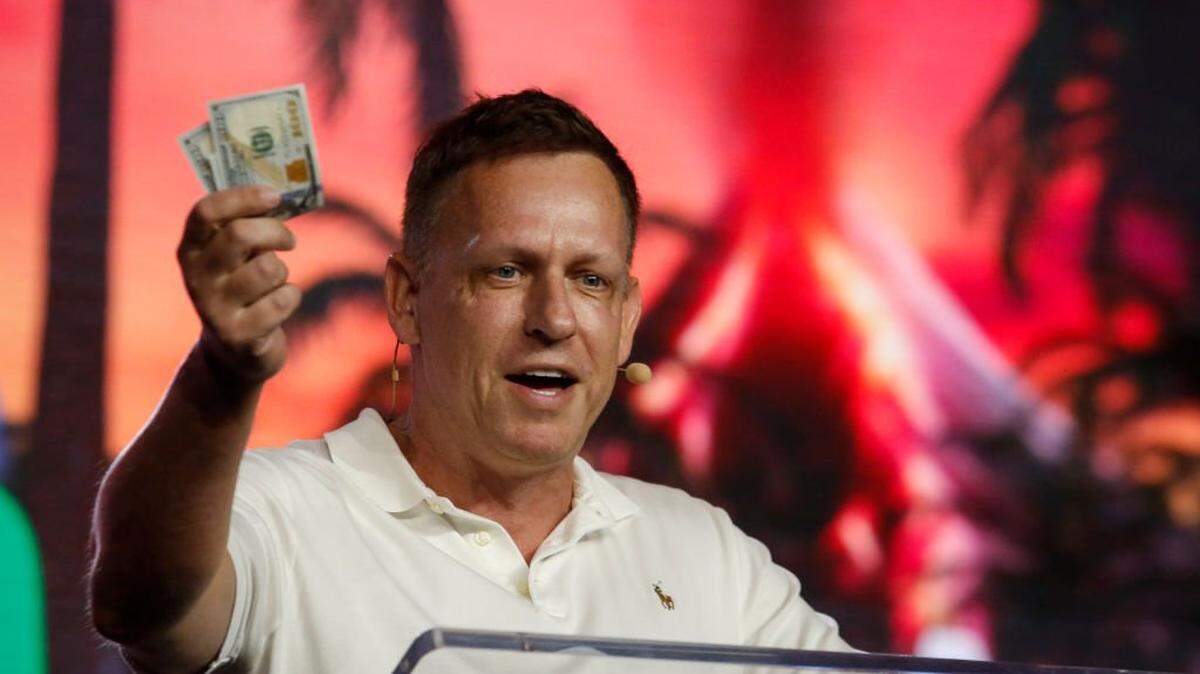
Peter Thiel, noted bestie of President Donald Trump and alleged government surveillance facilitator, has threatened to pack up his “software” company, Palantir, and leave the state in protest, while fellow billionaire and Google co-founder, Larry Page, has also reportedly threatened to leave. (Thiel’s personal wealth, by the way, is approximately $26 billion, while Page’s worth is around $257 billion, both according to Fortune Magazine, making Page the third-richest man in the world after a Google stock surge earlier this year.)
According to my back-of-the-napkin calculations, after the proposed tax, Thiel would still have around $26 billion and Page would still have about $244 billion. Not too shabby.
Newsom has historically and unsurprisingly been on the side of the billionaires in this matter. He once called the idea of taxing the wealthiest “shameful.” But Suzanne Jimenez, chief of staff for Service Employees International Union-United Healthcare Workers West, told the San Francisco Chronicle that the billionaires’ threats to leave the state were “familiar Chicken Little argument(s).”
To her point, those sky-falling fears haven’t borne out in other states that have pursued a wealth tax, such as Massachusetts. The state faced pushback two years ago when it introduced a “millionaires’ tax” with similar threats that it would deter the rich from settling in the state and drive out innovation. In fact, the Massachusetts Department of Revenue last month announced preliminary estimates that the state collected $5.7 billion in the last two years — far more than the $1.3 billion per year state officials had originally estimated.
So forgive me if I and (the SEIU’s) Jimenez find these wealthy men’s threats to leave be as empty as Chicken Little’s.
Million, billion, trillion — more than the difference of a letter
Why tax billionaires so specifically? Because there’s something excessive about wealth in the billions, and most Americans sense this.
The difference between a “b” and an “m” is slight, yet the difference between a millionaire and a billionaire is vast: A million seconds ago was approximately 12 days. A billion seconds ago was sometime back in 1994. Making $10,000 per hour, 40 hours per week for 10 years straight still would only amount to around $208 million. And yet, more than 40% of Americans say they believe they could be billionaires someday, according to a 2022 Harris Poll survey.
It’s hard for most of us little people to be on Thiel, Page and Newsom’s side of letting them keep their billions in hand when Californians are living on an average income of $93,000 per household, and 11% — or 4.3 million Californians — live in poverty.
According to data gathered by the Chronicle, the bulk of California’s billionaires live in or near Silicon Valley, with a handful living in or around Los Angeles. Sacramento’s sole resident billionaire is Michael Teel, former CEO of Raley’s Supermarkets, who is worth approximately $1.5 billion.
Rep. Ro Khanna, who represents the majority of California’s billionaires — as the state representative for the 17th congressional district that includes Cupertino, Fremont and parts of western San Jose — is unabashedly in favor of such a tax, though it has cost him some political support.
“Peter Thiel is leaving California if we pass a 1% tax on billionaires for 5 years to pay for health care for the working class facing steep Medicaid cuts,” Khanna wrote on social media site X, formerly Twitter. “I echo what FDR said with sarcasm of economic royalists when they threatened to leave, ‘I will miss them very much.’”
Khanna has also thrown his support behind Tom Steyer, the only billionaire in the 2026 California gubernatorial race, who has a net worth of nearly $2 billion. That’s at least in part though, it appears, because Steyer supports the billionaire tax. Make of that dichotomy whatever you will.
According to a recent Forbes poll, Americans are largely in favor of more regulations on billionaires: 71% of respondents said there should be a billionaires tax and 64% said they think the government should impose mandatory philanthropic involvement on people worth more than $1 billion. More than half of Americans, around 53%, believe billionaires threaten American democracy.
Who will win is still anyone’s guess, and there’s a long way to go before the proposal makes it on the ballot. Historically speaking, such massive wealth inequality has not saved the rich from the ire of the poor. But this is precisely the debate California Dems ought to be having: Whose side is the Democratic Party on? The people’s? Or the party’s wealthy benefactors’?
Well, we know what it looks like from the cheap seats, at least.