
In California governor’s race, money exposes bipartisan hypocrisy | Opinion
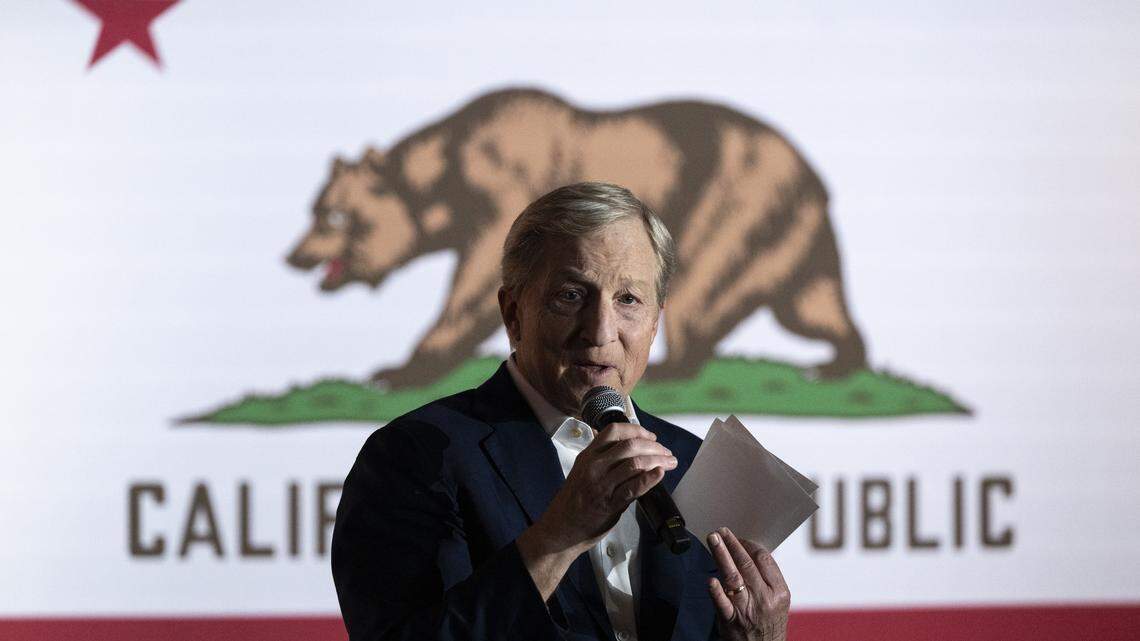
The race to succeed Gavin Newsom as governor of California has produced one of the most clarifying contrasts in recent American political history. On one side is Tom Steyer, a billionaire hedge fund manager who has spent $132 million of his own money on this race without a single ballot being cast. He’s on track to shatter California gubernatorial spending records
On the other is Xavier Becerra, a cabinet member for former President Joe Biden and a three-decade veteran of California public life who has raised just over $1 million total. Recent polls show the two men essentially tied for the Democratic lead.
That’s a spending ratio of 132 to 1 in a dead heat. These numbers alone should prompt serious questions about the state of American democratic culture and whether the values Democrats claim to hold are real or performative. A wide swath of the Democratic Party has built much of its political identity around opposition to the Citizens United v. Federal Election Commission decision by the U.S. Supreme Court, which held that corporations and other groups could spend unlimited amounts of money on elections.
With President Donald Trump in the White House, Democratic politicians and their donor base portrayed concentrated wealth in politics as an existential threat to self-governance. But California’s largest and most powerful labor unions have now endorsed Steyer. Our Revolution, the political arm of U.S. Sen. Bernie Sanders, has endorsed him too, despite having built its brand on the premise of billionaire money having no place determining the outcomes of American elections. The contradiction is not subtle. It is not deniable. It is simply being ignored. But before Democrats are too harshly judged, it is worth remembering that Republicans went through precisely the same reckoning a decade ago and resolved it in precisely the same way.
The evangelical voters who had made moral character a non-negotiable threshold for public office for 30 years set that aside for Trump without missing a beat. The fiscal conservatives who had marched under Tea Party banners against deficit spending embraced a candidate who had no intention of restraining it.
The party of free trade became the party of tariffs. The party of American global leadership became the party of retrenchment. In each case, the stated principle collapsed the moment it conflicted with tribal loyalty and the appeal of a candidate who promised to win. The psychology connecting Trump’s working-class base to Steyer’s progressive institutional base is identical. This is a deep social dysfunction clearly manifesting in both political parties,
The tribe decides first. The principles follow, or they don’t. This is not a partisan failure. It is a civic one. And it is worth being precise about what is actually collapsing.
The problem isn’t disagreement over policy or even values. It is that the stated values are revealed, under pressure, to be largely performative. They are the language of politics rather than its substance.
Citizens United is only a crisis when the other side benefits from it. Billionaires are a threat to democracy until one of them is your billionaire. Character counts until your candidate’s character is in question. Steyer is no more the villain of this story than Trump was of his.
Both men did what wealthy, ambitious people do when the rules of the game allow it. They played. The more searching indictment belongs to the institutions and voters who loudly insisted the rules mattered until the moment they were offered an advantage by breaking them. It is the hypocrisy of a self-serving system of political parties and interest groups that have created the unprecedented loss of confidence in politics, elections and government itself. Money in politics matters less than both its critics fear and its practitioners believe.
But the attempt to spend one’s way to power is not made less corrosive by its frequent failure. In fact, it actually reveals something disturbing about the interest groups that follow these wealthy candidates for no reason other than the promise of money: There are no underlying principles that guide these groups in the first place. What California’s primary is a stress test of whether the Democratic Party’s stated beliefs survive contact with competitive pressure. So far the evidence is not encouraging. The institutions that built their credibility on challenging concentrated wealth are now sheltering behind it. Encouraging it. Rationalizing it. The voters who demanded accountability from the other side are now explaining why their situation is different. It is not different. It is the same story, told by different people who are equally convinced of their own exception. A democracy depends not just on the right institutions but on a civic culture willing to hold those institutions to their stated principles even when it’s inconvenient. What the California governor’s race is quietly revealing is that this culture is weaker than either party’s rhetoric suggests. That is a problem that will outlast this primary, outlast this cycle, and outlast whoever is elected governor of California. The system, it turns out, is only rigged when you’re not the ones doing the rigging.
Mike Madrid is a political analyst and a special correspondent for McClatchy Media.