
Double-decker Amtrak trains in California and the West are going extinct. Here’s why
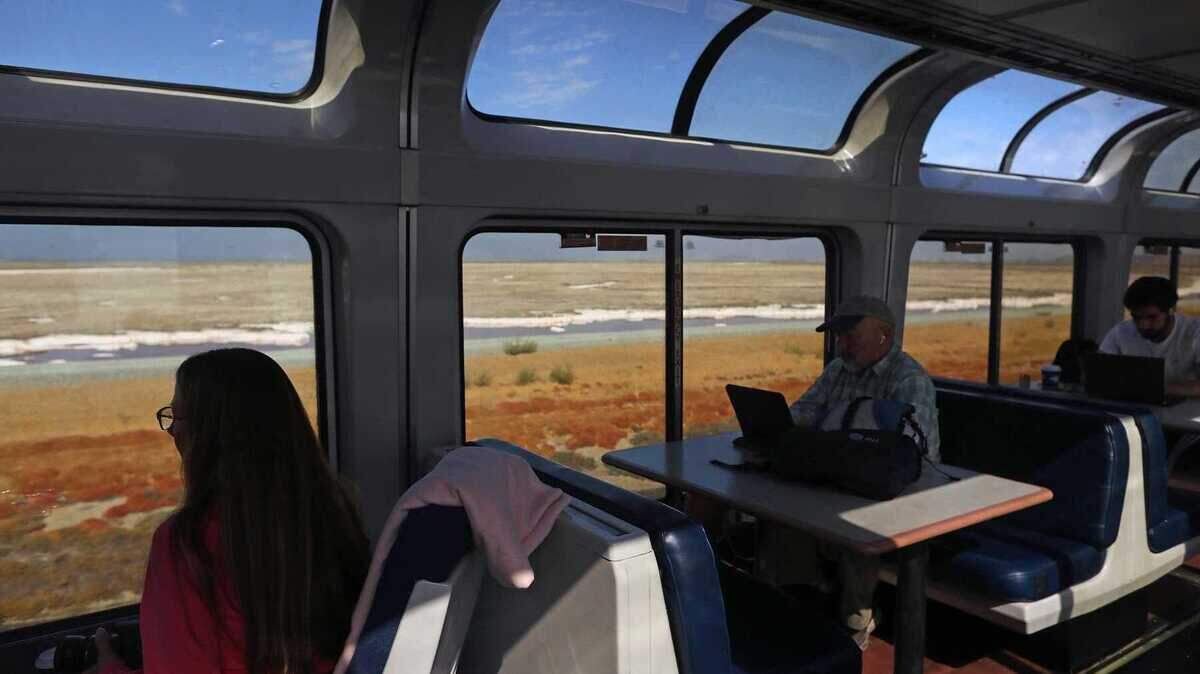
My first long-distance train ride started on a rainy summer night in Kansas City about 60 years ago. There, on its way to California from Chicago, a double-decker Santa Fe train arrived, now part of railroad lore.
To me, then a five-year-old, the San Francisco Chief looked like a rolling silver skyscraper, almost impossible to believe. From its majestic dome car the next afternoon, gazing at the vast Southwest for the first time, it was as if I could see forever.
I am hardly alone in my sense of awe aboard these tall trains. For the last 70 years, travel by long-distance trains throughout the West has featured these bilevel cars. They are physically impossible to operate on any line that reaches the shorter and older tunnels of the eastern seaboard. We have something special in the West, a true train rarity throughout the world.
Yet all too soon, the bilevel cars that lord over the landscape will be another memory of American railroading.
Amtrak has announced plans to phase out its bilevel cars, known as Superliners. Instead, Amtrak plans to operate the same single-level long-distance equipment everywhere it operates.
Why? Tall cars have been regulated out of existence, although that’s not the official version.
Amtrak struggled, and failed, to figure out how to get disabled passengers safely to the second floor in a new generation of bilevel equipment. So the ultimate solution was to get rid of the second floor altogether.
In the eye of the beholder, this is either a victory for equality or a defeat by a modern bureaucracy run by lawyers. To be fair, it may be a bit of both.
The San Francisco Chief got me addicted to train travel. When Santa Fe and most private railroad operators got out of the passenger business in 1970, as Congress created Amtrak, they turned over their equipment to the new operator. Soon, Amtrak began exploring how to build the next generation of cars.
The first public testing of the new bilevel Superliners was in the fall of 1979 between Chicago and Milwaukee. I was a college student living nearby and was among the first paying passengers. The ride aboard the new Superliner was eerily quiet. The flat Midwest, admired with a little elevation from the second floor, never looked better.
Like the Santa Fe equipment, the Superliners require passengers to climb a narrow and steep set of stairs to get to the second level. Anyone unable to do so missed out on the lounge and dining car, making for an inferior train experience.
Congress created the Americans with Disabilities Act in 1990, long after the invention of the Superliner. Ever since, this landmark law has achieved equal access to public spaces in a myriad of ways.
There is no doubt that Amtrak was well aware of the ADA in 2022 when it began to replace the Superliners. And Amtrak thought it had the physical solution — elevators throughout the train to make it accessible to everyone.
Yet even the mighty Superliner has its physical limits. The cars are some 10 feet wide and 16 feet tall. When Amtrak asked the potential manufacturers to incorporate passenger-operated elevators into the train designs, the firms threw up their hands.
“None reported having any experience producing elevators inside the trainset,” wrote Amtrak’s internal watchdog, its Inspector General, in 2023. Amtrak had also created a logistical monster for the manufacturers, desiring nine different car types.
Amtrak ignored the feedback. Instead, says the Inspector General, Amtrak “decided to push the limits of what car builders said was feasible.”
That backfired spectacularly. And as bureaucracies tend to do, Amtrak tried to put some lipstick on its self-created pig.
“Amtrak announces new and improved long-distance fleet replacement strategy,” the agency announced with a straight face this February. Gone were plans to replace the Superliners with new bilevel cars. Instead, Amtrak envisions a cookie-cutter fleet of single-level cars for long-distance service throughout the land.
With most of its fleet past a realistic life expectancy, Amtrak does not have the luxury of time. Even train enthusiasts are swallowing reality.
“We just can’t wait any longer to start designing and building new long-distance railcars in the U.S.,” said Jim Mathews, president of the Rail Passengers Association, in February.
For those wondering what Amtrak’s future fleet will look like, “there aren’t any car designs for them to like or dislike,” Mathews said.
Amtrak doesn’t tend to run on time. And even if it did, the new cars are still at least a half-decade away from beginning to replace the bilevel Superliners.
Am I sad about the demise of the tall trains throughout the West? Of course. But then again, my legs have never betrayed me. I have never endured the wildly inferior Amtrak steerage experience due to a physical limitation.
In the end, what’s most important is for Amtrak and long-distance train travel to remain a fixture in this nation.
There is no such thing as “flyover country,” an insulting, urbanite term, on Amtrak. There is just our one America, and its people and places that bind us together. What a joy it is to be along for the ride.